

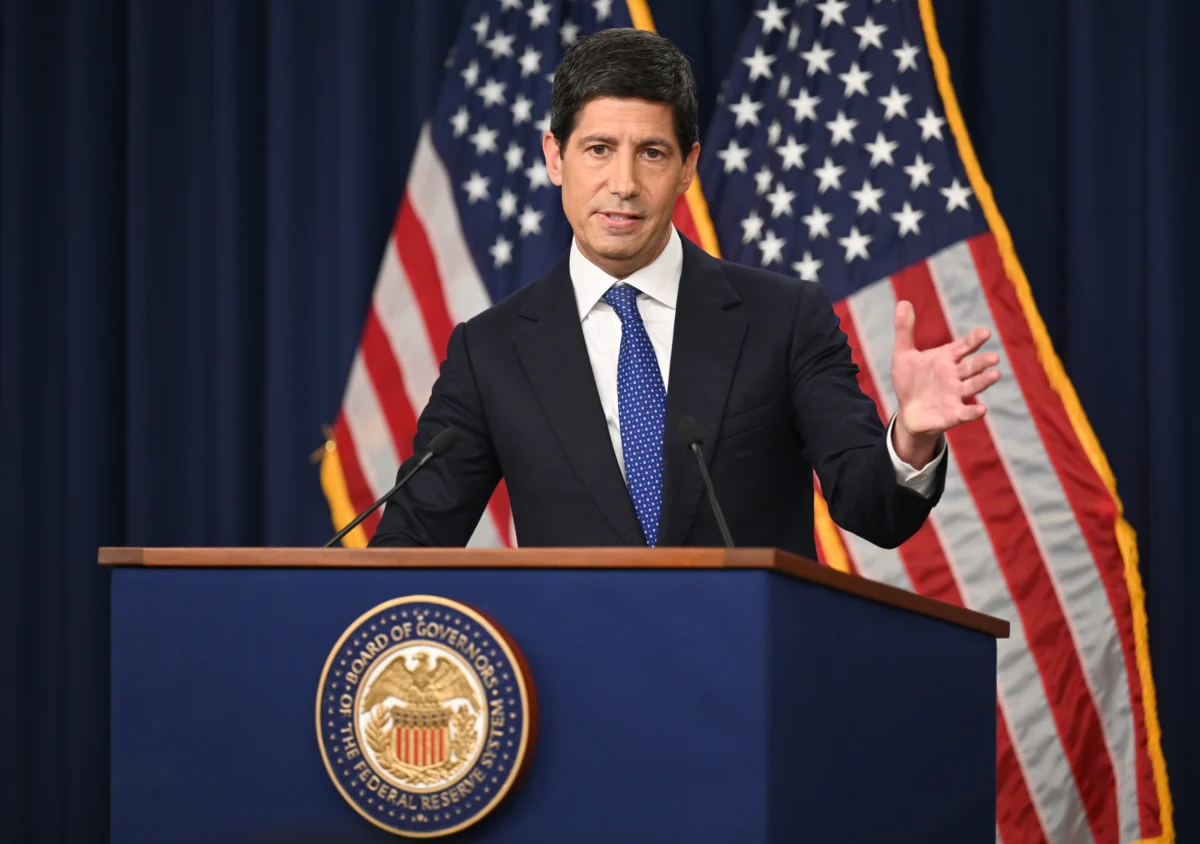
Washington, D.C. – In a pivotal moment for global financial markets, US Federal Reserve Chair Kevin Warsh announced on September 16, 2026, a decision to raise the benchmark interest rate by a quarter percentage point, marking the first such increase since 2023. Speaking at a news conference following the Federal Open Market Committee’s (FOMC) latest policy meeting at Federal Reserve Headquarters, Warsh’s carefully chosen words, particularly his characterization of the move as merely removing "a dose of accommodation" rather than a definitive tightening of policy, have ignited intense speculation and debate among economists and investors regarding the future trajectory of monetary policy.
The September 2026 Decision: A New Chapter in Monetary Policy
The Federal Reserve’s unanimous decision to lift the federal funds rate target to a new range of 3.75% to 4.00% signals a significant shift in the central bank’s approach to managing the U.S. economy. This move follows a period of substantial monetary support, initially implemented to cushion the economy through unprecedented global challenges and later sustained to foster a robust recovery. Warsh attributed the feasibility of this hike to a U.S. economy that has demonstrably "strengthened" and financial conditions that have become "less restrictive," suggesting that the underlying economic fundamentals are now sufficiently robust to withstand a reduction in monetary stimulus.
The backdrop to this decision includes persistent inflationary pressures that, despite previous efforts, continue to hover above the Fed’s long-term 2% target, alongside a remarkably resilient labor market characterized by low unemployment and steady wage growth. While the Fed’s dual mandate traditionally balances maximum employment and stable prices, the recent focus has increasingly leaned towards reining in inflation without derailing economic expansion. The hike serves as a pre-emptive measure to prevent the economy from overheating, which could entrench inflationary expectations and lead to more aggressive policy interventions down the line.
Unpacking Warsh’s Language: "A Dose of Accommodation"
The phrase "a dose of accommodation," repeated multiple times by Warsh during his post-meeting commentary, has become the focal point of market analysis. Unlike previous Fed chairs who might have framed such a move as "tightening" or "normalizing" policy, Warsh’s linguistic choice suggests a nuanced and potentially open-ended strategy. Krishna Guha, head of economics and central bank strategy at Evercore ISI, noted in a client communication that this specific framing was "the one stand-out hawkish element" of Warsh’s remarks. Guha emphasized that this was not an accidental utterance but a "deliberate choice to frame policy in this way," distinguishing it from the Fed’s communication strategies of recent years.
This distinction is crucial. If the central bank has only removed "a dose" of help, it implies that the current monetary policy stance remains, to some extent, accommodative or stimulative. This perspective opens the door to the possibility that several more "doses" may need to be withdrawn before the policy is deemed neutral or even restrictive. Such an interpretation suggests a more flexible and less predetermined path for future rate adjustments, potentially signaling a prolonged period of incremental hikes rather than a one-off adjustment.

A Shift from Traditional Frameworks: The Neutral Rate Debate
Further adding to the mystery surrounding the Warsh Fed’s operational framework was the Chair’s apparent dismissal of the "neutral rate" concept as a practical guide for current policy decisions. The neutral rate, often referred to as R-star, is a theoretical interest rate that neither stimulates nor constrains economic growth. For over a decade, central bankers and market participants have used this concept as a crucial benchmark to gauge whether monetary policy is accommodative, neutral, or restrictive. Policy rates significantly above the neutral rate are considered restrictive, while those closer to or below it are seen as accommodative.
When pressed by CNBC’s Steve Liesman to clarify where the current target rate of 3.75%-4.00% sits relative to the neutral rate, Warsh’s response was strikingly dismissive. He stated that while the concept is "useful academically" and aids in "thinking about policy," he does not believe "it has any operational effect of decisions that we make today." This statement runs counter to established central bank communication and analysis, leaving markets without a traditional anchor to predict the ultimate destination of the current tightening cycle.
Guha highlights the implications of Warsh’s stance: "Warsh’s framing, if taken literally, raises the possibility that rates might have to keep going up until financial conditions facing the private sector are no longer ‘accommodative’ — however that is defined. This is a relatively open-ended prospect." The absence of a clear benchmark like the neutral rate implies that the Fed under Warsh might be adopting a more empirical, data-dependent approach, reacting to evolving economic conditions rather than adhering to a predefined theoretical target. This could lead to greater volatility in market expectations as investors attempt to decipher the Fed’s evolving criteria for policy formulation.
Economic Backdrop: Fueling the Fed’s Move
The decision to raise rates did not occur in a vacuum. The U.S. economy in late 2026 presented a compelling case for a more restrictive monetary stance. Following the robust recovery from the pandemic-induced downturn, economic activity has sustained momentum. Key indicators point to a dynamic landscape:
- Inflationary Pressures: While headline inflation may have moderated from its peaks in 2021-2022, core inflation, which excludes volatile food and energy prices, has proven stubbornly persistent. Supply chain normalization has helped ease some price pressures, but strong consumer demand, coupled with tight labor markets, continues to fuel price increases across various sectors. The Fed’s commitment to its 2% inflation target remains paramount, and the recent hike underscores its resolve to achieve this objective.
- Robust Labor Market: The unemployment rate has remained near historic lows, and job creation continues at a healthy pace. Wage growth, while beneficial for workers, also contributes to inflationary pressures as businesses pass on higher labor costs to consumers. A tight labor market, where demand for workers outstrips supply, often signals an economy operating at or beyond its full employment capacity, necessitating a withdrawal of monetary stimulus.
- Financial Conditions: Warsh explicitly mentioned that financial conditions have become "less restrictive." This implies that credit remains readily available, borrowing costs, despite previous hikes, have not significantly dampened economic activity, and asset valuations are robust. This favorable environment provides the Fed with the necessary headroom to raise rates without immediately risking a sharp economic slowdown.
Market Reactions and Forward Guidance
Warsh’s cryptic commentary immediately triggered a flurry of activity and revised forecasts across Wall Street. The ambiguity surrounding the phrase "a dose of accommodation" and the rejection of the neutral rate concept led analysts to price in a higher probability of further rate hikes in the near future.

- Revised Forecasts: Goldman Sachs and Bank of America promptly updated their projections, now forecasting an additional rate increase in October 2026, with Bank of America also anticipating another move in December. This reflects a consensus among major financial institutions that the September hike is likely just the beginning of a new tightening phase.
- CME FedWatch Tool: The market-implied odds for an October increase, as tracked by the CME Group’s FedWatch tool, surged to nearly 58% on Friday morning following Warsh’s remarks, up significantly from 42% just a week prior. This tool, which derives probabilities from federal funds futures prices, provides a real-time gauge of market sentiment regarding future Fed actions.
- Longer-Term Expectations: Futures markets are now implying a fed funds rate of approximately 4.635% by the end of 2027. This projection suggests that investors anticipate three to four more quarter-percentage-point hikes beyond the September decision, indicating a sustained tightening cycle extending well into the following year.
Economists offered immediate interpretations. James Egelhof, chief U.S. economist at BNP Paribas Securities, highlighted that the Fed’s use of "accommodation" is synonymous with "stimulus." He concluded that Warsh’s comment "implies that the current monetary policy stance is meaningfully stimulative." Egelhof warned, "With policy starting at a stimulative stance, a strong cyclical impulse, and persistent inflation, we think significant rate increases, perhaps more than the three we expect, may be necessary to stabilize the unemployment rate from below and prevent overheating next year." He, too, agreed that the "dose of accommodation" remark was "the most striking feature" of Warsh’s abbreviated news conference.
Historical Context and the Legacy of Powell
The current trajectory under Kevin Warsh also casts a light on the legacy of his predecessor, Jerome Powell, who now serves as a governor on the FOMC. Many analysts view Warsh’s current actions as a deliberate unwinding of the "insurance cuts" implemented by the Powell Fed, particularly those delivered in the fall of 2025. These cuts were likely a response to perceived economic vulnerabilities or global headwinds at the time, designed to provide additional stimulus or cushion against potential downturns.
Jack Janasiewicz, portfolio manager and lead portfolio strategist at Natixis Investment Managers Solutions, articulated this perspective: "The ‘dose of accommodation’ remarks ‘seemingly helped to underscore this hawkish tone, implying that [the] committee no longer views policy as modestly restrictive.’" However, Janasiewicz cautioned against overinterpreting the long-term implications, adding, "We remain unconvinced that this is the start of an aggressive new tightening cycle. Rather, we see this as a removal of the insurance cuts the Fed delivered in the fall of 2025." This suggests a debate within the market regarding whether Warsh is merely correcting previous policy or embarking on a fundamentally new, more hawkish era.
The Path Ahead: Implications for Policy and Economy
The implications of Warsh’s September 2026 rate hike and his unconventional communication style are far-reaching.
- Borrowing Costs: Higher benchmark rates will inevitably translate into increased borrowing costs for consumers and businesses. Mortgage rates, auto loans, credit card interest rates, and corporate borrowing costs will all likely trend upwards, potentially dampening demand for large purchases and investment.
- Economic Growth: While designed to curb inflation, sustained rate hikes carry the risk of slowing economic growth. The Fed aims for a "soft landing," bringing inflation down without triggering a recession, but this path is notoriously difficult to navigate.
- Currency Strength: A hawkish Fed and rising interest rates typically strengthen the U.S. dollar, making American exports more expensive and imports cheaper. This could further impact the U.S. trade balance and have global ripple effects.
- Global Ramifications: As the world’s largest economy, U.S. monetary policy has significant global implications. A stronger dollar and higher U.S. interest rates can put pressure on emerging market economies with dollar-denominated debt, potentially leading to capital outflows and financial instability.
- Market Volatility: The ambiguity surrounding Warsh’s communication, particularly his rejection of traditional frameworks like the neutral rate, could introduce greater uncertainty and volatility into financial markets. Investors will be keenly watching for further clues and data points to discern the Fed’s ultimate policy destination.
The September 16, 2026, rate hike by the Federal Reserve, led by Chair Kevin Warsh, represents more than just a quarter-point increase. It marks a potential paradigm shift in how the central bank communicates its intentions and frames its policy actions. By describing the move as merely removing "a dose of accommodation" and downplaying the operational relevance of the neutral rate, Warsh has initiated a new era of monetary policy, one characterized by a seemingly open-ended approach and a departure from previously established communication norms. As markets grapple with deciphering the Warsh Fed’s evolving playbook, the coming months promise to be a critical period for understanding the future of interest rates and the broader economic landscape.
