

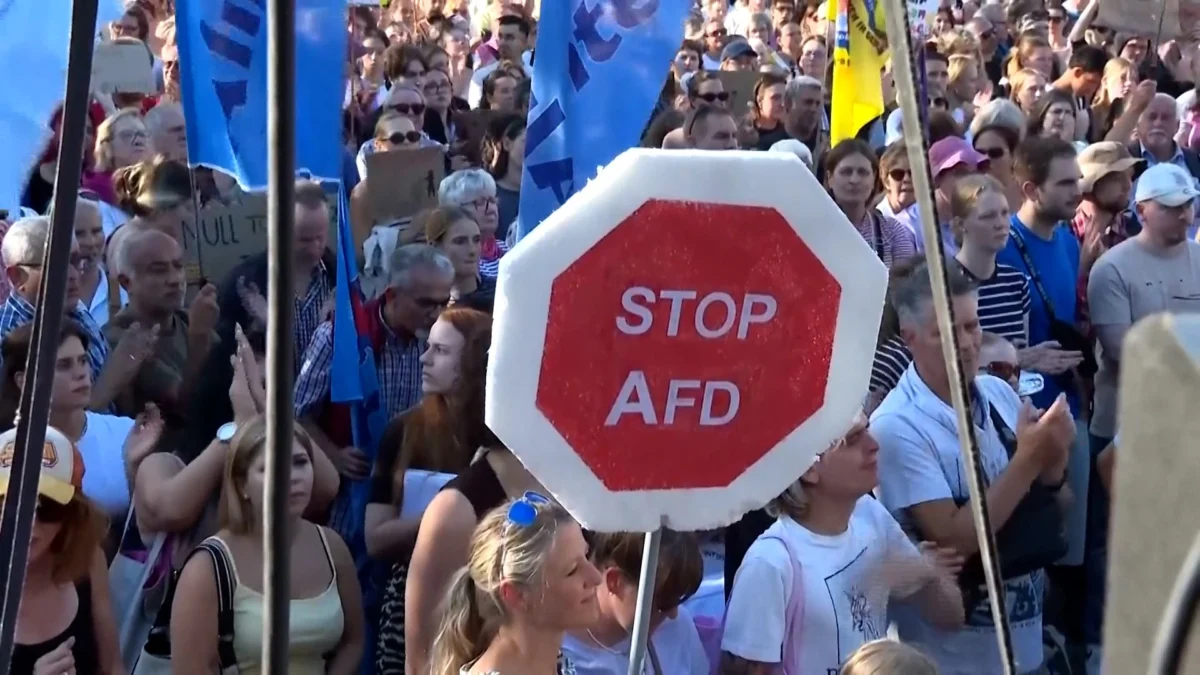
COLOGNE, Germany – Thousands of protesters converged on the streets of Cologne on September 9, 2026, to demonstrate against the far-right Alternative for Germany (AfD) party, just days after the party secured an unprecedented nearly 44% of the vote in Saxony-Anhalt’s state election. The demonstration, which drew participants from across various civil society groups and political spectrums, underscored widespread apprehension over the AfD’s surging influence and its implications for German democracy and social cohesion.
The protest in Cologne, a city historically known for its progressive values and multiculturalism, served as a powerful counter-narrative to the electoral success of the AfD in the eastern state. Organized by a coalition of anti-racism and pro-democracy groups, the rally saw attendees carrying banners emblazoned with slogans such as "Stop the AfD," "Defend Democracy," and "Diversity, Not Division." Speakers at the event emphasized the importance of civic engagement and collective action in safeguarding democratic principles against what they described as the party’s divisive and often extremist rhetoric. The significant turnout in a major western German city highlighted a deep ideological chasm within the nation, contrasting sharply with the electoral landscape in Saxony-Anhalt.
The Saxony-Anhalt Election: A Political Earthquake
The state election in Saxony-Anhalt, held on September 7, 2026, sent shockwaves through Germany’s political establishment. The AfD emerged as the dominant political force, capturing 43.8% of the vote according to final counts, a substantial increase from its previous performance in the state. This result positioned the AfD as the largest single party in the state parliament (Landtag) in Magdeburg, profoundly complicating the formation of a stable government and posing an existential challenge to the traditional political parties.
For decades, Saxony-Anhalt, like many other states in eastern Germany, has grappled with unique socio-economic challenges stemming from the post-reunification period, including deindustrialization, outward migration of younger populations, and a sense of being left behind by federal policies. These factors have created fertile ground for populist movements. While the AfD has steadily gained traction in the region, its nearly 44% showing marked a critical escalation, transforming it from a strong opposition force into a potential kingmaker, if not a direct participant, in government formation discussions.
The Christian Democratic Union (CDU), traditionally the strongest party in Saxony-Anhalt, saw its support base significantly eroded, securing an estimated 25% of the vote. The Left Party (Die Linke) garnered around 10%, while the Social Democratic Party (SPD) struggled with approximately 8%. The Greens managed to cross the 5% threshold with about 5.5%, and the Free Democratic Party (FDP) achieved roughly 6%. These results painted a grim picture for the established parties, forcing them to confront the reality of a political landscape fundamentally reshaped by the AfD’s appeal. The mathematical implications were stark: forming a stable coalition government without the AfD would require an unprecedented alliance of at least three, if not four, other parties, a scenario fraught with ideological and practical difficulties.
Chronology of Events
The rapid sequence of events from the election to the protest underscored the immediate and strong reactions across Germany:
- September 7, 2026: Voters in Saxony-Anhalt head to the polls for the state election. Early exit polls and projections quickly indicate a significant surge for the AfD, far exceeding expectations even for a party that had consistently polled strongly in the region.
- September 8, 2026: Official results are announced, confirming the AfD’s near-plurality with 43.8% of the vote. Political analysts and commentators across Germany react with alarm, initiating widespread discussions on the implications for state and federal politics. Mainstream parties begin internal deliberations on how to respond to the unprecedented electoral outcome. Calls for anti-AfD demonstrations begin to circulate rapidly on social media and through civil society networks.
- September 9, 2026: Thousands gather in Cologne for the planned anti-AfD protest. The demonstration serves as a visible expression of concern and opposition from a significant segment of the German population, particularly in the western parts of the country. Simultaneously, initial discussions regarding potential coalition formations commence in Magdeburg, with all established parties reiterating their firm stance against cooperating with the AfD.
This timeline illustrates the swift public and political response to what many perceive as a critical juncture in German democracy.
Supporting Data and Broader Context
The AfD’s success in Saxony-Anhalt is not an isolated incident but rather a symptom of deeper political and societal currents. Nationally, the party has seen its support fluctuate, but it has maintained a consistent presence in all 16 state parliaments since 2017 and in the Bundestag since 2017. Its platform, which often combines anti-immigration stances, Euroscepticism, and criticism of mainstream media and established political parties, resonates with a segment of the electorate feeling unheard and disenfranchised.
AfD’s National Trajectory:
Founded in 2013 primarily as an anti-euro party, the AfD quickly pivoted its focus to immigration during the 2015 refugee crisis. This shift, coupled with growing disillusionment with traditional parties, propelled it into the Bundestag in 2017 as the largest opposition party. While its national polling hovers between 15-20%, its regional strength, particularly in the former East German states, is often significantly higher. States like Thuringia, Brandenburg, and Saxony have consistently shown strong support for the AfD, often placing it as the second-largest or even the largest party in local and state elections. Saxony-Anhalt’s result, however, represents a new peak in this regional dominance, nearing an absolute majority.
Demographic and Socio-economic Factors in Eastern Germany:
The high support for the AfD in Saxony-Anhalt can be attributed to several intertwined factors:
- Economic Disparities: Despite significant investment since reunification, many regions in eastern Germany still lag behind their western counterparts in terms of economic development, job opportunities, and infrastructure. This can foster a sense of grievance and a belief that traditional parties have failed them.
- Demographic Change: Outmigration of younger, skilled workers has led to an aging population and a decline in overall population in many rural areas, creating a sense of decline and cultural anxiety.
- Historical Context: The legacy of the German Democratic Republic (GDR) and the subsequent rapid societal transformation has left some eastern Germans feeling culturally distinct and less trusting of established institutions and media, making them more receptive to anti-establishment narratives.
- Immigration Concerns: While eastern Germany has historically had lower immigrant populations, the AfD’s anti-immigrant rhetoric still resonates strongly, often tapping into broader cultural anxieties and fears of perceived societal changes.
The Cologne protest, by contrast, reflected the concerns of a largely urban, diverse, and often younger demographic who view the AfD’s rise as a threat to fundamental democratic values, human rights, and Germany’s international standing. The sheer scale of the protest, estimated by local police at over 15,000 participants, underscored the depth of this opposition.
Statements and Reactions from Related Parties
The Saxony-Anhalt election results and the subsequent Cologne protest triggered a wave of reactions from across the German political spectrum and civil society.
Protest Organizers and Civil Society:
"Today, Cologne sends a clear message: Germany will not stand idly by as the far-right attempts to dismantle our democratic institutions," declared Anna Schmidt, spokesperson for "United for Democracy," one of the key organizing groups of the Cologne rally. "The AfD’s success in Saxony-Anhalt is a wake-up call, but it also demonstrates the urgent need for all democratic forces to unite and actively defend our open society, our values of tolerance, and our commitment to human dignity." Other groups, including trade unions, religious organizations, and student associations, echoed these sentiments, emphasizing the importance of inclusive policies and robust civic education to counter extremist ideologies.
Mainstream Political Parties:
The established parties in Germany faced an immediate crisis of strategy and credibility following the Saxony-Anhalt outcome.
- CDU (Christian Democratic Union): Party leader and incumbent Minister-President of Saxony-Anhalt, Reiner Haseloff, expressed deep concern over the results. "This election result is a bitter pill for the CDU and a serious challenge for our democracy," Haseloff stated in a press conference in Magdeburg. "We must analyze profoundly why such a large number of voters turned to the AfD. Our clear stance remains: there will be no cooperation with the AfD. We are committed to forming a stable government based on democratic values, but this will be exceptionally difficult."
- SPD (Social Democratic Party): Federal SPD co-leader, Lars Klingbeil, reiterated the party’s ‘firewall’ against the AfD. "The rise of the AfD, particularly in eastern Germany, demands a robust response from all democratic parties," Klingbeil remarked. "We need to understand the concerns of the voters, but we must never compromise on our fundamental values or legitimize a party that seeks to divide our society."
- Alliance 90/The Greens: Annalena Baerbock, a prominent Green party figure, expressed alarm. "The results from Saxony-Anhalt are a stark reminder of the fragility of democracy when economic anxieties and cultural grievances are exploited by extremist forces," she said. "We must redouble our efforts to build an inclusive society and address the root causes of discontent, while firmly rejecting the AfD’s divisive agenda."
- FDP (Free Democratic Party): FDP leader Christian Lindner called for a renewed focus on economic prosperity and individual liberty to counter populist narratives. "We must offer compelling solutions to the challenges faced by citizens, rather than allowing them to seek refuge in extremist parties," Lindner commented.
- Die Linke (The Left Party): Co-leader Janine Wissler emphasized the need for stronger social policies to address the concerns of working-class voters. "The AfD thrives on social despair," Wissler argued. "Only by truly addressing poverty, precarious work, and a lack of public services can we effectively counter the siren call of the far-right."
Alternative for Germany (AfD):
The AfD, for its part, interpreted the election result as a resounding mandate from the people. Björn Höcke, a leading figure within the AfD’s hardline faction, declared the result a "historic victory for freedom and common sense." A local AfD spokesperson in Saxony-Anhalt stated, "The voters have clearly rejected the failed policies of the established parties. We are now the voice of Saxony-Anhalt, and it is time for the other parties to respect the democratic will of the people and engage with us." The party signaled its intention to play a central role in the state’s political future, either through direct participation in government or as a powerful opposition force.
Broader Impact and Implications
The Saxony-Anhalt election and the subsequent protests carry significant implications for Germany’s political landscape, both at the state and federal levels, and for the broader European context.
Challenges for Government Formation:
In Saxony-Anhalt, the immediate challenge is to form a stable government. Given the unwavering refusal of all other major parties to cooperate with the AfD, the arithmetic for a ruling coalition is incredibly complex. A "Germany coalition" (CDU, SPD, FDP) or a "Kenya coalition" (CDU, SPD, Greens) or even a "traffic light coalition" (SPD, FDP, Greens) would all struggle to achieve a majority, if not be outright impossible. This situation could lead to protracted negotiations, a minority government, or even a snap election, further exacerbating political instability. The precedent of a major state being unable to form a traditional government due to the strength of an ostracized party would be a significant blow to Germany’s political culture of consensus.
Impact on Federal Politics:
While Saxony-Anhalt is a single state, its electoral outcome sends a powerful signal to federal politics. The federal elections are due in 2029, and the AfD’s continued surge, particularly in the East, will put immense pressure on Chancellor Olaf Scholz’s coalition government and the mainstream opposition to refine their strategies. It forces a critical re-evaluation of how to address the underlying grievances that fuel AfD support without legitimizing the party itself. This includes questions of economic development in eastern Germany, immigration policy, and effective communication strategies to counter disinformation.
Societal Divisions and Democratic Resilience:
The stark contrast between the election results in Saxony-Anhalt and the widespread protests in Cologne highlights a deepening societal divide within Germany. This cleavage is not merely East-West but also urban-rural, and often ideological, pitting those who prioritize liberal democratic values and multiculturalism against those who feel marginalized and seek more nationalistic or conservative solutions. The ability of German society and its institutions to navigate these divisions, uphold democratic norms, and prevent further polarization will be a crucial test of its resilience. The protests demonstrate a vibrant civil society actively engaged in democratic discourse, serving as a vital counterweight to the rise of extremist ideologies.
European Context:
Germany’s political stability and its ability to manage the rise of the far-right have significant implications for the European Union. As a cornerstone of the EU, Germany’s internal political struggles resonate across the continent, where many other nations are also grappling with the rise of populist and far-right movements. The AfD’s success could embolden similar parties in other EU member states, potentially shifting the political balance within the European Parliament and influencing future EU policy directions, particularly on issues like migration and sovereignty.
In conclusion, the events of early September 2026, from the unprecedented AfD electoral success in Saxony-Anhalt to the robust civil society response in Cologne, mark a pivotal moment in contemporary German politics. They underscore the profound challenges facing democratic institutions in an era of growing populism, while also highlighting the enduring commitment of many Germans to the principles of an open, inclusive, and democratic society. The path forward for Saxony-Anhalt, and indeed for Germany, remains uncertain, but the urgency of addressing these deep-seated political and societal issues has never been clearer.
