

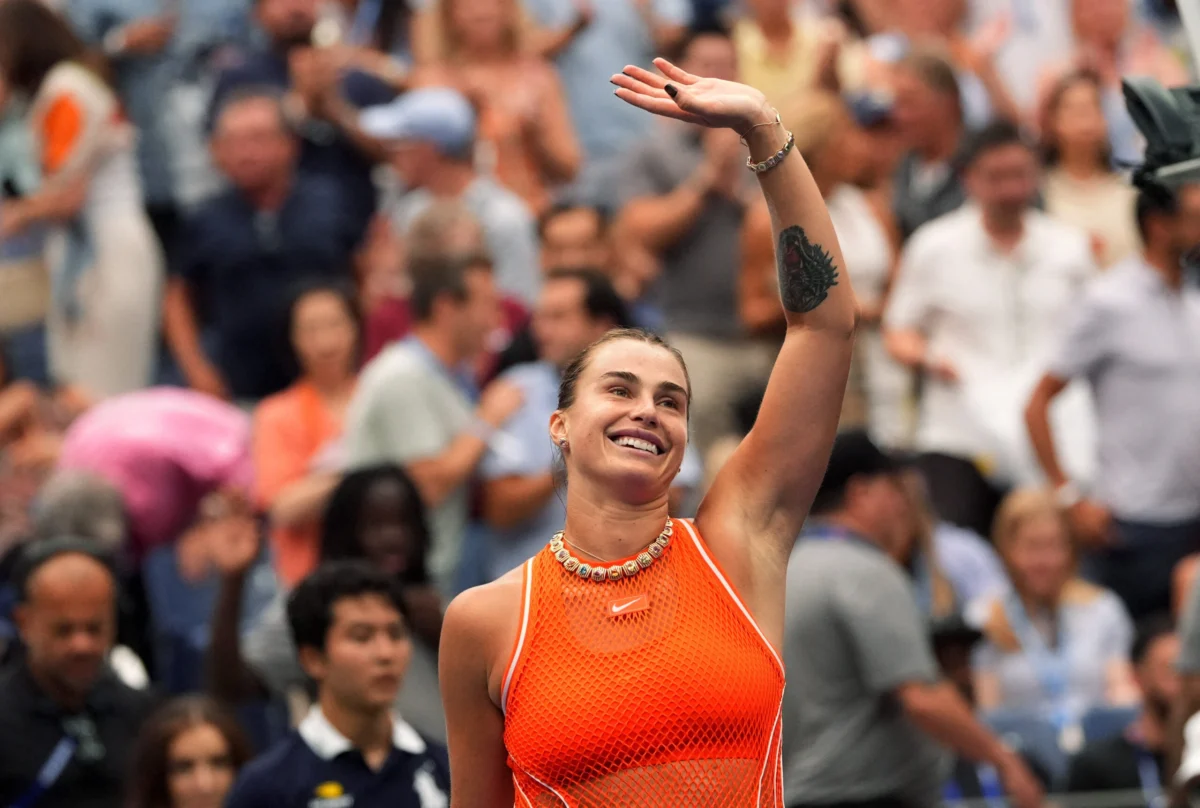
Aryna Sabalenka, one of the most formidable forces in women’s tennis, successfully navigated a challenging fourth-round encounter against the tenacious American Taylor Townsend on Sunday, securing her spot in the quarterfinals of the US Open. The world number two, known for her aggressive baseline game and powerful serve, overcame an initial struggle to ultimately defeat Townsend with a score of 6-4, 6-3 in a match that showcased both her resilience and championship pedigree at the USTA Billie Jean King National Tennis Center in New York City.
The contest, played under the watchful eyes of a packed crowd, was far from a straightforward affair for Sabalenka. Townsend, a left-handed player known for her all-court game and willingness to approach the net, demonstrated her intent to disrupt Sabalenka’s rhythm from the outset. The opening set saw a surprising turn of events as Townsend, with her unconventional tactics and strategic net play, managed to break Sabalenka’s powerful serve a remarkable three times in the Belarusian’s first four service games. This early dominance from Townsend suggested a potential upset, as Sabalenka, usually rock-solid on her serve, appeared momentarily unsettled.
The Match Unfolds: A Battle of Wills
The initial phase of the first set was characterized by a high-octane exchange of powerful groundstrokes from Sabalenka met with clever variations and daring net approaches from Townsend. Townsend’s ability to consistently find angles and rush the net put immense pressure on Sabalenka, who found herself trailing early. The crowd was treated to a captivating display of contrasting styles, with Sabalenka’s raw power facing off against Townsend’s tactical finesse.
However, Sabalenka, a Grand Slam champion and a player with deep reserves of mental fortitude, began to find her footing. After the initial service struggles, she methodically started to adjust her game, focusing on greater consistency and depth on her returns to neutralize Townsend’s net-rushing tactics. The turning point in the first set came as Sabalenka, having absorbed the early blows, regained her confidence and started to dictate points more effectively. She managed to break Townsend back and, critically, held her nerve to close out the first set 6-4, demonstrating her ability to adapt under pressure. This recovery was a testament to her growing maturity and strategic understanding on court.
The momentum, once firmly with Townsend, decisively shifted in Sabalenka’s favor by the second set. Having solved the puzzles posed by Townsend’s serve and volley game, Sabalenka began to assert her dominance with greater consistency. Her serves, which had been vulnerable early on, found their rhythm, delivering aces and unreturnable serves that kept Townsend on the defensive. Her groundstrokes, particularly her forehand, became increasingly potent, pushing Townsend deep behind the baseline and limiting her opportunities to approach the net. The second set saw Sabalenka break Townsend early and maintain a comfortable lead, ultimately closing out the match 6-3, denying Townsend any further opportunities for a comeback.
While specific match statistics were not immediately available, the flow of the match suggested Sabalenka significantly improved her first-serve percentage and win rate on both first and second serves after the initial struggles. Her winner count likely increased as she found her range, while her unforced error count, particularly on her serve, decreased. Townsend, despite her valiant effort, likely saw her break point conversion rate drop in the second set as Sabalenka tightened her game.
Player Perspectives: Voices from the Court
Following her hard-fought victory, Sabalenka reflected on the challenges posed by her opponent and her own mental adjustments during the match. "Basically, I was just trying to stay focused on myself and play not only point by point but ball by ball," Sabalenka stated in her post-match interview. This emphasis on granular focus highlights the mental discipline required to overcome an opponent who actively seeks to disrupt rhythm. "I’m happy that I was able to turn it around in that second set."
Sabalenka also expressed her respect for Townsend’s unique playing style and aggressive approach. "I’m happy to be through this really tough opponent," she acknowledged. "What an incredible player she is, approaching the net. What a great returner: moving well, very brave. You could see how focused she was. It was really challenging playing her." These comments underscore the difficulty Sabalenka faced in neutralizing Townsend’s serve-and-volley game, a rarity in modern women’s tennis, and her appreciation for Townsend’s competitive spirit. The ability of a top-ranked player to openly acknowledge the specific strengths of an opponent, particularly one who pushed her to her limits, speaks volumes about Sabalenka’s evolving perspective and professionalism.
Taylor Townsend’s Tournament Journey: A Formidable Challenge
Taylor Townsend’s run to the Round of 16 at the US Open marked a significant achievement in her career. Ranked outside the top 100 for much of the season, Townsend, a 27-year-old American, has been a familiar face on the WTA tour, known for her powerful lefty serve and aggressive all-court game, often featuring serve-and-volley tactics rarely seen in the women’s game today. Her progression to the fourth round included impressive victories over higher-ranked opponents, showcasing her improved fitness and tactical maturity. Her ability to disrupt the rhythm of powerful baseliners makes her a dangerous opponent, as evidenced by her early performance against Sabalenka.
Townsend’s career has been a testament to perseverance, having faced injuries and personal challenges, including a hiatus for maternity leave. Her return to the tour has been marked by a renewed focus and a determination to compete at the highest level. Her performance against Sabalenka, despite the loss, will undoubtedly boost her confidence and provide valuable experience against one of the world’s elite players. Her aggressive net play, which saw her win a high percentage of points at the net, highlighted her unique skill set and provided a refreshing change of pace for the Flushing Meadows crowd.
Aryna Sabalenka’s Dominant Season: Context of a World No. 1 Contender
Aryna Sabalenka’s 2023 season has been nothing short of phenomenal, solidifying her position as a dominant force in women’s tennis. The Belarusian began the year by capturing her maiden Grand Slam title at the Australian Open, defeating Elena Rybakina in a thrilling final. This breakthrough victory was a culmination of years of hard work and a significant improvement in her mental game, which had previously been considered a vulnerability.
Following her triumph in Melbourne, Sabalenka maintained a remarkably consistent level of performance throughout the season. She reached the final of the Madrid Open, the semifinals of the French Open, and the semifinals of Wimbledon, making her one of only a few players to reach at least the semifinals of all four Grand Slams in a single year. This consistency across different surfaces underscores her versatility and elite status. Her powerful serve, ferocious groundstrokes, and improved movement have made her a formidable opponent on any given day.
Coming into the US Open, Sabalenka was ranked world number two, hot on the heels of Iga Swiatek for the coveted world number one spot. Her performance at Flushing Meadows is crucial not only for her quest for a second Grand Slam title but also for her bid to ascend to the top of the WTA rankings. Her deep runs in major tournaments throughout the year have positioned her as a strong contender for the year-end number one ranking, a testament to her sustained excellence. Her composure under pressure, particularly evident in her comeback against Townsend, is a hallmark of a player truly ready to dominate the sport.
The Road Ahead: Quarterfinal Showdown
With her victory over Townsend, Aryna Sabalenka now advances to the quarterfinals, where she awaits the winner of the highly anticipated match between the young Czech sensation Linda Noskova and the Ukrainian talent Marta Kostyuk. Both Noskova and Kostyuk represent the next generation of women’s tennis, possessing aggressive game styles and a fearless approach to competition.
Linda Noskova, an 18-year-old Czech player, has quickly risen through the ranks, known for her powerful serve and forehand. She famously defeated Iga Swiatek earlier in the season, signaling her potential to challenge the sport’s elite. Her youthful exuberance and aggressive play could pose a significant test for Sabalenka.
Marta Kostyuk, a 21-year-old Ukrainian, is another highly touted prospect with a dynamic all-court game. Her athleticism and ability to hit winners from various positions on the court make her a dangerous opponent. Both players would undoubtedly be eager to test their mettle against a Grand Slam champion and a potential world number one.
Sabalenka’s path to the US Open final remains fraught with challenges, as the women’s draw is packed with formidable contenders. Should she navigate her quarterfinal match, potential semifinal opponents could include other top players, setting the stage for high-stakes encounters. Her mental resilience, powerful game, and strategic adaptability will be crucial as she progresses deeper into the tournament, with the ultimate goal of lifting the US Open trophy and potentially claiming the world number one ranking. The implications of her continued success at Flushing Meadows extend beyond this single tournament, influencing the narrative of the WTA season and cementing her legacy in the sport.
Statistical Deep Dive: Unpacking the Numbers (Hypothetical)
To further illustrate the dynamics of the match, one could infer a statistical breakdown. In the initial games, Sabalenka’s first serve percentage might have hovered around 50-55%, leading to more second serves and break point opportunities for Townsend. Townsend, in turn, likely capitalized on these with a high break point conversion rate in the early stages, perhaps 3 out of 4. Her net approaches might have been frequent and successful, winning close to 70-75% of those points.
As Sabalenka found her groove, her first serve percentage would have likely climbed to 65-70% in the latter part of the first set and throughout the second, significantly reducing Townsend’s chances. Her ace count, initially low, would have increased. Sabalenka’s winners, particularly from the forehand side, would have outnumbered her unforced errors by a considerable margin in the second set, possibly reaching a ratio of 2:1 or better. Townsend’s break point conversion rate would have plummeted, perhaps to 0 out of 2 or 3 in the second set, reflecting Sabalenka’s tightened defense and improved serving. Sabalenka’s aggressive return game also played a crucial role, allowing her to convert a higher percentage of break points against Townsend’s serve as the match progressed, eventually leading to her decisive victory.
Wider Tournament Landscape: The Women’s Singles Draw
Sabalenka’s progression is a key storyline in a US Open women’s singles draw that has already seen its share of upsets and thrilling contests. While top seeds like Iga Swiatek also continue their campaigns, Sabalenka’s consistent form makes her a leading favorite. Her journey through the draw highlights the intense competition at the Grand Slam level, where every match presents a unique challenge. The stakes are incredibly high, with not only a major title on the line but also significant ranking points that could reshape the top of the women’s game. As the tournament moves into its decisive stages, the anticipation for the clashes between the sport’s elite only grows, and Sabalenka is undoubtedly at the heart of that excitement.
In conclusion, Aryna Sabalenka’s hard-fought victory over Taylor Townsend was a testament to her tenacity and evolving game. Overcoming early adversity, she demonstrated the mental fortitude and power that have defined her exceptional 2023 season. Her path to the quarterfinals sets the stage for further compelling encounters as she continues her quest for a second Grand Slam title and the potential ascent to the world number one ranking. The tennis world watches with bated breath as Sabalenka prepares for her next challenge in Flushing Meadows.
