

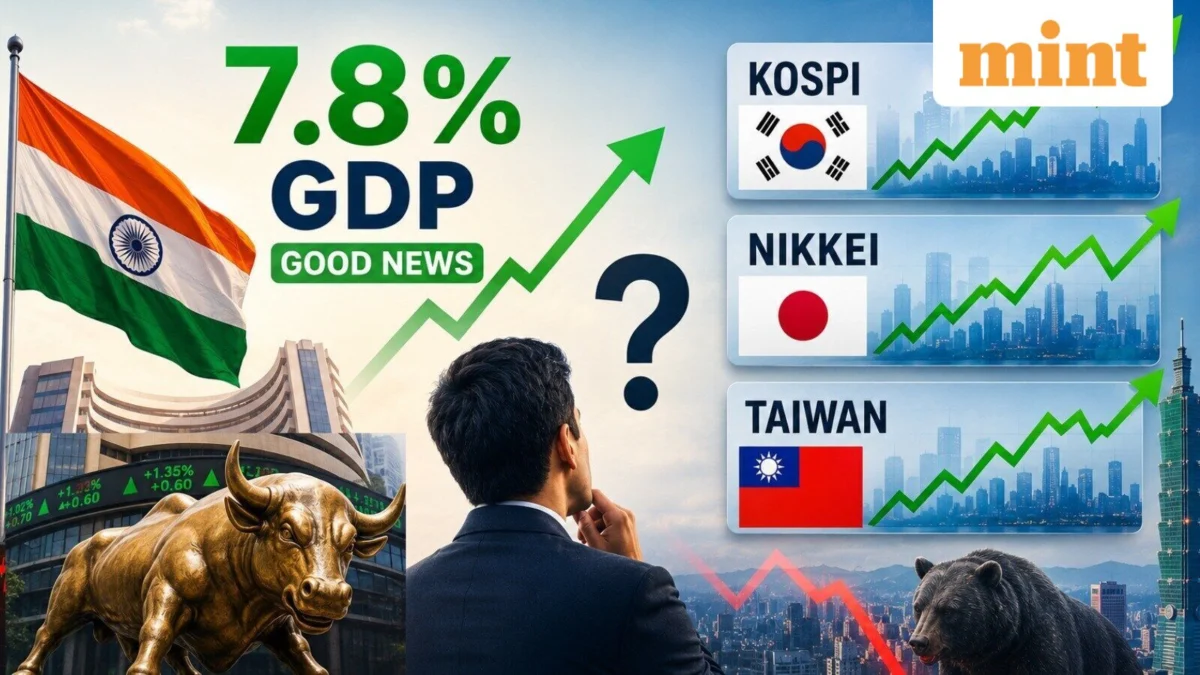
The Indian economy has once again demonstrated its resilience on the global stage, reporting a robust Gross Domestic Product (GDP) growth rate of 7.8% for the first quarter of the 2026-27 fiscal year (Q1FY27). While this figure serves as a testament to the nation’s underlying economic strength, it has failed to ignite the expected rally on Dalal Street. In a striking divergence from macroeconomic fundamentals, India’s premier stock indices—the Nifty 50 and the BSE Sensex—have languished in the red, while their East Asian counterparts, such as South Korea’s KOSPI and Japan’s Nikkei 225, have witnessed meteoric rises. This disconnect has left investors grappling with a complex puzzle: why is the world’s fastest-growing major economy seeing its equity markets corrected by double digits while technically weaker economies see their stock markets skyrocket?
The Paradox of Growth: India’s Macro vs. Market Performance
According to official data released on Monday of last week, India’s GDP growth engine maintained its momentum during the April-June quarter of 2026. The 7.8% growth rate arrived despite a confluence of domestic and international headwinds, including the late onset of the southwest monsoon, which threatened agricultural output, and a period of significant geopolitical uncertainty in West Asia. This growth rate comfortably positions India as a global leader in economic expansion, yet the stock market reflects a different reality.
As of early September 2026, the Nifty 50 has registered a Year-to-Date (YTD) loss of 8.60%. The BSE Sensex has fared even worse, logging a correction of over 10% since the start of the year. Even the Bank Nifty index, often considered the backbone of Indian market liquidity, has shed nearly 3.90% in 2026. This creates a rare economic anomaly where the "real economy" is thriving while the "paper economy" of stocks is retreating.
In sharp contrast, other Asian markets are experiencing a historic bull run. South Korea’s KOSPI has delivered a staggering 55% return YTD, while Japan’s Nikkei 225 has surged by 25%. The Taiwan Weighted Index has outperformed them all, posting gains of approximately 60%. These returns are particularly noteworthy because these nations have not matched India’s 7.8% GDP growth. In many cases, their domestic economies are struggling with aging populations, stagnant consumption, or lower industrial output compared to India’s vibrant manufacturing and service sectors.
A Chronology of the 2026 Market Disruption
The roots of this divergence can be traced back to the early months of 2026. To understand the current market volatility, one must look at the timeline of geopolitical and technological shifts that have reshaped global capital flows:
- February 28, 2026: The onset of the US-Iran conflict sends shockwaves through the energy markets. Crude oil, which was trading at a relatively stable $65 per barrel, begins a rapid ascent.
- March – April 2026: The closure of the Strait of Hormuz, a critical maritime chokepoint, severely disrupts global oil supply chains. India, which imports over 80% of its crude requirements, begins to feel the inflationary pressure.
- May 2026: While India grapples with rising input costs, a global surge in Artificial Intelligence (AI) investment begins to concentrate capital in semiconductor-heavy economies.
- June 2026: India reports strong Q1FY27 GDP figures (7.8%), but the equity markets fail to react positively as crude oil prices stabilize at a high plateau of over $90 per barrel.
- August 2026: The "AI-decoupling" becomes evident. Markets like Taiwan and South Korea continue to hit record highs driven by chip demand, while the Sensex and Nifty remain suppressed by energy costs and FII (Foreign Institutional Investor) outflows.
The Oil Factor: Why India is Vulnerable
The primary reason for the Indian market’s inability to reflect domestic economic growth is its sensitivity to energy prices. Anuj Gupta, a SEBI-registered market expert, points out that the Indian stock market has been unable to sustain the pressure of soaring crude oil prices.
"The US-Iran war has entered its seventh month with no signs of a ceasefire," Gupta noted. "When the conflict began, crude was at $65. It has since surged and stayed above $90 per barrel. For a country like India, high oil prices act as an indirect tax on the entire economy, squeezing corporate margins and fueling inflationary expectations."
High oil prices have a cascading effect on the Indian markets. They increase the trade deficit, weaken the Rupee against the US Dollar, and force the Reserve Bank of India (RBI) to maintain a hawkish monetary stance. This environment is inherently bearish for equities, regardless of how fast the GDP is growing. While the 7.8% GDP growth suggests that the domestic sector is absorbing these costs for now, the stock market is a forward-looking mechanism that fears the long-term impact on corporate profitability.
The AI Revolution: Why East Asia is Skyrocketing
If high oil prices are a global problem, why are the KOSPI, Nikkei, and Taiwan Weighted indices performing so well? The answer lies in the sectoral composition of these markets.
Unlike the Nifty 50, which is heavily weighted toward financial services, energy, and traditional IT services, the indices in South Korea, Taiwan, and Japan are dominated by the global semiconductor and hardware supply chain. As the world undergoes an unprecedented AI-led industrial revolution, the demand for high-end chips, HBM (High Bandwidth Memory), and AI-server components has reached a fever pitch.

"These Asian bourses performed well due to the AI-led buying in the semiconductor and chip stocks," Gupta explained. Companies like TSMC in Taiwan and Samsung and SK Hynix in South Korea have seen their valuations double as they become the sole providers of the infrastructure needed for the AI era. In this specific cycle, investors are prioritizing "AI-readiness" over "GDP-growth," leading to a massive migration of capital from diversified emerging markets like India to specialized tech hubs in East Asia.
Expert Analysis: The Risks of Overvaluation and Contagion
While the gains in East Asia are impressive, they have created a new set of risks for Indian investors. Sandeep Pandey, Co-founder of Basav Capital, issued a warning regarding the current state of global markets. He suggests that the Indian market’s current weakness might actually be compounded if the Asian "AI bubble" bursts.
"We have noticed a troubling trend: the Indian stock market falls when global markets fall, but it doesn’t always rise when they rise," Pandey observed. "Currently, the KOSPI, Nikkei 225, and Taiwan Weighted Index are in overbought territory. Profit-booking in these markets is inevitable. When global tech and AI stocks eventually see a correction, our tech and IT sectors—already struggling—will likely face further selling pressure."
Pandey’s analysis suggests that the outlook for the Sensex, Nifty 50, and Bank Nifty remains cautious. Even with stellar GDP growth, the Indian market is caught between the "rock" of high energy prices and the "hard place" of potential global tech volatility.
Institutional Perspective and Future Outlook
From a fundamental standpoint, the 7.8% GDP growth provides a safety net. Avinash Gorakshkar, a SEBI-registered fundamental equity analyst, believes that the link between the economy and the market will eventually restore itself, though it may take time.
"Normally, the stock market is linked to the national economy. India’s GDP performed well during the April to June 2026 quarter, and the market is expecting similar results in the next quarter," Gorakshkar said. "The Q2 2026 results will be crucial. If corporate earnings can show that they are managing to maintain margins despite $90 oil, we could see a ‘catch-up’ rally where the Nifty and Sensex begin to close the gap with their Asian peers."
However, the immediate future remains clouded by the Strait of Hormuz situation. As long as the US-Iran conflict dictates energy prices, India’s "growth premium" will be offset by "energy discounts."
Conclusion: A Tale of Two Realities
As India moves into the second half of the 2026-27 fiscal year, the divergence between its economic health and market performance serves as a reminder of the complexities of modern global finance. A 7.8% GDP growth rate is an enviable achievement that signals strong domestic demand, government infrastructure spending, and a resilient service sector.
Yet, in a world where capital is increasingly mobile and hyper-focused on specific themes like Artificial Intelligence, being "the fastest-growing economy" is sometimes not enough to attract equity flows. For the Indian investor, the challenge lies in navigating this period of transition. While the domestic story remains intact, the external pressures of high oil prices and the gravity-defying performance of AI-centric markets in East Asia will continue to weigh on the Sensex and Nifty. The coming months will determine whether India’s fundamental strength can finally overcome the geopolitical and technological shadows cast by its neighbors.
Disclaimer: This report is for educational and informational purposes only. The views and recommendations expressed are those of individual analysts and do not necessarily reflect the official position of this publication. Investors are urged to consult with certified financial advisors before making any investment decisions.
