

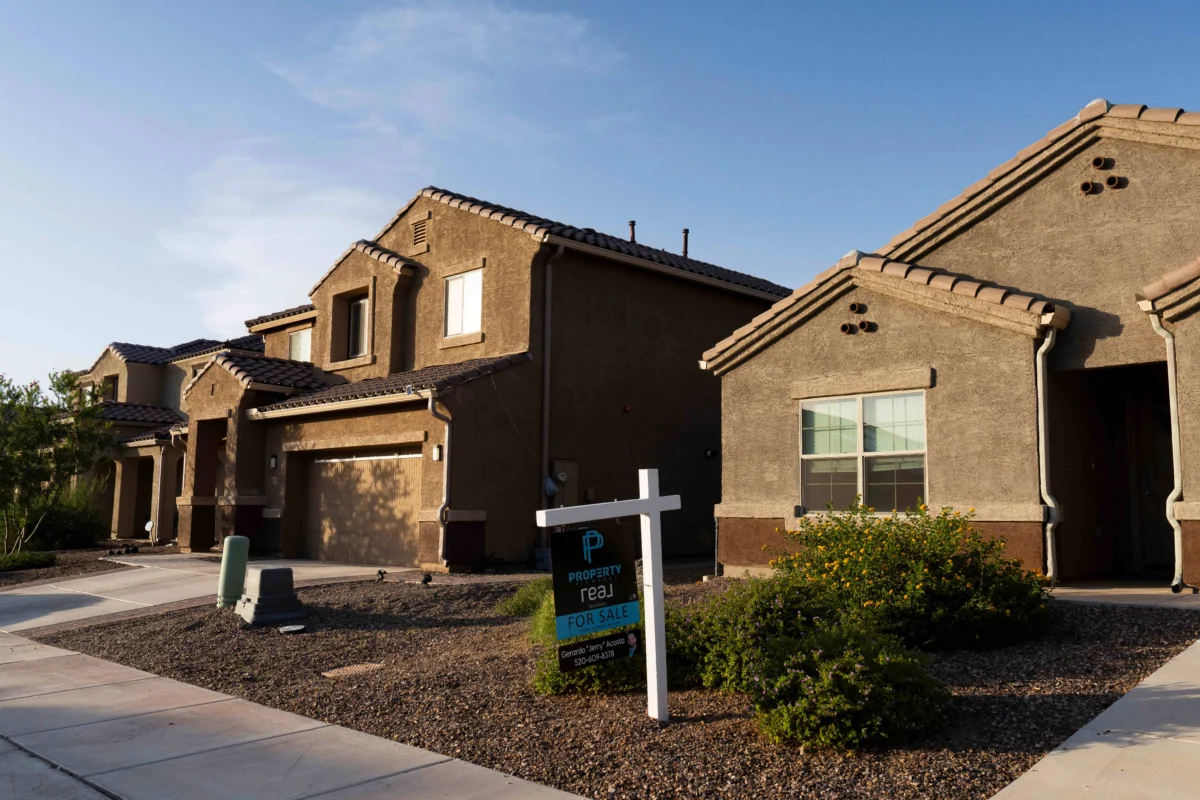
The landscape of the United States housing market continues to be shaped by persistent upward pressure on mortgage interest rates, which last week climbed to a three-week high, subsequently dampening demand for new home loans and refinancing. This trend underscores a broader cooling in market activity, evident in data released by the Mortgage Bankers Association (MBA), even as global economic and geopolitical factors introduce a layer of day-to-day rate volatility. A "For Sale" sign prominently displayed outside a residence in Marana, Arizona, on Wednesday, August 5, 2026, serves as a poignant visual metaphor for a national market grappling with affordability challenges and shifting buyer sentiment.
The Latest Data: A Stalling Market
According to the Mortgage Bankers Association’s (MBA) seasonally adjusted index, total mortgage application volume experienced a 1% decline from the preceding week. This reduction signals a continued weakening in borrowing interest, a direct consequence of the escalating cost of financing a home. The benchmark 30-year fixed-rate mortgage, a crucial indicator for most homebuyers, saw its average contract interest rate for conforming loan balances (up to $832,750) increase to 6.78% last week, up marginally from 6.77% the prior week. Accompanying this rise, points – an upfront fee paid to the lender to lower the interest rate – also edged higher, from 0.65 to 0.66, including the origination fee, for loans requiring a 20% down payment. This latest figure represents the highest rate observed in three weeks, indicating a renewed upward trajectory following a brief period of potential stabilization or minor fluctuations.
The implications of such increases, however slight on a weekly basis, accumulate over time, significantly impacting borrower purchasing power and long-term affordability. For a median-priced home, even a fractional rise in interest rates can translate into hundreds of dollars added to monthly mortgage payments, effectively pricing out a segment of potential buyers. The conforming loan limit, currently set at $832,750 for most of the U.S., defines the maximum size of a mortgage that Fannie Mae and Freddie Mac are able to buy or guarantee, thereby influencing the rates available to a vast majority of borrowers. Loans exceeding this limit are considered "jumbo" loans and typically come with different underwriting standards and, at times, different rate structures.
Refinance Market Retreats Amid "Golden Handcuffs"
Unsurprisingly, applications to refinance an existing home loan, which are inherently most sensitive to weekly rate movements, bore the brunt of the recent rate hike. These applications plummeted by 2% for the week, compounding an already significant year-over-year decline. Compared to the same week one year ago, when mortgage rates were a more favorable 9 basis points lower, refinance volume was a stark 17% lower. This dramatic decrease illustrates the concept of "golden handcuffs" or "rate lock-in," where a substantial portion of existing homeowners are now locked into historically low interest rates secured during the pandemic-era boom. For these homeowners, current rates offer no financial incentive to refinance, effectively tethering them to their existing properties and limiting market liquidity.
Joel Kan, Vice President and Deputy Chief Economist at the MBA, highlighted specific segments of the refinance market experiencing notable contractions. "Refinance applications decreased, particularly for FHA and VA loans, and the average loan size for refinances was at its lowest since June 2025," Kan noted in a recent release. The particular decline in FHA (Federal Housing Administration) and VA (Department of Veterans Affairs) loans is significant. These government-backed programs primarily serve first-time homebuyers, low-to-moderate-income borrowers, and military veterans, respectively, often requiring lower down payments or offering more lenient credit standards. A reduction in refinance activity within these categories suggests that even borrowers with less equity or more specific needs are finding the current rate environment prohibitive. The shrinking average loan size for refinances further indicates that homeowners with smaller mortgage balances, perhaps those who have paid down a substantial portion of their principal or who own less expensive properties, are also opting out of the refinance market. This trend points to a broad-based retreat from refinancing across various borrower demographics and property values.
Purchase Activity Cools, Especially for FHA Borrowers
While less volatile than refinance applications, the demand for new home mortgages also felt the chill of higher rates. Applications for a home mortgage dipped by 0.3% for the week and registered a 5% decrease compared to the same week a year ago. This year-over-year contraction, though smaller than that seen in the refinance segment, is nonetheless indicative of a market where potential buyers are increasingly hesitant or unable to enter.
Kan further elaborated on the specific pressures on the purchase market: "Purchase activity was down over the week, driven by a 7 percent decrease in FHA applications. The purchase market has also slowed these past two months." The disproportionate impact on FHA purchase applications underscores the challenges faced by first-time and lower-income buyers, who frequently rely on these government-insured loans due to their more accessible entry requirements. As rates climb, the already tight budgets of these buyers are stretched even thinner, making homeownership an increasingly distant dream for many. The observed slowdown over the past two months suggests that this is not an isolated weekly fluctuation but a sustained trend, pointing to a broader deceleration in housing market transactions as affordability continues to erode.
Shifting Dynamics: Cash No Longer King, but Financing Remains Challenged
Interestingly, despite the prevailing higher interest rates, a separate report from Realtor.com indicates a subtle but significant shift in transaction dynamics: fewer buyers are utilizing all-cash purchases. This contrasts with earlier periods of intense competition, particularly during the pandemic-fueled housing frenzy, when all-cash offers often dominated the market, leaving financed buyers at a considerable disadvantage. The current environment, characterized by less overall competition, appears to be making sellers more amenable to offers from buyers who require financing.
This shift suggests a rebalancing of power in the housing market. As the pool of cash buyers potentially shrinks—perhaps due to a broader economic cooling, a reallocation of investment capital, or a simple return to more normalized market conditions—sellers are finding themselves with fewer premium, no-contingency offers. This scenario, while still challenging for buyers navigating higher rates, might offer a glimmer of opportunity for those reliant on mortgages, as their offers are now more likely to be seriously considered. However, this increased acceptance of financed offers does not negate the fundamental challenge of affordability posed by elevated interest rates and persistently high home prices. It simply means that for those who can secure financing, the pathway to homeownership might be less obstructed by cash-rich rivals.
Economic Undercurrents Driving Rates: The Fed, Inflation, and Global Stability
The trajectory of mortgage rates is intrinsically linked to broader economic forces, primarily the Federal Reserve’s monetary policy and the dynamics of the bond market. The Federal Reserve has been steadfast in its commitment to combating inflation, which has remained stubbornly elevated for an extended period. To achieve its inflation targets, the Fed has systematically raised its benchmark federal funds rate and engaged in quantitative tightening, both of which aim to reduce liquidity in the financial system and cool economic demand. These actions directly influence the yields on U.S. Treasury bonds, particularly the 10-year Treasury note, which serves as a key benchmark for 30-year fixed mortgage rates. When Treasury yields rise, mortgage rates typically follow suit, reflecting the increased cost of capital for lenders.
Beyond domestic monetary policy, global events frequently inject volatility into the bond market, and consequently, into mortgage rates. This past week offered a prime example of such external influence. Mortgage News Daily reported a drop in rates on Tuesday, directly attributable to falling oil prices. Matthew Graham, Chief Operating Officer at Mortgage News Daily, explained the intricate connection: "News reports suggested progress in the peace process via Pakistani mediators. Oil prices dropped sharply in response, and bond yields followed the move. Bond yields correlate with mortgage rates."
This chain reaction illustrates the complex interplay of international relations, commodity markets, and domestic financial instruments. Positive developments in global peace initiatives can reduce geopolitical risk premiums, leading to a decrease in the perceived future scarcity of oil, and thus lower oil prices. Lower oil prices, in turn, can alleviate inflationary pressures, as energy costs are a significant component of both producer and consumer price indices. When inflation expectations recede, the demand for safe-haven assets like U.S. Treasury bonds can increase, driving up bond prices and pushing down their yields. Since mortgage rates are typically priced at a spread above these Treasury yields, a drop in bond yields often translates into a decrease in mortgage rates, albeit often with a slight lag. This demonstrates the highly interconnected nature of modern financial markets, where events on one side of the globe can have immediate and tangible effects on the cost of borrowing for an American homebuyer.
Historical Context and Broader Implications
To fully appreciate the current rate environment, it is crucial to place 6.78% in historical context. While significantly higher than the ultra-low rates experienced during the peak of the pandemic (which dipped below 3%), current rates are still below the multi-decade highs seen in the early 1980s, when rates soared into the double digits. However, they represent a substantial increase from the 2010s, when rates hovered in the 3-5% range for much of the decade. This rapid ascent in borrowing costs, combined with years of robust home price appreciation, has severely impacted housing affordability. The affordability index, which measures the ability of a typical family to afford a median-priced home, has deteriorated significantly, making homeownership increasingly challenging for first-time buyers and those in lower-to-middle income brackets.
The broader implications of a slowing housing market extend beyond individual buyers and sellers. It impacts homebuilders, who may scale back new construction projects in anticipation of diminished demand, leading to fewer jobs in the construction sector. Real estate agents, mortgage lenders, and related service providers also face reduced transaction volumes. A less active housing market can also have ripple effects on consumer spending, as fewer home sales mean less spending on home improvements, furnishings, and moving services. This can contribute to a broader economic slowdown, highlighting the housing sector’s critical role as a bellwether for the overall economy.
The Road Ahead: Navigating Uncertainty
The immediate future of mortgage rates remains subject to a complex interplay of economic data, Federal Reserve pronouncements, and global events. While the recent dip due to geopolitical progress offers a glimpse of potential relief, the overarching inflationary environment and the Fed’s commitment to price stability suggest that significant and sustained rate reductions may not be imminent. Market participants, from potential homebuyers to seasoned real estate investors, will need to remain vigilant, closely monitoring inflation reports, employment figures, and central bank communications.
The "Property Play" newsletter by CNBC’s Diana Olick, offering weekly insights into new and evolving opportunities for real estate investors, underscores the necessity of staying informed in such a dynamic market. As rates continue to fluctuate and market conditions evolve, accurate and timely information becomes an invaluable asset for making informed decisions in the complex world of real estate. The current environment demands careful consideration and strategic planning from all involved, as the housing market navigates a period of profound adjustment and uncertainty.
