

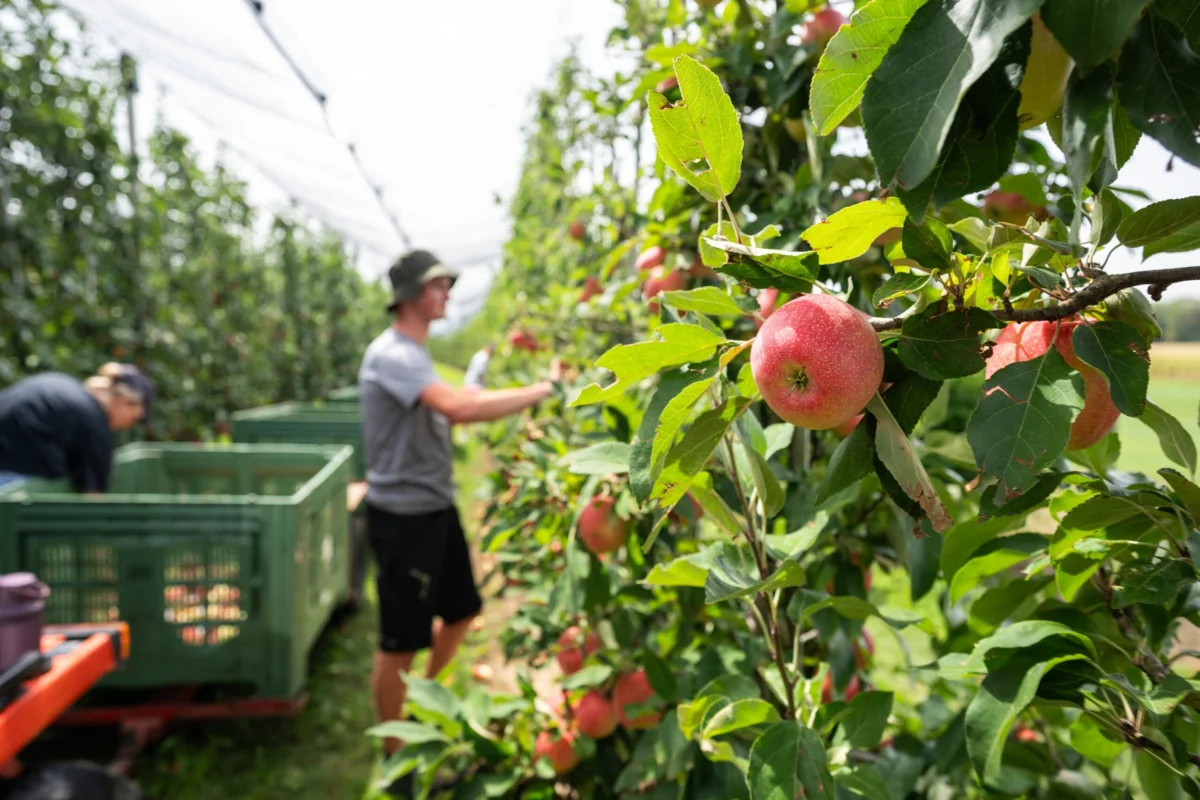
The American grocery store often presents a façade of permanence, where fresh fruits like apples, pears, and cherries seemingly remain abundant on shelves long after their harvest seasons conclude. This consistent availability belies a stark reality for the agricultural workforce responsible for bringing these products to market, a reality characterized by profound instability and cyclical employment. Agriculture, particularly in labor-intensive sectors such as fruit growing, relies heavily on a flexible workforce hired for specific tasks—picking, packing, and transporting crops—only to be released once the seasonal demand subsides. For consumers, the product is a staple; for the farmworkers, the job is anything but permanent. This inherent tension between steady supply and precarious labor is currently manifesting with significant impact in Washington state, one of the nation’s most crucial fruit-growing regions.
Major Layoffs Signal Deeper Uncertainty
Borton & Sons, a prominent Washington-based fruit grower and packer, has announced plans to lay off 928 farmworkers in November as the current year’s harvest concludes. This significant workforce reduction was detailed in a Worker Adjustment and Retraining Notification (WARN) reviewed by TheStreet, highlighting the scale of the impending job losses. The affected employees are general farm laborers primarily working under the federal H-2A program, which permits agricultural businesses to hire foreign workers for temporary or seasonal jobs when a verifiable shortage of U.S. workers exists.
The layoffs at Borton & Sons are scheduled to commence on November 8 and continue through November 15, impacting operations across multiple locations critical to Washington’s agricultural landscape, including Yakima, Zillah, Pasco, Burbank, Prescott, Soap Lake, Othello, and Mesa. While seasonal layoffs following the harvest are a common and anticipated aspect of the agricultural industry, Borton’s filing contains a notable departure from typical practice. The company has characterized all 928 layoffs as "permanent" because it has not identified specific recall dates or established staffing needs for the 2027 season. This classification introduces a level of long-term uncertainty that transcends the usual seasonal ebb and flow, suggesting potential shifts in operational strategy or a response to broader economic and environmental pressures.
Furthermore, Borton & Sons indicated that it remains unclear whether additional domestic workers could also be affected, citing uncertainties such as unpredictable weather patterns, fluctuating crop conditions, and employee attrition during the final weeks of the harvest season. The company did not respond to TheStreet’s request for additional information regarding its 2027 staffing projections, leaving many questions unanswered about the future of its workforce and operations.
The H-2A Program: A Pillar of Modern Agriculture, A Source of Debate
The H-2A visa program is a nonimmigrant visa category that allows U.S. employers to bring foreign nationals to the United States to fill temporary agricultural jobs. Established under the Immigration and Nationality Act, its purpose is to address labor shortages in the agricultural sector, particularly for highly seasonal tasks like fruit harvesting. Employers seeking H-2A workers must demonstrate that there are not enough U.S. workers who are able, willing, qualified, and available to perform the temporary agricultural labor, and that employing foreign workers will not adversely affect the wages and working conditions of similarly employed U.S. workers.
The program has seen exponential growth over the past two decades. According to data from the U.S. Department of Labor, the number of H-2A positions certified has surged from approximately 48,000 in fiscal year 2005 to over 371,000 in fiscal year 2023. This dramatic increase underscores the growing reliance of American agriculture on this specific labor pipeline. Washington state, given its vast and labor-intensive fruit and vegetable production, is consistently among the top states utilizing the H-2A program. In 2023, Washington ranked third nationally in the number of H-2A certified positions, behind only Florida and California, further emphasizing the program’s integral role in the state’s agricultural economy.
While the H-2A program provides a legal and reliable workforce for growers, it is not without its critics. Labor advocates often point to the vulnerability of H-2A workers, whose visas are tied to a single employer, making them susceptible to exploitation and reluctant to report poor working conditions or wage disputes for fear of reprisal and jeopardizing future employment. Workers are often housed in employer-provided accommodations and their ability to move freely or seek alternative employment is severely restricted. Critics also argue that despite protections, the program can depress wages for domestic farmworkers by introducing a large, compliant labor pool. Employers, on the other hand, maintain that the program is essential for their survival, providing a dependable workforce that U.S. citizens are often unwilling to perform due to the strenuous nature of the work and seasonal instability.
A Broader Trend: Thousands of Farm Jobs Vanish Post-Harvest
Borton & Sons’ substantial layoffs, while individually large, are far from an isolated incident within Washington’s agricultural sector. The cyclical nature of farming dictates that jobs tied to specific harvest seasons will inherently be temporary. Data from the Washington State Employment Security Department reveals a pervasive pattern: from November 2024 through November 2025, employers across the state reported 20 agriculture-related layoffs affecting a staggering 14,831 mostly seasonal workers. These figures encompass not only direct agricultural businesses but also agencies specializing in providing services to agricultural employers, illustrating the widespread impact of seasonal shifts.
Several individual filings within this period involved the displacement of more than 1,000 workers, underscoring the scale of this annual turnover. For instance, Stemilt Ag Services, another major Washington fruit company, reported laying off 1,561 seasonal H-2A field workers in November 2023 as their contracts concluded with the end of the harvest season. The company noted that its warehouse and shipping employees, who often have more stable, year-round positions, were not affected by these specific seasonal reductions. This distinction highlights the differing employment realities within the agricultural supply chain, where field labor remains the most susceptible to seasonal fluctuations.
Washington’s Agricultural Backbone: Apples, Cherries, and the Labor Behind Them
Washington state is an agricultural powerhouse, particularly renowned for its fruit production. It is the leading producer of apples in the United States, accounting for over 60% of the nation’s total supply, and a significant producer of cherries, pears, and other specialty crops. The state’s unique climate, fertile soils, and sophisticated irrigation systems, especially in regions like the Yakima Valley, create ideal conditions for high-quality fruit. This industry contributes billions of dollars annually to the state’s economy and supports tens of thousands of jobs, both directly and indirectly.
The cultivation and harvesting of these crops are incredibly labor-intensive. Apples, for instance, are hand-picked to avoid bruising, requiring a large, skilled workforce during a concentrated period. Cherries have an even shorter and more demanding harvest window, necessitating an even larger temporary labor force. This inherent characteristic of fruit farming underpins the reliance on seasonal workers and, by extension, programs like H-2A. However, this reliance also creates a fragile ecosystem where the economic well-being of thousands of individuals is tied directly to the vagaries of weather, market prices, and the specific needs of individual growers.
The Human Cost: Implications for Workers and Communities
For the nearly 1,000 H-2A workers affected by Borton & Sons’ layoffs, and the thousands more across Washington state facing similar circumstances, the "permanent" classification carries significant weight. Unlike seasonal layoffs where workers often have an expectation of recall the following season, a permanent layoff for H-2A workers means their current employment contract is terminated, and they must return to their home countries. Securing future H-2A visas requires a new application process by a new or the same employer, often involving substantial uncertainty and waiting periods. This directly impacts their ability to provide for their families, both in the U.S. during their work tenure and back home.
These workers, predominantly from Mexico and Central American countries, often send remittances back to their families, which are crucial for their survival and economic stability. The sudden and potentially permanent cessation of employment can have devastating ripple effects on these transnational households. Beyond the individual economic hardship, large-scale layoffs also affect the rural communities in Washington where these workers temporarily reside. While often transient, farmworkers contribute to local economies through their spending on goods and services, and their presence, even if seasonal, is integrated into the fabric of these agricultural towns. The uncertainty surrounding future labor needs can also impact community planning for housing, healthcare, and social services that cater to this unique population.
Industry Challenges and the Future of Agricultural Labor
From the perspective of agricultural businesses, managing a workforce that aligns precisely with unpredictable harvest schedules and market demands is a monumental challenge. Growers face numerous variables that influence their labor needs, including:
- Weather and Climate Change: Unpredictable frosts, heatwaves, and droughts can significantly impact crop yields, ripening schedules, and overall demand for labor.
- Market Fluctuations: Global supply and demand, trade policies, and consumer preferences directly affect fruit prices and, consequently, a grower’s ability to finance operations, including labor costs.
- Rising Costs: Input costs for fertilizer, fuel, water, and compliance with labor regulations continue to climb, squeezing profit margins.
- Labor Availability and Cost: Despite the H-2A program, securing a sufficient and willing workforce at a sustainable cost remains a perennial concern.
Borton & Sons’ decision to declare layoffs as "permanent" for 2027 could signal a deeper strategic re-evaluation, possibly driven by these accumulating pressures. It might suggest an anticipated reduction in planted acreage, a shift towards crops requiring less labor, or an accelerated investment in mechanization technologies. While fruit harvesting has historically resisted widespread automation due to the delicate nature of the produce, advancements in robotics and AI are gradually making inroads, particularly in tasks like pruning and some forms of picking. Such a shift, while potentially improving efficiency for growers, would further exacerbate the displacement of human labor.
Calls for Reform and a More Stable Future
Farmworker advocacy groups have long championed the need for more comprehensive immigration reform that would provide a stable legal status and pathways to permanent residency for agricultural workers, thereby decoupling their employment from the precarious H-2A visa system. Organizations such as the United Farm Workers (UFW) and local advocacy groups in the Pacific Northwest consistently highlight the systemic vulnerabilities faced by farmworkers and advocate for stronger labor protections, improved wage standards, and access to social safety nets.
The Borton & Sons layoffs, particularly their "permanent" classification, intensify the urgency of these discussions. They underscore the precarious balance between a nation’s demand for fresh produce and the human cost borne by those who harvest it. As Washington state and the broader U.S. agricultural industry navigate an increasingly complex landscape of climate change, market volatility, and evolving labor dynamics, the tension between the "permanent" product on the shelf and the "temporary" nature of farm labor will continue to be a defining challenge, demanding innovative solutions and a re-evaluation of current policies to ensure both agricultural viability and worker dignity. The future of American agriculture, and the livelihoods of its essential workforce, hang in this uncertain balance.
