

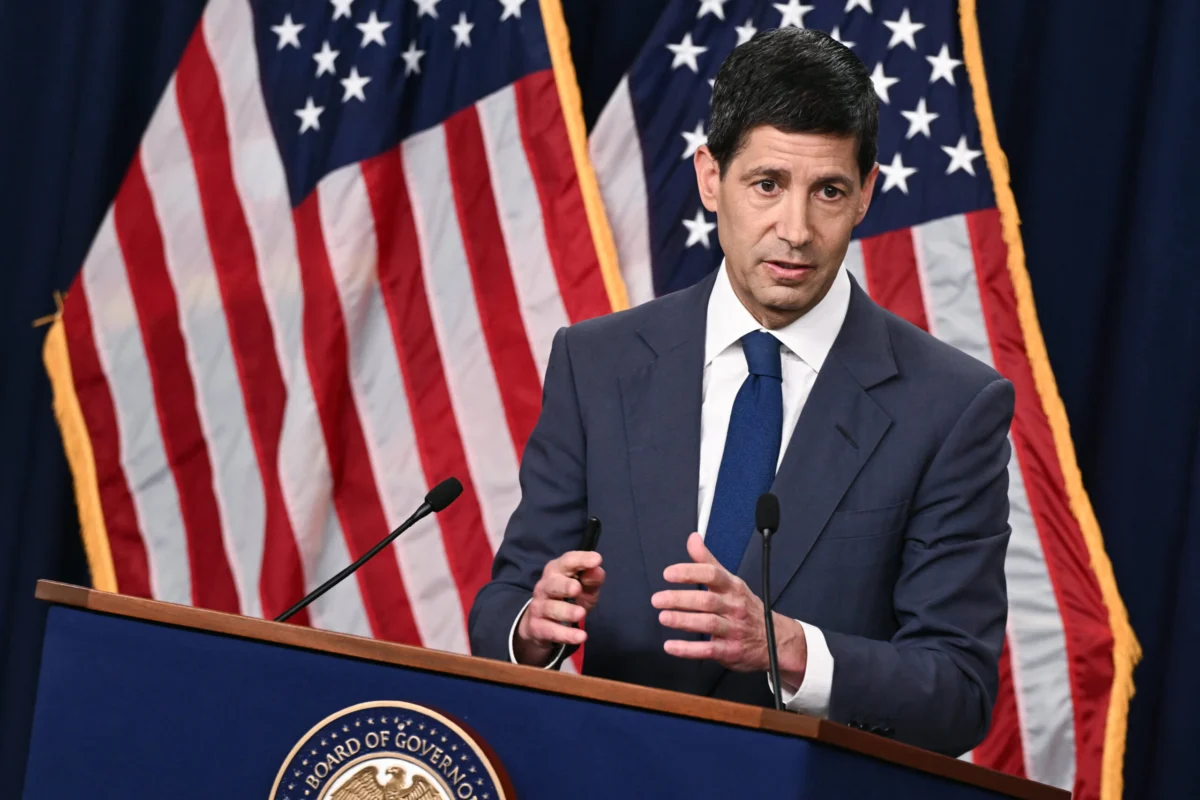
Federal Reserve Chairman Kevin Warsh on Friday articulated significant concerns regarding the persistent elevation of inflation, while subtly indicating that interest rates may need to be further increased if substantial progress in taming price pressures is not achieved. In closely watched remarks delivered at the Federal Reserve’s annual symposium in Jackson Hole, Wyoming, Warsh’s commentary deliberately abstained from providing explicit forward guidance—the verbal cues that typically inform the market about the Fed’s future intentions—or a clearly defined reaction function, which outlines the economic indicators that would prompt adjustments to interest rates.
Warsh acknowledged that current inflation readings remain unacceptably high. "While this summer’s [inflation] readings were better than expected, they do not tell me that underlying trends have meaningfully improved," he stated. He emphasized the Fed’s commitment to its mandate, asserting, "We must be confident that underlying inflation is moving to our objective, clearly and at sufficient speed. Otherwise, we have work to do. That’s our job, our mandate and our charge to keep."
The market’s reaction to Warsh’s address, which commenced at 10 a.m. ET, was swift and pronounced. Stock market indexes experienced an upward trend following the digestion of his remarks, while Treasury yields saw a substantial climb. Specifically, the policy-sensitive 2-year Treasury note surged by nearly 8 basis points, or 0.08 percentage point, reaching 4.31%, its highest level since late July. This movement underscored the market’s interpretation of Warsh’s speech as a hawkish signal.
Traders, reflecting this sentiment, significantly raised the probability of an interest rate hike at the upcoming September Federal Open Market Committee (FOMC) meeting. According to the CME Group’s FedWatch tool, the likelihood of a hike increased to 55.7%, a notable jump of approximately 20 percentage points from the previous day. This adjustment in market expectations suggests a growing consensus that the Federal Reserve might opt for further tightening to combat inflation.
Heather Long, chief economist at Navy Federal Credit Union, provided an analysis of the market’s reaction: "Warsh ‘opened the door to a Fed rate hike. A hike probably won’t come in September, but it will by October or December.’ Warsh explicitly said this summer’s encouraging inflation readings don’t indicate ‘meaningful’ improvement on inflation. Bond markets reacted swiftly by pricing in a hike." This observation highlights the perceived clarity of Warsh’s message, even in its indirect form.
Warsh also sought to reassure market participants about the Fed’s commitment to its price stability objective. "Market prices show confidence that we will deliver price stability. And I can assure you they’re right," he declared, reinforcing the central bank’s resolve.
Beyond the immediate concerns surrounding inflation, Warsh expressed a generally positive outlook on the broader economy, describing it as having "strengthened." He reiterated previous observations regarding the beneficial impact of artificial intelligence on economic activity and noted the resilience of both business and consumer spending. While acknowledging a deceleration in hiring, he attributed this trend to a plateauing labor supply rather than a weakening economic outlook.
A significant portion of Warsh’s address was dedicated to articulating his philosophy on monetary policy, carefully avoiding any definitive pronouncements on specific actions to achieve the Fed’s dual mandate of low inflation and full employment. "I stand here today committed to a discipline, not to a decision," Warsh stated in his prepared remarks, addressing an audience comprising fellow FOMC policymakers, economists, and members of the media. This framing suggested a preference for principled decision-making based on evolving economic conditions rather than adherence to rigid, pre-determined policy paths.
Responding to Critics and Re-evaluating Communication Strategies
The Federal Reserve Chairman has faced criticism for his perceived reticence regarding his policy approach, particularly at a time when inflation continues to significantly exceed the Fed’s 2% target. Warsh has previously expressed reservations about the utility of forward guidance, arguing that it can foster an over-reliance on Fed rhetoric by markets that should be independently interpreting economic data.
Early in his speech, provocatively titled "In Our Time," Warsh quipped, "You can call it an outline, you can call it a trail map, just don’t call it forward guidance," adding that such a practice "has overstayed its welcome." This statement was a clear rejection of the conventional practice of providing explicit forward guidance, signaling a potential shift in the Fed’s communication strategy.
However, the broader implication of his remarks pointed towards a fundamental re-evaluation of the Fed’s role in its interactions with the market and the public. Since assuming the chairmanship 100 days prior to his speech, Warsh has been instrumental in initiating five task forces aimed at examining various facets of the Federal Reserve’s operations. A central theme emerging from these initiatives is the desire to reduce market dependency on the pronouncements of individual policymakers. Warsh advocated for a "quieter Fed, more purposeful in its communications," suggesting a move away from the daily market interpretations of every Fed statement.
"The Fed plays an essential role in the economy and the markets. And our tools are powerful. We determine the path of short-term interest rates. And market participants will always try to anticipate what we will do next," he acknowledged. "But we should not indulge a regime in which market participants are looking primarily to the Fed for their next trade." This statement articulated a vision for a Federal Reserve that guides the economy through its policy actions rather than through constant, explicit signaling to financial markets.
Warsh’s address at Jackson Hole marked a departure from the patterns set by his predecessors. Historically, the symposium has served as a platform for Fed chairs to signal the direction of interest rates, announce significant shifts in the Fed’s policy framework, or delineate new approaches to monetary policy. In stark contrast, at the previous year’s event, then-Chair Jerome Powell had signaled potential interest rate cuts ahead, an announcement that triggered a substantial rally in the stock market. Warsh’s approach signaled a more cautious and data-dependent stance.

The Elusive Reaction Function: Navigating Policy Uncertainty
In his relatively short tenure as Chairman, Warsh has embarked on a mission to chart a new course for the Federal Reserve, one that arguably harks back to the pre-financial crisis era, when markets received less certain signals from the central bank and the Fed’s direct influence was perceived as more limited.
While market participants have begun to adjust to the absence of explicit forward guidance, they have looked to Warsh, at the very least, for a clearer articulation of the Fed’s reaction function—the conditions under which policy responses would be triggered. Even on this front, Warsh remained deliberately non-committal.
He appeared to acknowledge the ongoing criticism by posing a rhetorical question: "So, if forward guidance is ill-suited to normal times, then how about the new Fed chief commits—at the very least—to an explicit reaction function? Surely, he should tell us his interest rate path—if, say, the data were to come in hot or cold." This question highlighted the market’s desire for predictability in the face of potential economic volatility. He specifically questioned whether the Fed should adhere to a precise rule for its policy decisions.
However, Warsh countered by asserting that "our knowledge just doesn’t extend that far—at least not yet—and the factors most relevant to the proper conduct of monetary policy change over time." This statement underscored the complexity of modern economic management and the inherent limitations of predictive modeling. He suggested that a rigid, pre-defined reaction function might be insufficient to address the dynamic and evolving nature of economic challenges.
"In my term as Chairman, my colleagues and I will endeavor to construct more reliable models and more robust rules to guide policy decisions," Warsh pledged. "We’ll do this knowing that accuracy in economic forecasting is still just an aspiration. With so much changing so fast in geopolitics, global supply chains, and technology, it’s wise to be modest about what we can and cannot know." This commitment to improving analytical tools and policy frameworks, coupled with a candid admission of forecasting limitations, suggested a long-term strategy of enhancing the Fed’s understanding of the economy.
Notably absent from Warsh’s prepared remarks was any mention of the recent announcement by Treasury Secretary Scott Bessent regarding accelerated buybacks of government debt. This initiative, aimed at managing the national debt, appears to run counter to the Federal Reserve Chairman’s stated desire for a reduced government footprint in market operations, raising potential questions about the coordination of fiscal and monetary policy in the coming months.
Supporting Data and Context
The backdrop for Warsh’s speech at Jackson Hole was a complex economic landscape. Inflation, as measured by the Consumer Price Index (CPI), had shown signs of moderation in recent months, with the July reading indicating a year-over-year increase of 3.2%. However, the core CPI, which excludes volatile food and energy prices, remained stubbornly elevated, rising by 3.3% annually. This persistent core inflation has been a key concern for the Federal Reserve, suggesting that underlying price pressures are not dissipating as rapidly as desired.
The labor market, while showing some signs of cooling, remained relatively robust. The unemployment rate stood at 3.8% in July, near historic lows. Job growth, though slowing from its peak, continued to add hundreds of thousands of positions each month. This strength in the labor market has provided the Fed with some latitude to maintain a tighter monetary policy without triggering a significant economic downturn.
The Federal Reserve’s benchmark federal funds rate was currently set within a target range of 5.25% to 5.50%. This represents a significant increase from the near-zero rates that prevailed for much of the post-financial crisis period. The Fed’s aggressive rate-hiking cycle, initiated in March 2022, was aimed at combating the highest inflation seen in decades.
The Jackson Hole Economic Symposium, hosted annually by the Federal Reserve Bank of Kansas City, is a prestigious gathering that attracts central bankers, economists, academics, and financial market participants from around the globe. It serves as a crucial forum for discussing pressing economic issues and for central bank leaders to share their perspectives on the economic outlook and monetary policy. The location, set against the scenic backdrop of the Grand Teton mountains, has often been associated with significant policy pronouncements.
Broader Implications and Analysis
Warsh’s emphasis on a "quieter Fed" and his skepticism towards traditional forward guidance signal a potential shift in how the central bank communicates its intentions to the market. This approach, if fully embraced, could lead to a more disciplined market that focuses on fundamental economic data rather than dissecting every utterance from Fed officials. However, it also carries the risk of increased market volatility if economic signals become less clear.
The commitment to developing "more reliable models and more robust rules" suggests a long-term effort to improve the Fed’s analytical capacity. In an era characterized by rapid technological change, geopolitical instability, and evolving supply chain dynamics, the need for sophisticated and adaptable economic modeling is paramount. The Fed’s ability to accurately forecast and respond to these complex forces will be critical in achieving its dual mandate.
The market’s immediate reaction, with rising Treasury yields and increased expectations of a rate hike, demonstrates that Warsh’s message was received as a signal of continued vigilance against inflation. The implication is that the Federal Reserve is prepared to keep interest rates higher for longer if necessary to ensure price stability. This stance could have implications for economic growth, business investment, and consumer borrowing costs in the coming months.
The departure from the communication strategies of his predecessors, particularly regarding forward guidance, places a greater onus on market participants to conduct their own rigorous analysis. This could foster a more mature and independent market, but it also necessitates a higher level of sophistication and a tolerance for greater uncertainty. The success of this approach will ultimately depend on the Fed’s ability to consistently implement sound policy based on a deep understanding of the evolving economic landscape.
