

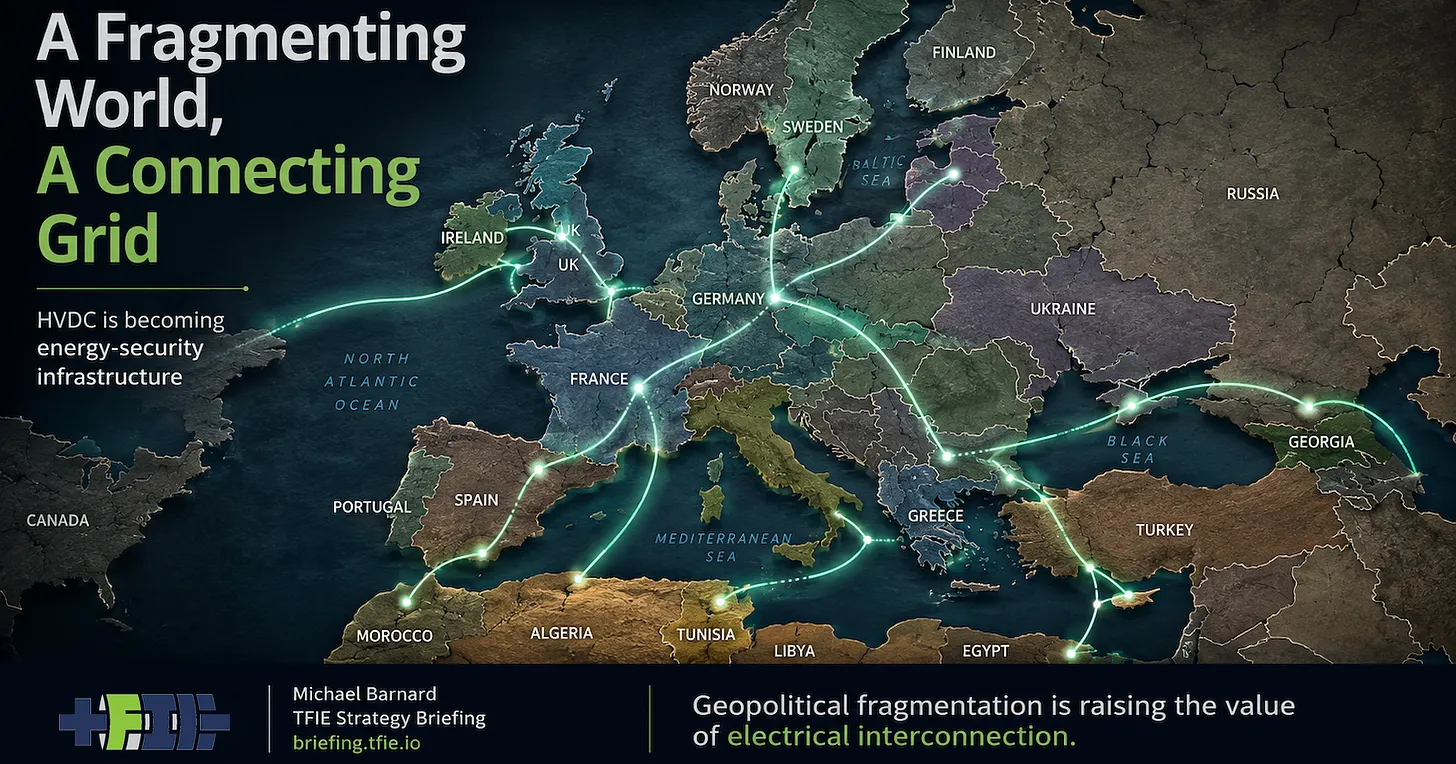
The paradigm of European energy security has undergone a fundamental transformation since the onset of the conflict in Ukraine in early 2022. While the immediate political reaction to the weaponization of natural gas was a clarion call for "energy independence," a more nuanced strategy has emerged in the years following: strategic energy interdependence. This approach acknowledges that isolationism, or electrical autarky, is both economically prohibitive and technically inferior to a well-integrated, diversified network of trusted partners. Today, cross-border electricity links are no longer viewed merely as tools for market arbitrage or price equalization; they have become essential pillars of national security, grid resilience, and renewable energy integration.
The Geopolitical Catalyst for Grid Transformation
The shift in perspective was born out of the 2022 energy crisis, which saw wholesale gas and electricity prices reach unprecedented heights across the European continent. For decades, many European nations relied on a concentrated supply of fossil fuels from a single, increasingly volatile counterparty. The vulnerability of this model was exposed when supply lines were throttled, leading to a frantic search for alternatives. However, the lesson learned was not that international cooperation had failed, but that the nature of the dependency was flawed.
Unlike a gas pipeline, which creates a one-way flow of a single commodity and leaves the importer exposed to price shocks and supply manipulation, an electrical interconnector facilitates a reciprocal relationship. These links connect complex power systems that possess their own internal generation, storage, and demand-response capabilities. In an interconnected grid, electricity can move in either direction based on weather patterns, surplus production, or emergency needs. This creates a "portfolio effect," where a nation’s energy security is bolstered by access to a diverse array of resources—including Scandinavian hydro, North Sea wind, Southern European solar, and French nuclear—without sacrificing domestic generation assets.
The 2026 Inventory: A Roadmap for Interconnection
As of mid-2026, the international High Voltage Direct Current (HVDC) pipeline serves as a barometer for this strategic shift. According to the July 2026 inventory compiled by RTE International, there are approximately 60 prospective international links currently in various stages of development or planning. The majority of these projects are concentrated in Europe and its immediate maritime neighborhoods, such as the North Sea, the Mediterranean, and the Baltic Sea.
The prevalence of these projects suggests that despite a global trend toward geopolitical fragmentation, European nations are doubling down on physical integration. The technology of choice is increasingly Voltage Source Converter (VSC) HVDC. This technology is particularly well-suited for the modern era because it allows for precise control of power flows and can provide "black start" capabilities—the ability to restart a grid after a total blackout—which is a critical component of national resilience.
The scale of this infrastructure is significant. These 60 links represent billions of euros in investment and thousands of kilometers of subsea and underground cabling. The fact that these projects continue to advance, even as geopolitical tensions rise, indicates that policymakers view them as protective measures rather than liabilities.

Chronology of the Baltic Shift: From BRELL to the European Grid
Perhaps the most salient example of the strategic value of interconnection is found in the Baltic states. For decades, Estonia, Latvia, and Lithuania remained part of the BRELL (Belarus, Russia, Estonia, Latvia, and Lithuania) power ring, a legacy of the Soviet era that left their frequency control in the hands of operators in Moscow.
The timeline for their transition has been accelerated by security concerns:
- Pre-2022: The Baltic states maintained a long-term goal of synchronizing with the Continental European Network (CEN) by 2025.
- 2022-2023: Following the invasion of Ukraine, the Baltic governments and transmission system operators (TSOs) moved to decouple from the Russian grid as quickly as possible, citing the risk of "accidental" or purposeful disconnection by Russia.
- 2024-2025: Significant infrastructure investments, including synchronous condensers and new transmission lines, were fast-tracked.
- July 2026: Projects like the Baltic-German PowerLink continue to move toward the European Union’s "Project of Common Interest" (PCI) status.
The Baltic-German PowerLink illustrates the new reality: even as these nations face direct threats to their physical infrastructure, their response is to build deeper, more robust connections to Western partners. This project is not just about trading kilowatt-hours; it is about ensuring that if one corridor is compromised, others remain open to maintain the stability of the regional grid.
Supporting Data: The Economic and Security Multiplier
The Agency for the Cooperation of Energy Regulators (ACER) has increasingly emphasized that stronger interconnection is the most cost-effective way to meet climate targets while maintaining security of supply. Data from ACER indicates that integrated markets saved European consumers billions of euros during the height of the energy crisis by allowing power to flow from areas of lower-cost generation to areas of high demand.
Furthermore, the European Union has set a target for all member states to achieve an interconnection level of at least 15% of their installed electricity production capacity by 2030. While some nations, such as Spain and Italy, have historically struggled to meet these targets due to geographic barriers, the new wave of HVDC projects is designed specifically to overcome these bottlenecks.
In the United Kingdom, the "Clean Flexibility Roadmap" has integrated international links into a broader portfolio of flexibility assets. The UK government now treats interconnectors as being on par with domestic battery storage and demand-side response. By 2030, the UK aims to have 18 GW of interconnector capacity, recognizing that the variability of offshore wind in the North Sea can be balanced by the different weather systems and resource mixes of its neighbors.
Official Responses and Regulatory Evolution
The shift in rhetoric from regulatory bodies is telling. In previous decades, the primary justification for a new interconnector was "price arbitrage"—the ability to buy cheap power in one market and sell it for a profit in another. While the economic business case remains important, official statements now prioritize "flexibility" and "adequacy."

ACER’s recent reports argue that as the share of variable renewable energy (VRE) like wind and solar increases, the need for cross-border cooperation doubles. "Interconnection is the backbone of the energy transition," a recent ACER briefing stated. "It allows us to share the burden of flexibility across borders, reducing the need for redundant domestic fossil-fuel backup."
Similarly, British energy regulators have noted that interconnectors provide a "hedge" against domestic system failures. If a major domestic power plant goes offline or a localized weather event reduces wind output, the ability to import power from a wide geographic area prevents the need for rolling blackouts or the activation of expensive, high-emission "peaker" plants.
Broader Impact and Risk Mitigation
While the benefits of strategic interdependence are clear, the strategy is not without risks. The sabotage of the Nord Stream gas pipelines in 2022 and the damage to the Balticconnector gas pipe in 2023 have highlighted the vulnerability of subsea infrastructure. A single, massive interconnector can become a "concentration risk"—a high-value target for state or non-state actors looking to cause disruption.
To mitigate these risks, the current development strategy focuses on diversification and redundancy. Rather than relying on one "super-cable," nations are building multiple smaller links across different geographic routes. This "mesh" approach ensures that the loss of a single asset is a manageable contingency rather than a national catastrophe.
Furthermore, the integration of cross-border links requires a corresponding investment in internal transmission. A country cannot benefit from imported electricity if its domestic grid suffers from bottlenecks that prevent power from reaching industrial hubs or urban centers. Consequently, the rise in international links is driving a massive wave of domestic grid modernization across the continent.
Conclusion: Toward a Reciprocal Electricity Portfolio
The evolution of cross-border electricity links represents a fundamental shift in how modern states view sovereignty and security. The old model of "concentrated fuel dependence" is being replaced by a "reciprocal electricity portfolio." This new model recognizes that in a world of volatile weather and even more volatile politics, security is found in the strength of the network.
As the 2030s approach, the successful completion of the 60 projects currently in the pipeline will determine whether Europe can achieve its twin goals of decarbonization and strategic autonomy. By moving away from the fragile "single-supplier" model and toward a resilient, interconnected system, the region is building an energy architecture that is designed to withstand the shocks of the 21st century. The path forward is not found in retreating behind national borders, but in weaving a tighter, more diverse web of electrical cooperation.
