

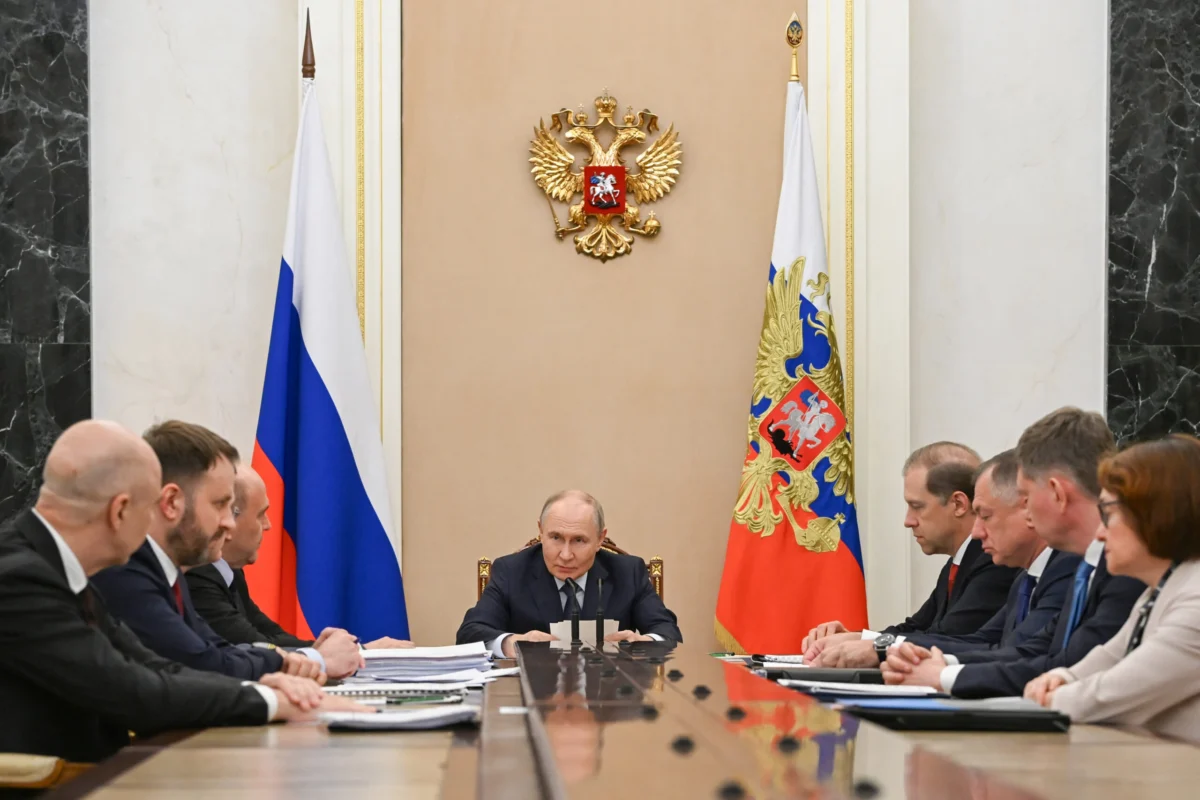
Russian government officials are projecting an image of robust economic health, asserting that the nation’s economy remains strong and healthy despite what they describe as "unprecedented foreign pressure" stemming from the full-scale invasion of Ukraine in early 2022. This official narrative, however, stands in stark contrast to the views of a former high-ranking economist, Andrei Klepach, who was reportedly dismissed from his position as chief economist of Russia’s state-controlled development bank VEB. His dismissal, which occurred on Sunday, is reportedly linked to an economic assessment he presented earlier in the year, warning of Russia’s inability to sustain a prolonged war of attrition and predicting a significant social crisis.
The discrepancy between the government’s optimistic pronouncements and Klepach’s somber analysis highlights a deepening divide within Russia’s economic discourse, particularly as the conflict in Ukraine enters its fourth year. The Kremlin’s swift action in dismissing Klepach underscores its intolerance for public dissent or criticism regarding its ongoing military campaign, a stance that has become increasingly pronounced over the protracted duration of the war.
Klepach’s Warning and Dismissal: A Stark Economic Foreboding
Andrei Klepach, a former deputy economy minister, was reportedly fired after presenting a confidential report that painted a grim picture of Russia’s economic future under the strain of prolonged conflict. The report, which was not publicly released by official channels, allegedly warned that Russia could not emerge victorious in a protracted war of attrition with Ukraine. Furthermore, Klepach is said to have predicted a major social crisis for the nation, a consequence of the mounting economic costs and the widening economic lag compared to Western nations.
The exiled independent Russian outlet The Bell, citing unnamed sources familiar with the matter, was the first to report on the circumstances surrounding Klepach’s dismissal. According to their report, which CNBC could not independently verify, Klepach’s termination was directly linked to his critical economic assessment.
Klepach’s stark warning was reportedly articulated in a speech delivered to fellow economists on May 21, 2026. A translation of his remarks, obtained by CNBC, reveals his deep concern: "In this war of attrition, we will not win the competition. We’re under the illusion that everything will collapse. It hasn’t, and it won’t. Our costs are mounting."
He elaborated on his concerns, stating, "I believe Russia won’t collapse, but I’m almost certain that we’ll end up in a social crisis. We won’t collapse economically, but our lag will widen, with all the ensuing consequences." These statements, delivered just months before his reported dismissal, suggest a significant divergence between the views of some of Russia’s economic experts and the official government line.
Russia’s Defiant Stance on its Fiscal Position
Despite the internal economic anxieties seemingly voiced by Klepach, Russian government officials have maintained a resolute and defiant posture regarding the nation’s economic resilience. The Russian embassy to the United Kingdom, in its communication with CNBC, asserted that Russia’s fiscal position remains "significantly stronger" than that of many Western economies. They pointed to the country’s relatively low foreign public debt, estimated at around $57 billion, a figure they argue is "considerably less" than the amounts some major Western nations, such as the U.S., U.K., Italy, or France, spend solely on servicing their debt.
"The Russian economy remains resilient, as does the will of our people," a spokesperson for the Russian Embassy to the U.K. stated via email. "Attempts to undermine Russia through economic pressure have not produced the results their authors expected. On the contrary, the West – including the U.K. – is itself paying a substantial price for its reckless sanctions policy. British businesses have lost access to the Russian market, while disrupted supply chains and higher energy and commodity costs have imposed additional costs on the U.K. economy."
This official response frames the economic challenges as a consequence of Western sanctions rather than inherent weaknesses within the Russian economy. It also suggests a narrative of Russian self-sufficiency and resilience in the face of external pressures.
Broader Context: The Economic Strain of a Protracted Conflict
The economic situation in Russia has been under increased scrutiny in recent weeks, particularly in light of Ukraine’s long-range drone attacks targeting Russian oil refineries and logistics hubs. These attacks, while not crippling the Russian energy sector, have brought the economic realities of the conflict into sharper focus.
Russia’s economy, according to recent data, has shown signs of slow growth, defying some earlier expectations of a more severe downturn. However, analysts suggest that this growth may be masking underlying structural issues. A significant portion of this economic activity is reportedly driven by increased military spending, which stimulates demand but can lead to inflationary pressures and divert resources from other sectors. Furthermore, higher taxes and subsidized bank lending, often directed towards state-backed enterprises and defense contractors, are seen as contributing factors to the economy’s apparent resilience, albeit with potential long-term consequences for fiscal sustainability and market competition.
The economic underpinnings of a prolonged war of attrition are complex and often involve a trade-off between immediate output and long-term stability. For Russia, the sustained diversion of resources towards the military effort, coupled with the ongoing impact of international sanctions, presents a significant challenge. The ability to maintain economic momentum while prosecuting a costly military campaign is a delicate balancing act.
Expert Reactions: "The Best Economic Minds in Russia Are the Most Alarmed"
The news of Klepach’s dismissal has drawn commentary from international experts who specialize in the Russian economy and geopolitics. Anders Åslund, a Swedish economist and former senior fellow at the Atlantic Council, expressed little surprise at the development.
"In an eminent analysis, he concluded that Russia could not win a war of attrition against Ukraine and that Russia was likely to end up in a social crisis as in 1917," Åslund stated via X (formerly Twitter) on Sunday, referencing Klepach’s reported assessment. This comparison to the pre-revolutionary era of 1917 suggests a dire outlook for Russia’s social and economic stability if current trends continue.
Similarly, Nigel Gould-Davies, a senior fellow for Russia and Eurasia at the International Institute for Strategic Studies, described Klepach as a highly capable and intelligent economist. Gould-Davies commented on social media on Monday, stating, "I have long said the best economic minds in Russia are the most alarmed. This again confirms it." His assertion suggests that Klepach’s views may be representative of a wider concern among Russia’s leading economists, who may be more acutely aware of the long-term economic ramifications of the current geopolitical situation.
Timeline of Events and Implications
The conflict in Ukraine began with Russia’s full-scale invasion in February 2022. Since then, a complex web of international sanctions has been imposed on Russia by numerous countries, targeting its financial institutions, energy sector, and key individuals. Despite these measures, the Russian government has consistently maintained that its economy is adapting and proving resilient.
February 2022: Russia launches its full-scale invasion of Ukraine. International sanctions begin to be imposed.
Early 2026: Andrei Klepach reportedly presents an internal economic assessment warning of Russia’s inability to win a war of attrition and predicting a social crisis.
May 21, 2026: Klepach delivers a speech to fellow economists, reiterating his concerns about mounting costs and the widening economic lag.
July 10, 2026: A scene in Moscow depicts a billboard honoring participants in Russia’s military action and a gas station with no gasoline, symbolizing potential economic strains.
August 11, 2026 (reported): Andrei Klepach is dismissed from his position as chief economist at VEB.
August 14, 2026: Russian-language media reports on Klepach’s dismissal and the content of his assessment.
August 15, 2026: CNBC reports on the contrasting views of Russian officials and the former economist.
The implications of Klepach’s dismissal and the contrasting economic narratives are significant. For the Russian government, maintaining an image of economic strength is crucial for domestic stability and international standing. Any perceived economic weakness could embolden opposition and erode public confidence. The dismissal of a senior economist who voiced concerns suggests a prioritization of political messaging over candid economic assessment, a strategy that could have long-term economic consequences if underlying issues are not addressed.
From an international perspective, the situation highlights the ongoing economic warfare between Russia and the West. While Russia claims resilience, the internal warnings from economists like Klepach suggest that the economic costs of the conflict are indeed substantial and may have profound implications for the nation’s future development and social cohesion. The widening economic lag predicted by Klepach, if realized, could lead to reduced living standards, technological stagnation, and increased social discontent over time. The contrast between official pronouncements and expert assessments will likely remain a key indicator of the true state of Russia’s economy in the years to come.
