

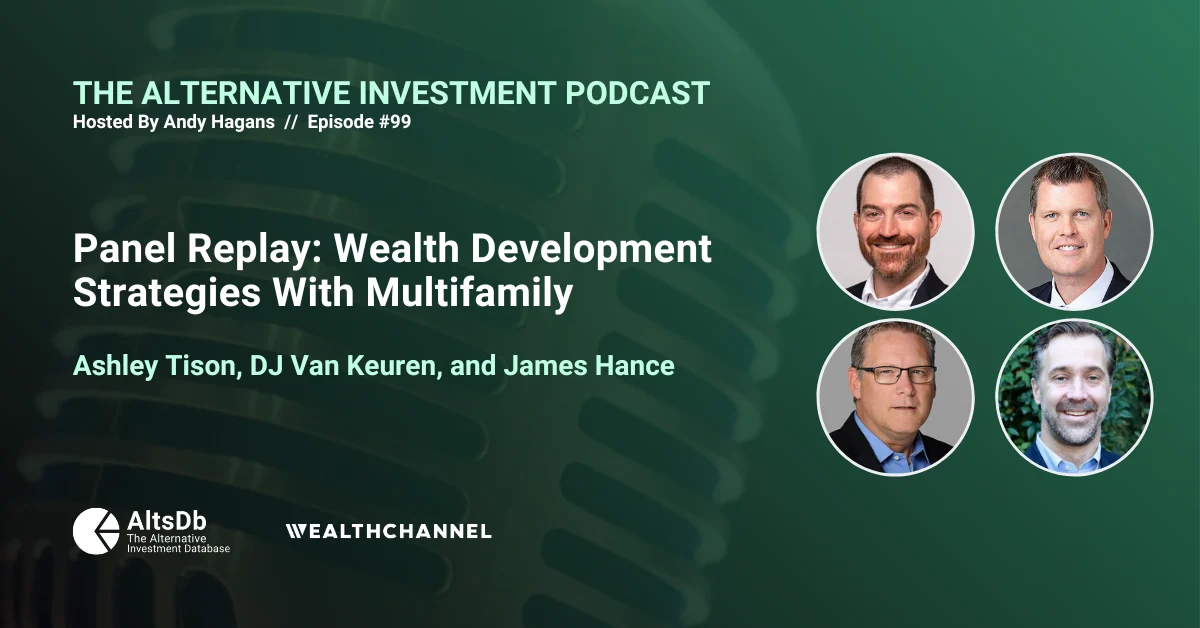
The complexities and opportunities within wealth development through multifamily real estate were thoroughly examined at the recent Multifamily Investor Expo 2023. A distinguished panel of experts, moderated by Andy Hagans of AltsDb and WealthChannel, delved into the multifaceted strategies that leverage multifamily investments for long-term wealth creation and preservation. The discussion featured insights from Ashley Tison, founder and CEO of OZPros; DJ Van Keuren, co-managing member at Evergreen Property Partners and founder of the Family Office Real Estate Institute; and James Hance, founder at Green Bison Capital.
The expo, a prominent event within the alternative investment community, provided a platform for seasoned investors, asset managers, and industry leaders to convene and share knowledge. The panel, titled "Wealth Development Strategies with Multifamily," underscored the enduring appeal of the multifamily sector as a cornerstone for building generational wealth, particularly among high-net-worth individuals and family offices.
The Enduring Appeal of Multifamily Real Estate
The fundamental question posed to the panel was why multifamily real estate continues to be a dominant force in wealth development strategies. James Hance initiated the discussion by highlighting the intrinsic value and essential nature of housing. "People always need a place to live," Hance stated, emphasizing the stability inherent in a sector driven by constant demand. He further elaborated on the financial advantages, noting the potential for consistent cash flow, the ability to drive appreciation through effective property management and value-add initiatives, and the significant tax efficiencies offered by direct real estate ownership, particularly through depreciation. This ability to offset taxable income, coupled with the potential for forced appreciation, makes multifamily an attractive asset class for both active and passive investors.
DJ Van Keuren, drawing on his extensive experience with family offices, corroborated Hance’s points. Van Keuren noted that multifamily consistently ranks as the preferred property type in their annual family office real estate investment studies. He attributed this to its inherent understandability and risk mitigation. Unlike single-family rentals, the diversification across multiple units within a multifamily property significantly reduces the impact of individual tenant vacancies. Furthermore, Van Keuren pointed to broader economic trends, such as rising home prices and student loan burdens, which have increased the demand for rental housing. This demographic shift, coupled with migration to areas with job growth and affordability, solidifies the demand for multifamily units.
Ashley Tison added another layer to the discussion, focusing on the scalability and efficiency of multifamily investments. He described how multifamily allows for the consolidation of a large number of residents in a compact area, leading to more efficient infrastructure utilization and management compared to dispersed single-family rentals. Tison also highlighted the environmental benefits, framing multifamily as a more sustainable and "green" approach to housing development, which can be a crucial factor in gaining community support and navigating regulatory landscapes. This perspective underscores a growing trend in real estate where environmental, social, and governance (ESG) factors are increasingly integrated into investment decisions.
Navigating Tax Advantages in Multifamily Investments
A significant portion of the discussion revolved around the tax advantages associated with multifamily investing, particularly for high-net-worth individuals. Ashley Tison elaborated on the benefits of Opportunity Zones (OZ), a federal program designed to encourage investment in economically distressed communities. Tison explained how OZ investments can defer, reduce, and potentially eliminate capital gains taxes. He highlighted the substantial impact of OZ benefits, noting that they can add approximately 3% to an investor’s Internal Rate of Return (IRR). This is particularly impactful in a market where cap rates have historically been low, making even marginal improvements in returns highly significant.
DJ Van Keuren emphasized the widespread underutilization of the 1031 exchange, a mechanism that allows investors to defer capital gains taxes by reinvesting the proceeds from the sale of one investment property into a like-kind property. He stated that a significant percentage of families do not leverage this powerful tool, often due to a lack of education. Van Keuren argued that the 1031 exchange is crucial for compounding gains over time, making it tax-free at deferral. He also touched upon other tax credit programs, such as Low-Income Housing Tax Credits (LIHTC) and New Markets Tax Credits (NMTC), as additional avenues for tax-advantaged investing.
James Hance echoed the sentiment regarding the 1031 exchange, reporting that a substantial portion of the capital his firm raises comes from 1031 deferrals. He noted that these exchanges can be effectively executed within syndication structures, allowing investors to transition from active property management to passive investment while deferring capital gains taxes. This offers a dual benefit of tax deferral and a more hands-off investment approach, particularly appealing to those looking to exit active management roles.
The panelists also touched upon the evolving estate tax landscape. Ashley Tison cautioned that with the potential reduction in the lifetime estate tax exemption in the coming years, the step-up in basis at death, a traditional benefit of holding real estate, might become less advantageous for larger estates. He suggested that Opportunity Zone investments, which freeze the value of the investment for estate tax purposes at the time of contribution, could offer a distinct advantage in such scenarios.

The Current Investment Climate: Navigating Higher Interest Rates
The discussion then shifted to the prevailing market conditions in 2023, characterized by higher interest rates. Andy Hagans posed the critical question: is this an opportune moment to invest, or should investors hold cash for future opportunities?
James Hance suggested that the era of cap rate compression is over and that investors must be exceptionally diligent in vetting sponsors. He emphasized the importance of investing with well-capitalized, vertically integrated operators who have a proven track record and strong broker relationships. Hance indicated that opportunities are already emerging due to distressed properties and maturing debt, creating situations where motivated sellers need to divest.
DJ Van Keuren observed that many family offices, having learned from past market cycles, are strategically deploying "dry powder" rather than waiting for the market to fully recover. He stressed the importance of fundamental analysis, including cost of living, quality of life, and demand drivers in specific markets, noting that profitable investments can be made in any market if fundamentals are strong. Van Keuren also cautioned about the potential for negative leverage and the impact of floating interest rates, urging investors to stress-test deals against various adverse scenarios, such as increased vacancy rates or higher interest expenses. He highlighted a sentiment from banking circles suggesting a more challenging debt environment this time around, without the same level of intervention seen in past crises.
Ashley Tison acknowledged the need for caution and rigorous due diligence, aligning with the "stress test" approach advocated by Van Keuren. However, he also pointed to the unique driver of Opportunity Zone investments, where a time-bound investment horizon compels investors to deploy capital. Tison noted that OZ investments often involve value-add or ground-up development, providing inherent upside potential even in a challenging market. He suggested that for those within the OZ framework, a degree of optimism is warranted due to the active deployment of capital.
Lessons from Family Offices for Independent Investors
A key segment of the conversation focused on what independent high-net-worth investors can learn from the philosophies and habits of successful family offices managing generational wealth. DJ Van Keuren highlighted patience and sound decision-making as paramount. He emphasized the long-term perspective inherent in real estate investing, noting that its illiquid nature necessitates a strategic approach. Van Keuren advised investors to find trusted partners, conduct thorough due diligence on sponsors, and quantify risks by stress-testing potential investments. He also underscored the importance of referrals and building strong relationships within the investment community, a practice common among family offices.
Ashley Tison expanded on the theme of intentionality and legacy building. He discussed the practice of developing a family constitution, outlining core values and a mission statement to guide future generations in managing wealth. This intentional approach, Tison argued, is even more critical for families than for businesses, ensuring that wealth is preserved and utilized according to established principles. He also stressed the importance of educating younger family members about wealth management and the value of professional guidance.
Andy Hagans concluded this segment by emphasizing humility and the strategic advantage of surrounding oneself with expertise. He noted that successful leaders, regardless of their initial source of wealth, recognize their limitations and leverage the knowledge of specialists in areas like real estate. This involves partnering with experienced operators who have navigated multiple market cycles, thereby mitigating risk and enhancing the probability of successful investment outcomes.
The Outlook for Ground-Up vs. Value-Add Multifamily
In a rapid-fire round, the panelists were asked to weigh in on whether ground-up development or value-add strategies held a better outlook in the current environment. James Hance favored value-add, citing his personal preference for lower risk and a more predictable return profile, acknowledging that ground-up development requires a longer time horizon and greater risk tolerance. Ashley Tison, however, leaned towards ground-up development, particularly within the context of Opportunity Zones where the "substantial improvement" threshold often necessitates new construction. DJ Van Keuren offered a more nuanced perspective, suggesting that the optimal strategy depends on the specific property type and market dynamics. He highlighted situations where ground-up development might be necessary for emerging sectors like cold storage, while value-add opportunities could arise from stalled or underperforming existing multifamily projects.
The discussion at the Multifamily Investor Expo 2023 provided a comprehensive overview of wealth development strategies utilizing multifamily real estate. The consensus among the experts was clear: multifamily remains a robust asset class, offering significant opportunities for wealth creation and preservation, especially when combined with astute tax planning and strategic investment approaches. The current economic climate, while presenting challenges, also offers unique opportunities for well-informed and patient investors.
