

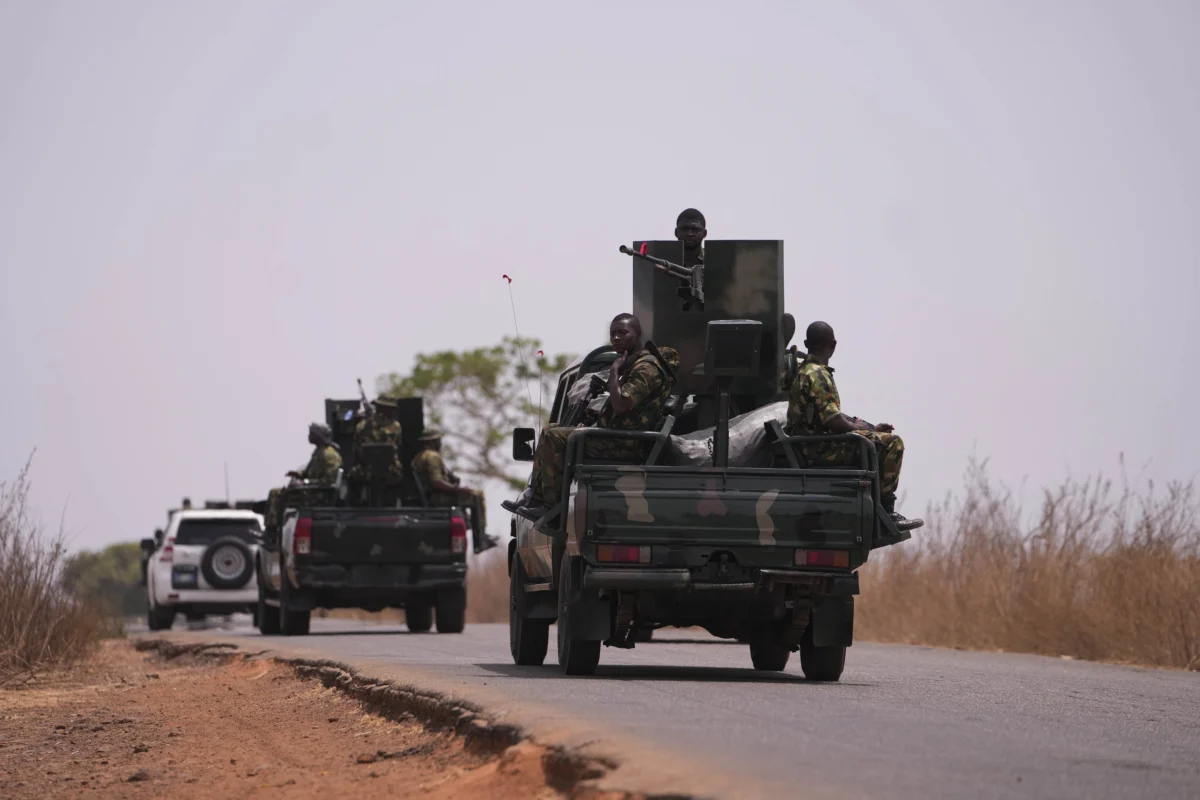
Armed assailants have unleashed a fresh wave of terror in Nigeria’s central Niger State, orchestrating a mass abduction that saw dozens of worshippers kidnapped from a mosque and residents seized from surrounding villages. The audacious attack, which unfolded on a Friday afternoon and continued into Saturday, has intensified concerns over the escalating insecurity plaguing the North Central region of the country, raising questions about the efficacy of current security strategies and the government’s capacity to protect its citizens.
Unfolding Crisis in Dekara District
The meticulously planned assault commenced on Friday afternoon, specifically targeting communities within the Dekara district of Borgu Local Government Area. Police spokesperson Wasiu Abiodun confirmed that the assailants, reportedly numbering in the hundreds, first descended upon the villages of Gidan-Zana and Kpenya. Eyewitness accounts suggest a coordinated and ruthless operation, designed to instill maximum fear and facilitate widespread abductions.
Following the initial village attacks, the armed group, identified by survivors as members of the notorious Lakurawa faction, converged on the Kpenya Mosque. The timing of the attack, around 2:00 PM (13:00 GMT), coincided with the conclusion of the customary Friday congregational prayers (Jum’at), a period when the mosque would have been filled with worshippers. Jibril Ahmad, a survivor of the traumatic ordeal in Dekara, recounted the harrowing scene, stating, "Soon after finishing the normal Friday prayer, the armed group of Lakurawa, in their hundreds, wielding guns, knives and machetes, began to attack us." Ahmad’s chilling testimony further claimed that some individuals were "slaughtered" during the attack, though police officials have yet to confirm any fatalities directly linked to the mosque raid. Local residents, speaking to Reuters, reported that more than 60 worshippers were abducted from the mosque alone, a figure that underscores the scale of the operation, even if it could not be independently verified by authorities at the time. Separately, residents also informed the AFP news agency of fatalities, another claim awaiting official corroboration.
The situation took a complex turn when a third armed group, identified as Mahmuda, reportedly intervened. According to Ahmad, the Mahmuda group engaged the kidnappers in a fierce clash, an unexpected turn of events that provided a window of opportunity for some of the abductees to escape their captors. Federal lawmaker Jafaru Mohammed elaborated on this dynamic, explaining that "Some members of the Mahmuda group were against the doctrine of the Lakurawa, and when they heard of what the Lakurawa were doing, they fought them." This internal conflict among armed factions highlights the fragmented and often shifting alliances within Nigeria’s criminal underworld, making security responses even more challenging.
The violence, however, did not cease with the initial Friday attacks. Residents reported a disturbing escalation on Saturday. Abdullahi Ahmad, a local resident, revealed that the armed group returned to the area, intent on seizing more people. This secondary wave of abductions was reportedly aimed at accumulating more captives as a "bargaining chip" in anticipation of an expected deployment of security forces to the region. In a sinister development, the assailants also planted landmines on the roads leading out of Dekara, a tactic designed to impede pursuit and inflict further casualties on fleeing civilians or responding security personnel. The tragic consequences of this tactic manifested almost immediately when a man and his family, attempting to flee the besieged town, were killed on Saturday after their vehicle struck one of these landmines. "Everyone is living in fear," Abdullahi Ahmad grimly concluded, encapsulating the pervasive terror gripping the community.
The Expanding Nexus of Insecurity: Banditry in Nigeria’s Heartland
The attack in Niger State is not an isolated incident but rather a stark illustration of a rapidly metastasizing security crisis that has engulfed Nigeria’s North Central and Northwest regions. Often termed "banditry," this form of violence is distinct from the long-running Boko Haram and Islamic State West Africa Province (ISWAP) insurgencies primarily concentrated in the country’s northeast. While the northeast conflict is ideologically driven, "banditry" is largely propelled by economic motives, particularly mass abductions for ransom, coupled with resource conflicts, cattle rustling, and vigilante justice.
The phenomenon has its roots in decades of neglect, the proliferation of small arms, porous borders, and the breakdown of traditional authority structures. What began as localized conflicts, often between nomadic pastoralists and settled farming communities over land and resources, has evolved into a sophisticated criminal enterprise. Armed groups, comprising disaffected youth, former cattle rustlers, and increasingly, elements with extremist leanings, have carved out vast ungoverned territories where they operate with alarming impunity. These groups exploit socio-economic grievances, leveraging poverty and unemployment to recruit members, while their criminal activities generate substantial illicit wealth.
Niger State, strategically located and sharing borders with several other volatile states like Kaduna, Zamfara, and Kebbi, has become a major flashpoint. Its proximity to Nigeria’s western border with Benin also introduces a cross-border dimension, allowing these armed groups to potentially retreat and regroup in neighboring territories, complicating inter-state and international security efforts. The vast, ungoverned forest reserves and difficult terrain in these regions provide ideal hideouts for these criminal gangs, making aerial surveillance and ground operations challenging for security forces.
A Lucrative and Devastating Industry: Kidnapping for Ransom
Mass abductions have emerged as the hallmark tactic of these armed groups, transforming into a multi-million-dollar industry. The financial rewards from ransoms have become a primary driver, fueling the groups’ capacity to acquire more sophisticated weaponry and expand their operations. Targets range from schoolchildren and university students to travelers on highways, farmers in their fields, and entire communities. The targeting of a mosque, a sacred place of worship, represents a particularly brazen and provocative escalation, signaling a complete disregard for religious sanctity and human life.
According to various security analyses and NGO reports, thousands of Nigerians have been kidnapped in recent years, with millions of dollars paid in ransom. For instance, data from organizations like SBM Intelligence indicate a staggering increase in abduction cases across the country, with hundreds of incidents recorded annually, affecting virtually every demographic. These payments, often facilitated through informal channels, inadvertently strengthen the criminal networks, allowing them to perpetuate the cycle of violence. The economic impact extends beyond direct ransom payments; agricultural activities are crippled as farmers abandon their lands out of fear, trade routes are disrupted, and investment shies away from insecure regions, further exacerbating poverty and driving more people into destitution, creating a fertile ground for recruitment by these very groups.
The humanitarian toll is immense. Beyond the immediate trauma of abduction, communities are displaced, livelihoods are destroyed, and the psychological scars run deep. Millions have been forced from their homes, contributing to a growing internal displacement crisis that strains limited government resources and humanitarian aid efforts. Schools are forced to close, denying children access to education and jeopardizing the future of an entire generation.
Official Responses and the Quest for Security
In the wake of the latest attacks, official responses have reiterated condemnation and pledges of action, reflecting the persistent challenge faced by both federal and state governments. Police spokesperson Wasiu Abiodun confirmed that a "joint security detachment has been deployed to the area for assessment and rescue operations." While crucial, such deployments often face significant obstacles, including intelligence gaps, difficult terrain, and the sheer scale of the affected areas.
The Niger State Governor, Abubakar Sani Bello, while yet to issue a direct statement on this specific incident, would typically condemn such acts in the strongest terms, expressing solidarity with the victims and their families. He would likely promise enhanced security measures, call for calm, and appeal to the federal government for additional support and resources to combat the growing menace within his state. Such calls are frequent from governors in the North Central and Northwest, highlighting the feeling of being overwhelmed by the scale of the problem.
At the federal level, President Bola Ahmed Tinubu’s administration has inherited a deeply entrenched security crisis. A presidential spokesperson, while not directly quoted for this event, would invariably condemn the attack, reaffirming the President’s unwavering commitment to securing the lives and property of all Nigerians. The President would likely instruct security agencies – including the military, police, and intelligence services – to track down the perpetrators, rescue the abducted, and bring the culprits to justice. Such directives are commonplace, yet the persistence of these attacks underscores the formidable challenges in translating presidential orders into effective ground-level security.
Federal lawmaker Jafaru Mohammed’s account of the Mahmuda group’s intervention offers a glimpse into the complex local dynamics and potential for community-based resistance, or even rivalry among criminal groups. Such insights are crucial for developing nuanced security strategies that go beyond brute force. However, reliance on one armed group to counter another is a precarious strategy that could further destabilize the region in the long run. Human rights organizations, both local and international, are expected to issue statements condemning the attacks, urging the government to prioritize the protection of civilians, investigate human rights abuses by all parties, and ensure accountability for perpetrators. They would likely emphasize the need for a comprehensive approach that addresses the root causes of insecurity rather than just its symptoms.
Broader Implications and the Path Forward
The persistent and escalating violence, exemplified by the Niger State abductions, carries profound implications for Nigeria’s stability and development. Firstly, it severely erodes public trust in governmental institutions. When citizens feel unprotected in their homes and places of worship, the social contract between the governed and the government weakens, fostering disillusionment and despair.
Secondly, the economic consequences are dire. Beyond the immediate ransoms, the insecurity paralyzes local economies. Farmers cannot access their fields, leading to food scarcity and inflation. Markets are deserted, and transport links become perilous, stifling trade and exacerbating poverty. This creates a vicious cycle where economic hardship fuels crime, and crime deepens economic hardship.
Thirdly, the humanitarian crisis continues to deepen. Mass displacements create internal refugees who require shelter, food, and medical care, placing immense strain on already stretched resources. The psychological trauma inflicted on survivors and communities is immeasurable, contributing to long-term societal challenges.
Fourthly, the targeting of religious sites, such as the Kpenya Mosque, carries the potential to ignite sectarian tensions, even if the primary motivation is criminal. While the current "banditry" is largely non-ideological, such acts can be exploited by extremist groups to sow discord and radicalize vulnerable populations, further complicating the security landscape.
Finally, the regional implications are significant. The porous borders mean that insecurity in one Nigerian state can spill over into neighboring countries, creating a broader regional crisis. This necessitates stronger cross-border intelligence sharing and collaborative security operations with countries like Benin, Niger, and Cameroon.
Addressing this multifaceted crisis requires a comprehensive and multi-pronged approach. Military operations and law enforcement efforts are crucial for containing the immediate threat, but they must be complemented by robust intelligence gathering to dismantle criminal networks. Equally important are initiatives to address the root causes: poverty alleviation programs, job creation, educational opportunities, and land dispute resolution mechanisms. Strengthening governance, reforming the justice system, and promoting community engagement are also vital components of a sustainable solution. Without a holistic strategy that combines kinetic action with socio-economic development and good governance, Nigeria risks being trapped in a protracted cycle of violence, with devastating consequences for its people and its future. The attacks in Niger State serve as a poignant and urgent reminder of the immense challenges that lie ahead for the Nigerian government in its quest to secure the nation.
