

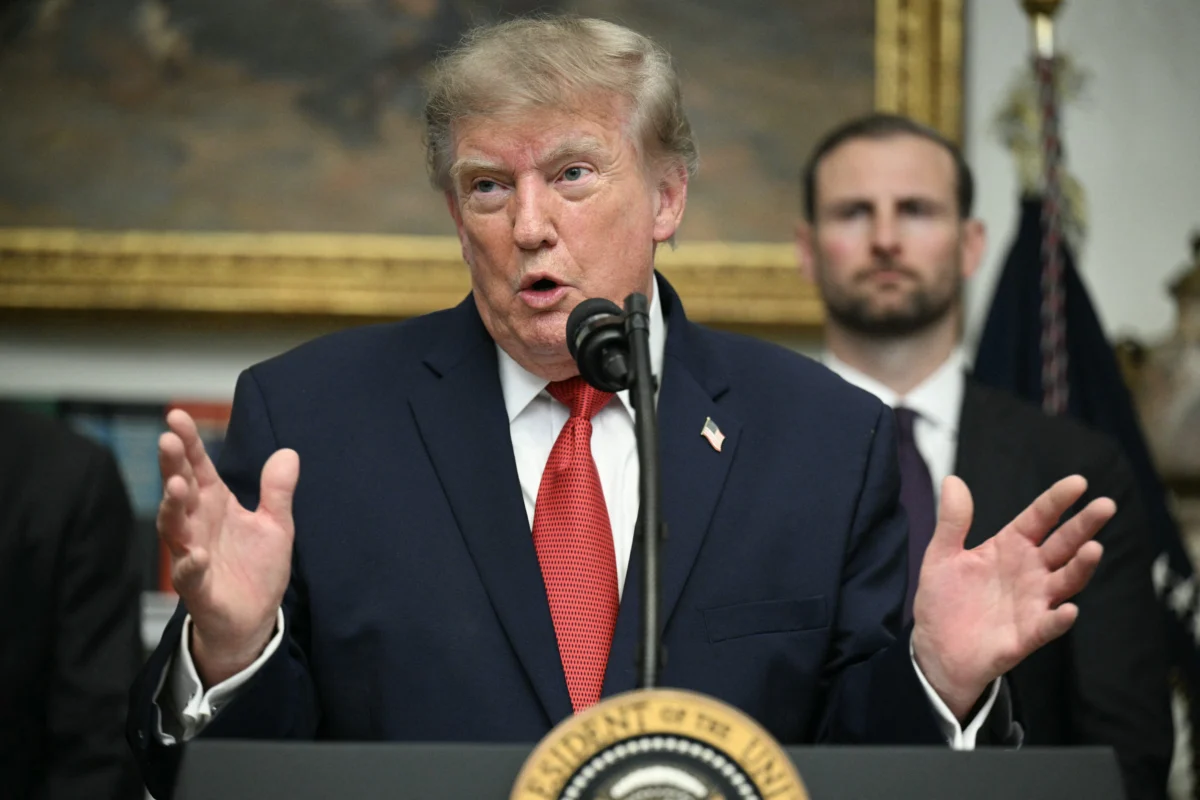
President Donald Trump on Wednesday voiced significant dissatisfaction with the Federal Reserve’s continued reluctance to lower interest rates, contending that robust economic indicators should compel the central bank to embrace a more accommodative monetary policy. This latest critique, echoing previous pronouncements, saw the President directly challenge the Fed’s decision-making process, alleging political motivations among its leadership, with a notable exception made for Federal Reserve Chairman Kevin Warsh, whom President Trump had appointed to the helm earlier in the year.
Warsh, who assumed the chairmanship in May, has earned the President’s praise for his performance. This contrasts sharply with President Trump’s persistent criticisms of his predecessor, Jerome Powell, whom he frequently admonished for not implementing rate cuts with sufficient alacrity. Powell, though no longer at the Fed’s helm, remains a member of the Board of Governors.
"The problem is he has a board, and it’s a political board," President Trump remarked to reporters at the White House. "People put in by Obama, Biden, and me, and there are quite a few members still left, as you understand, and so they vote to raise interest rates. I don’t know if they’re doing it because they think they’re doing a good thing or because they like the politics of it."
However, official records indicate that the Federal Open Market Committee (FOMC) has not voted to increase its benchmark interest rate in over three years. In fact, the latter half of 2025 saw three rate reductions by the FOMC, building upon three similar cuts implemented in the preceding year. Despite this series of reductions, President Trump views the pace as insufficient to adequately stimulate economic growth and alleviate the substantial financing burden associated with the nation’s escalating national debt, which has now surpassed $40 trillion.
"My point is, years ago, 25 years ago, when the country announced good numbers, interest rates went down because we had a stronger country," President Trump asserted, drawing a historical parallel. "Now, when we announce good numbers, the better they are, the worse it is for interest rates." This sentiment suggests a perceived inversion of the traditional economic response, where positive economic data historically led to lower borrowing costs, thereby encouraging further investment and expansion.
The President’s remarks coincided with the release of the FOMC’s minutes from its July meeting, which revealed a prevailing sentiment among many officials that further interest rate hikes might be necessary if inflation did not show a more pronounced cooling. While subsequent inflation data has generally been positive, the annual inflation rate continues to remain significantly above the Fed’s stated 2% target. This indicates a persistent challenge for policymakers in achieving price stability without unduly stifling economic activity.
The broader economic landscape presented a mixed picture. The U.S. economy experienced a slowdown in its growth rate, registering a 1.5% annualized expansion in the second quarter. This figure fell short of expectations and represented a deceleration from the 2.1% growth rate recorded in the first quarter of the year. Such data points underscore the delicate balancing act faced by the Federal Reserve: the need to manage inflation while simultaneously supporting sustainable economic expansion.
President Trump also drew attention to the United States’ relative position in terms of interest rates compared to some of its international counterparts. He specifically highlighted Switzerland, where benchmark interest rates have hovered around zero. Switzerland has been grappling with the opposite economic challenge faced by the U.S. – exceptionally low inflation and an unusually strong safe-haven currency, which can hinder export competitiveness.
"I see countries like Switzerland where they’re the number one lowest interest rates, a half a percent, and we pay three and a half percent," President Trump stated, lamenting the perceived disadvantage. He further declared, "I have the absolute right to cut off all business with a country like Switzerland," signaling a willingness to employ trade measures if economic disparities are perceived to be detrimental to U.S. interests. This assertion underscores the intertwining of monetary policy, international trade, and national economic strategy in the President’s view.
Despite his concerns about the level of interest rates, President Trump expressed confidence that the U.S. does not face an imminent crisis in its bond market. This statement comes at a time when the Treasury Department has announced an enhancement of its bond buyback program. This initiative, designed to address a recent surge in longer-maturity debt, will specifically target debt with durations of at least 10 years. The aim of such buybacks is typically to reduce the supply of certain maturities in the market, which can, in turn, influence yields and potentially lower borrowing costs for the government. The Treasury’s move signals an active management of the national debt and its associated financing costs.
Background and Chronology of Interest Rate Policy
The Federal Reserve’s interest rate policy has been a focal point of economic discussion and political debate for several years. The period leading up to President Trump’s current tenure saw a gradual normalization of interest rates following the 2008 financial crisis and the subsequent Great Recession. The Fed’s primary tool for influencing economic activity is the federal funds rate, which is the target rate that commercial banks charge each other for overnight lending.
- Post-2008 Financial Crisis Era: The federal funds rate was lowered to near zero and maintained there for an extended period to stimulate economic recovery.
- Gradual Rate Hikes (2015-2018): As the economy showed signs of sustained growth and unemployment fell, the Fed began a series of modest interest rate increases.
- Rate Cuts in 2019: Facing concerns about slowing global growth and trade tensions, the Fed reversed course and implemented three rate cuts in the latter half of 2019.
- COVID-19 Pandemic Response (2020): In response to the severe economic shock of the COVID-19 pandemic, the Fed rapidly cut interest rates back to near zero and initiated large-scale asset purchases (quantitative easing) to inject liquidity into the financial system and support economic activity.
- Recent Policy Stance (2024-2026): Following a period of low inflation, the Fed’s stance shifted in recent years. As inflation began to rise, the FOMC enacted a series of rate hikes in 2024 and 2025 to combat inflationary pressures. The current discussions and the minutes released from the July meeting reflect the ongoing debate about whether to maintain current rates, consider further hikes, or begin to lower them.
President Trump’s presidency, which began in January 2017, has been marked by his consistent advocacy for lower interest rates. He has often argued that higher rates stifle business investment, increase the cost of servicing the national debt, and hinder overall economic competitiveness. His appointments to the Federal Reserve Board, including Chairman Warsh, were seen by many as an indication of his desire for a more dovish monetary policy.
Supporting Data and Economic Indicators
The Federal Reserve bases its monetary policy decisions on a range of economic data, including:
- Inflation: The Consumer Price Index (CPI) and Personal Consumption Expenditures (PCE) price index are key measures. The Fed’s target is 2% inflation. Recent data shows inflation remaining above this target, albeit with some signs of moderation. For instance, the annual inflation rate, as measured by the CPI, has been reported in the range of 3.3% to 3.5% in recent months, well above the Fed’s objective.
- Employment: Key indicators include the unemployment rate, job creation (nonfarm payrolls), and wage growth. The U.S. unemployment rate has remained historically low, often below 4%, indicating a tight labor market. However, wage growth, while present, has not always kept pace with inflation, impacting real disposable income for some households.
- Economic Growth (GDP): Gross Domestic Product (GDP) growth reflects the overall health of the economy. As noted, the second quarter GDP growth of 1.5% represented a slowdown.
- Consumer Spending and Confidence: These indicators gauge household demand, a significant driver of economic activity.
- Business Investment: Data on capital expenditures and manufacturing activity provide insights into the willingness of businesses to invest and expand.
The interplay of these indicators creates a complex decision-making environment for the Federal Reserve. While a low unemployment rate might suggest an overheating economy that warrants higher rates, subdued GDP growth and persistent inflation above target present a conflicting scenario.
Analysis of Implications
President Trump’s persistent pressure on the Federal Reserve highlights a fundamental tension between political objectives and the independent mandate of the central bank.
- Impact on Monetary Policy: While the Fed is designed to be independent of political influence, sustained public commentary from the President can create an environment of uncertainty and potentially influence market expectations. However, the Fed’s mandate is to maintain price stability and maximum employment, which may not always align with short-term political goals.
- National Debt Concerns: The President’s argument that lower rates are essential to manage the national debt is valid from a fiscal perspective. Higher interest rates increase the government’s borrowing costs, diverting funds that could otherwise be used for public services or investments. The Congressional Budget Office (CBO) has consistently projected significant increases in net interest payments on the national debt in the coming years, a trend exacerbated by higher interest rates.
- International Competitiveness: The comparison with countries like Switzerland underscores the impact of interest rate differentials on currency values and trade. Higher U.S. rates can attract foreign capital, strengthening the dollar. While this can make imports cheaper, it can also make U.S. exports more expensive, potentially hurting domestic industries.
- Market Reaction: The Treasury Department’s decision to step up its bond buyback program, occurring on the same day as the President’s remarks, could be interpreted in several ways. It might be a pre-scheduled policy action, an attempt to proactively manage debt yields in anticipation of market reactions to economic data or Fed policy, or a coordinated effort to influence borrowing costs. Such actions can impact bond yields, mortgage rates, and other borrowing costs throughout the economy.
The ongoing dialogue between the President and the Federal Reserve underscores the critical role of monetary policy in shaping economic outcomes and the inherent challenges in balancing diverse economic objectives with political considerations. The Fed’s decision-making process, rooted in data analysis and a long-term economic outlook, will continue to be closely scrutinized by policymakers, markets, and the public alike.
