

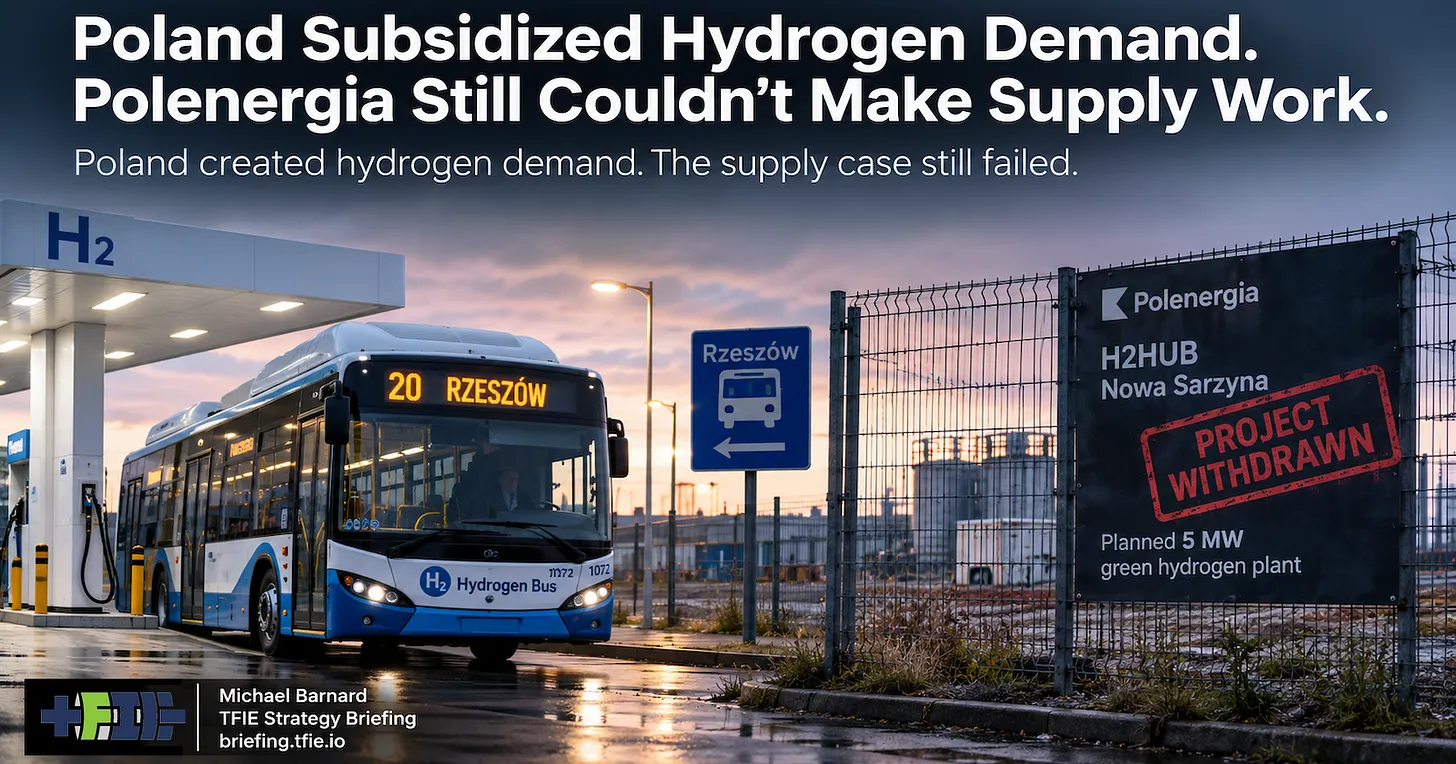
The Republic of Poland has achieved what many hydrogen-economy advocates have long considered the "holy grail" of green energy policy: the creation of tangible, large-scale demand for hydrogen in the public transport sector. Through a combination of aggressive public subsidies and municipal initiatives, the nation successfully incentivized the adoption of hydrogen-powered buses across several major cities. However, the momentum of this transition hit a significant roadblock in early 2025 when Polenergia, the country’s largest private energy group, announced its withdrawal from a flagship green hydrogen supply project. This move has exposed a growing rift between the government’s demand-side successes and the economic realities of the supply-side infrastructure required to sustain them.
The Polish Hydrogen Strategy: Success in Demand Creation
For several years, the Polish government has pursued a dual-track industrial policy designed to decarbonize its heavily coal-reliant transport sector. By utilizing funds from the National Fund for Environmental Protection and Water Management (NFOŚiGW), Poland offered substantial subsidies to municipal transit authorities to replace aging diesel fleets with hydrogen fuel-cell electric vehicles (FCEVs).
The results of this policy were rapid and visible. By April 2026, the nation had recorded 153 hydrogen buses registered, with 140 already in active service and another 107 under contract. These figures moved Poland from a phase of small-scale pilot demonstrations into a legitimate, functioning market. The logic was simple: subsidized buses would create a guaranteed market for hydrogen fuel; this demand would attract private investment into refueling stations; and the resulting infrastructure would justify the construction of domestic green hydrogen production facilities.
This "demand-first" approach was intended to mitigate the "chicken-and-egg" problem that has historically plagued the hydrogen industry. By ensuring that customers were already waiting at the pump, the Polish government aimed to de-risk the massive capital expenditures required for electrolyzers and distribution networks.
The Rise and Fall of the Nowa Sarzyna Project
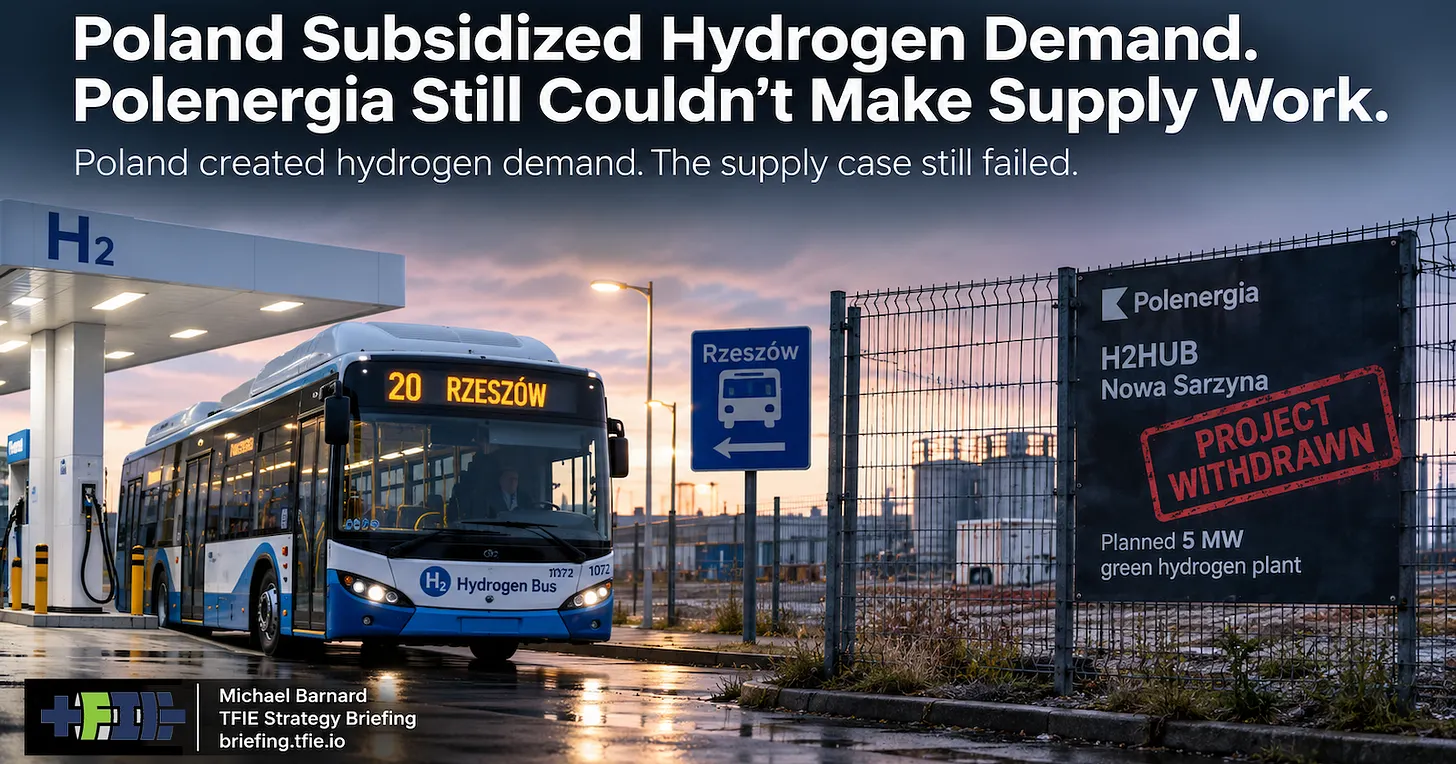
Polenergia’s Nowa Sarzyna project was designed to be the cornerstone of this new ecosystem. Unlike many hydrogen projects that exist only as non-binding memoranda of understanding (MoUs), Nowa Sarzyna had progressed deep into the development phase. The project centered on a 5-megawatt (MW) renewable hydrogen plant capable of producing approximately 500 tonnes of green hydrogen annually.
The project’s development timeline showed significant maturity:
- Technology Procurement: Polenergia had contracted Hystar to supply high-efficiency electrolyzer stacks.
- Technical Milestones: By October 2024, all eight electrolyzer stacks had successfully completed factory acceptance testing.
- Permitting: The project had secured a full building permit, a hurdle that often stalls energy projects for years.
- Financial Backing: The International Finance Corporation (IFC) provided support for development spending and equipment purchases, while Polish public funds were earmarked for the associated refueling infrastructure.
- Customer Acquisition: In October 2024, Polenergia won a 15-year fuel-supply tender for the city of Rzeszów, which was procuring 20 fuel-cell buses. The contract was valued at approximately 120 million PLN (roughly 30 million USD).
Despite having all the components of a successful venture—permits, technology, financing, and a long-term municipal customer—Polenergia shocked the market in January 2025 by announcing it would not conclude the Rzeszów agreement.
Strategic Reassessment and the Retreat from Transport
The official reasons cited by Polenergia for the withdrawal included legal complexities surrounding the municipal tender and a high risk of being unable to meet the strict delivery schedules required by the transit authority. However, analysts point to a broader strategic pivot within the company.
Following the withdrawal, Polenergia released an updated corporate strategy that signaled a "gradual withdrawal" from the hydrogen transportation sector. The company’s disclosures highlighted several systemic risks that made the Nowa Sarzyna project less attractive than originally envisioned:
- Market Maturity: The green hydrogen market in Central Europe has developed slower than anticipated, leading to higher-than-expected costs for raw materials and energy.
- Investment Risk: The gap between the cost of producing green hydrogen (via electrolysis powered by renewables) and the price municipalities are willing to pay remains wide, even with subsidies.
- Financing Hurdles: While initial development was funded, securing long-term project financing for hydrogen infrastructure remains difficult due to the lack of a liquid, transparent market for the molecule.
The Rzeszów Dilemma: Stranded Assets in the Public Sector
The withdrawal of Polenergia leaves the city of Rzeszów and other municipalities in a precarious position. When a city purchases fuel-cell buses, it commits to a specific technology for the duration of the vehicle’s 12-to-15-year lifespan. Unlike diesel or even battery-electric buses, which can often utilize standardized charging or fueling infrastructure, hydrogen buses require a highly specialized and consistent supply chain.
By subsidizing the purchase price of the vehicle, the government made the initial acquisition affordable for Rzeszów. However, the subsidy did not guarantee the long-term availability of economical fuel. Without the local production promised by the Nowa Sarzyna plant, the city must now look for alternative suppliers. This often involves transporting hydrogen via truck from distant industrial sites, significantly increasing the carbon footprint of the "green" bus and driving up operational costs beyond what municipal budgets can sustain.
This situation highlights a critical flaw in current hydrogen policy: a vehicle subsidy is a one-time capital injection, but the fuel system must be competitive and resilient for over a decade. If local production fails to materialize, the buses become "stranded assets"—expensive pieces of technology that are either too costly to run or are powered by "grey" hydrogen derived from fossil fuels, defeating the original purpose of the decarbonization effort.
The Competitive Pressure of Battery Electric Alternatives
A significant factor in the cooling interest in hydrogen for public transport is the rapid advancement of Battery Electric Vehicles (BEVs). In the time it took for the Nowa Sarzyna project to move from conception to its 2025 cancellation, battery technology improved in density and decreased in cost.

The efficiency argument is particularly challenging for hydrogen. In a direct-electric system (BEV), approximately 70-80% of the energy generated at a wind farm reaches the wheels of the bus. In a green hydrogen system, energy is lost during electrolysis, compression, transport, and finally during the reconversion to electricity within the bus’s fuel cell. This results in a "well-to-wheel" efficiency of often less than 30%.
For many Polish cities, the mature direct-electric alternative now appears more fiscally responsible. While hydrogen offers faster refueling times and longer ranges—benefits that are crucial for heavy-duty trucking—the stop-and-start nature of urban transit routes often makes battery-electric buses a more logical choice.
Industrial Decarbonization: The Real Role for Polish Hydrogen
The Polenergia retreat does not imply that hydrogen has no future in Poland; rather, it suggests that the focus may be shifting toward industrial applications. Poland is already one of the largest producers and consumers of hydrogen in Europe, but the vast majority of this is "grey hydrogen" produced from natural gas for use in oil refining, chemical production, and fertilizer manufacturing.
These are "hard-to-abate" sectors where electricity cannot easily replace hydrogen as a feedstock or reducing agent. Analysts argue that the Polish government’s efforts might be better spent decarbonizing these existing industrial clusters rather than trying to force hydrogen into the municipal bus market. In refining and chemicals, the demand is already concentrated and massive, which allows for larger-scale (and thus more economical) electrolysis projects.
Chronology of the Polish Hydrogen Shift
- 2021: Poland adopts its National Hydrogen Strategy to 2030, with a focus on transport and power generation.
- 2022-2023: Large-scale subsidies are rolled out for municipal hydrogen bus fleets. Rzeszów and other cities begin procurement.
- Early 2024: Polenergia’s Nowa Sarzyna project receives building permits and secures IFC backing.
- October 2024: Hystar completes electrolyzer testing. Polenergia wins the Rzeszów fuel supply tender.
- January 2025: Polenergia officially withdraws from the Rzeszów contract, citing legal and schedule risks.
- Mid-2025: Polenergia announces a strategic pivot away from hydrogen transport, citing market volatility and financing challenges.
Implications for Future Policy
The Polish experience serves as a cautionary tale for other nations looking to build a hydrogen economy. It demonstrates that while government intervention can successfully stimulate demand, it cannot easily manufacture a self-sustaining supply chain if the underlying economics are not yet viable.
For the hydrogen industry to move forward in Poland, several hurdles must be cleared:
- Grid Integration: The cost of green hydrogen is tethered to the cost of renewable energy. Poland’s slow expansion of offshore wind and solar capacity keeps electricity prices high for electrolyzer operators.
- Standardization: The legal and technical hurdles cited by Polenergia suggest a need for more standardized tender processes and regulatory frameworks for hydrogen supply.
- Focused Investment: Policymakers may need to pivot away from light and medium transport (buses) toward heavy industry and long-haul shipping, where hydrogen’s energy density provides a clearer competitive advantage over batteries.
As the 153 hydrogen buses currently on Polish roads continue their routes, the question of where their fuel will come from—and at what cost—remains the most pressing challenge for the nation’s green transition. The Polenergia withdrawal is not the end of hydrogen in Poland, but it is a definitive signal that the "hydrogen-for-everything" era is being replaced by a more sober, industrially-focused reality.
