

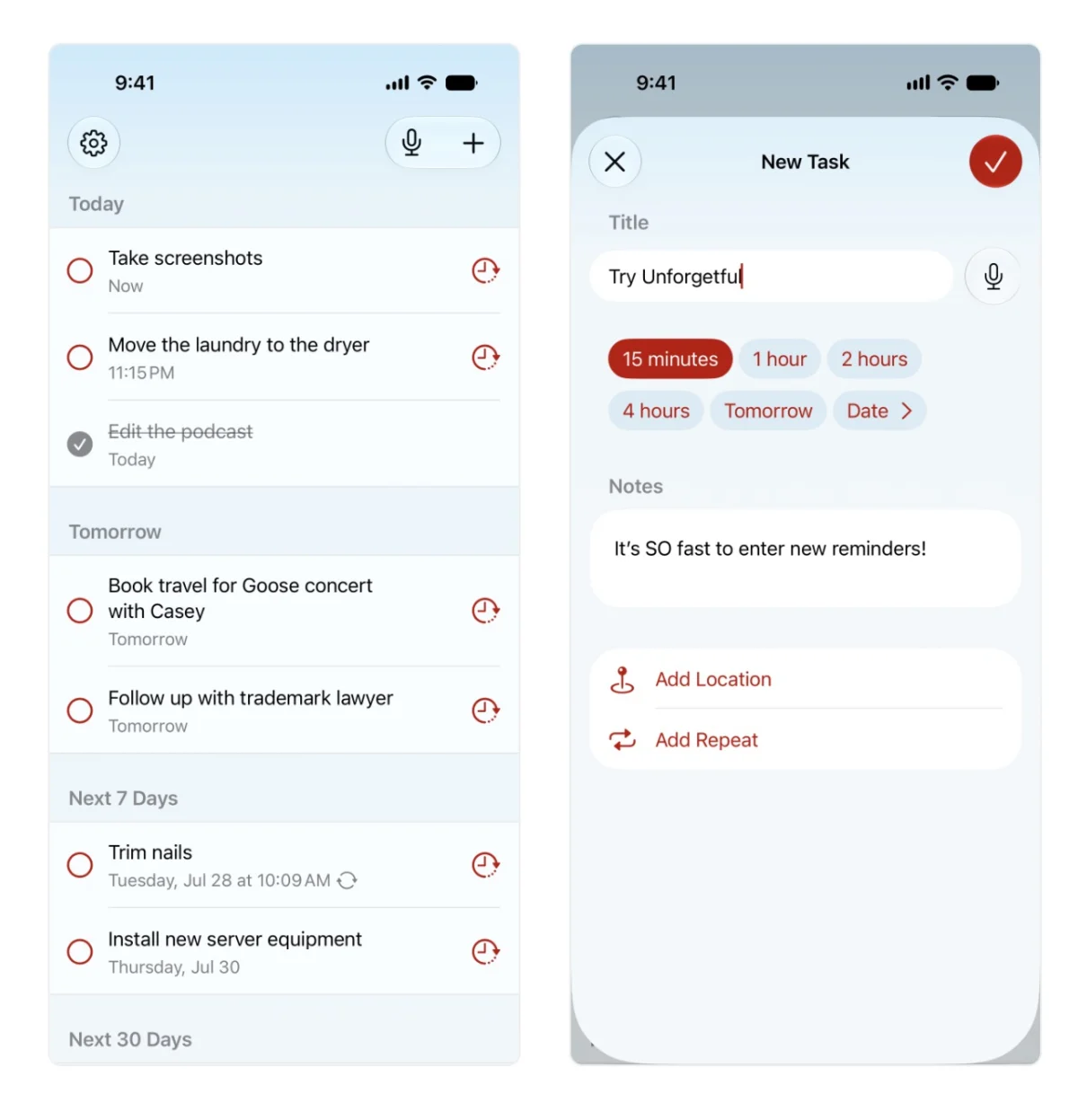
Marco Arment, the renowned indie developer behind seminal applications such as Overcast and Instapaper, and the former chief technology officer of Tumblr, has officially released his latest software project: Unforgetful. Designed as a specialized alternative to Apple’s native Reminders application, Unforgetful is specifically engineered to address the behavioral hurdles faced by chronic procrastinators and individuals who find traditional task management systems easy to ignore. The application, which launched on Friday, August 14, 2026, is available for both iOS and macOS, offering a seamless bridge between Apple’s existing cloud infrastructure and a more aggressive, persistence-oriented user interface.
The core premise of Unforgetful is not to replace the data backend of Apple Reminders, but rather to replace the interaction model. By utilizing the existing Reminders database, Unforgetful allows users to maintain their current workflows—including the use of Siri for hands-free task creation—while providing a radically different notification and organization philosophy. Arment’s entry into the productivity space marks a significant moment for the indie development community, as it highlights a growing trend of "boutique" utilities designed to fix specific psychological friction points within the broader Apple ecosystem.
The Philosophical Shift: Moving Beyond Traditional Task Management
The genesis of Unforgetful stems from Arment’s personal dissatisfaction with the native Apple Reminders experience. Despite Apple’s consistent updates to the app over the last decade, many users find that the system’s design allows for too much "drift"—a phenomenon where tasks are easily dismissed or forgotten once a notification is swiped away. Arment noted in his launch announcement that while Siri remains an efficient tool for capturing tasks on the fly, the management of those tasks within the Reminders app often feels cumbersome or aesthetically unappealing.
“The Reminders app doesn’t fit me at all,” Arment explained. “I don’t like how it looks, how it works, or how it’s organized. I don’t even like its icon. There’s nothing about it I like. So I never open it.” This sentiment reflects a broader critique of "all-in-one" productivity tools that prioritize feature density over psychological effectiveness. For many users, the primary failure of a reminders app is not a lack of features like tagging or sub-tasks, but rather the ease with which a user can "opt out" of a task through accidental dismissal or ineffective snoozing.
Arment identified several specific failure points in the native system that Unforgetful seeks to rectify. Most notably, the "snooze" feature in standard apps often leads to a cycle of repetitive delay without eventual completion. Furthermore, if a user accidentally dismisses a notification instead of snoozing it, the task essentially disappears from the user’s immediate consciousness, often resulting in missed deadlines or forgotten obligations. Unforgetful is designed to make such "losing" of tasks nearly impossible.
Technical Specifications and Feature Set
Unforgetful distinguishes itself through a "persistence-first" architecture. Unlike standard applications that offer a single alert, Unforgetful’s notifications are designed to repeat indefinitely. Even if a user misses an alert or attempts to dismiss it without completing the task, the app will continue to provide nudges until the item is marked as done or deleted. This creates a level of digital accountability that mimics the persistence of a human assistant or an unavoidable physical reminder.

The application also introduces a revamped snooze mechanism. Rather than offering static intervals (e.g., "Remind me in one hour"), Unforgetful employs scaling snooze intervals. As a user continues to snooze a task, the timing adjusts to ensure the task remains visible without becoming overwhelming "noise." This is a critical distinction for users who suffer from "notification fatigue," where a constant barrage of alerts leads to the user ignoring the device entirely.
Key features included in the launch version of Unforgetful include:
- Reminders Database Integration: Full synchronization with Apple’s native Reminders, ensuring that tasks added via Siri, Apple Watch, or other devices automatically appear in Unforgetful.
- Persistent Alerts: Notifications that do not stop until the task is resolved, preventing the "accidental dismissal" trap.
- Simplified Interface: A streamlined UI that eschews complex organizational tools like tags or folders in favor of a clear, actionable list.
- Voice Integration: A dedicated in-app microphone for rapid voice-to-task capture.
- System-Wide Widgets: A comprehensive suite of widgets for the iOS Lock Screen, Home Screen, and Control Center, keeping tasks visible at all times.
- Cross-Platform Availability: Native builds for both iOS and macOS, providing a consistent experience across the Apple hardware suite.
The Economics of Indie Productivity Software
Unforgetful is positioned as a premium utility, carrying a subscription price of $19.99 per year. This pricing strategy reflects the modern reality of indie software development, where sustainable revenue is required to maintain cloud synchronization and provide long-term updates. While some users may balk at a subscription for a task manager, Arment’s track record with Overcast suggests a loyal user base willing to pay for refined, opinionated software that solves a specific problem better than a free, generalized alternative.
The decision to build atop Apple’s Reminders database is also a strategic one. It lowers the barrier to entry for new users, as they do not need to migrate data or set up new accounts. Furthermore, it serves as a "fail-safe" for the user; if they decide to stop using Unforgetful, their data remains safely stored within Apple’s ecosystem. This "bring-your-own-backend" approach is becoming increasingly popular among developers who want to focus on UI/UX innovation rather than server maintenance.
Market Analysis and the "Procrastination Economy"
The launch of Unforgetful arrives at a time when the "productivity app" market is deeply saturated. From heavyweights like Todoist and Things 3 to enterprise solutions like Notion and Asana, users have no shortage of ways to track their work. However, there is a growing niche for "anti-procrastination" tools—apps that focus less on organization and more on execution.
Research into executive dysfunction and procrastination suggests that for many, the hurdle is not a lack of organization, but a failure of the "trigger" mechanism. Standard notifications are often too easy to ignore for those with ADHD or general task-avoidance tendencies. By making notifications persistent and removing the complexity of "organizing" (which itself can be a form of productive procrastination), Unforgetful targets a specific psychological profile rather than a general demographic.
Industry analysts suggest that Arment’s move could signal a shift in how third-party developers interact with Apple’s core apps. Instead of trying to build "the next Reminders," developers are building "the better interface for Reminders." This symbiotic relationship allows Apple to provide the heavy lifting of data storage and sync, while indie developers provide the specialized logic and aesthetic variety that a mass-market company like Apple cannot easily justify for a default system app.

Timeline and Development Background
Marco Arment’s career has been defined by a sequence of apps that "fix" a medium. Instapaper changed how the web was read by stripping away the clutter of 2008-era websites. Overcast revolutionized podcast listening by introducing features like Smart Speed and Voice Boost, which handled the audio deficiencies of early digital broadcasting. Unforgetful follows this lineage by attempting to "fix" the notification-response loop of mobile computing.
The development of Unforgetful has been a topic of speculation among the Apple developer community for several months, as Arment frequently discusses his development process on his popular podcast, Accidental Tech Podcast. The Friday launch marks the culmination of a development cycle focused on refining the "nagging" logic of the app—ensuring it is persistent enough to work, but not so annoying that users delete the app in frustration.
Broader Implications for the iOS Ecosystem
As Apple continues to expand the capabilities of its native apps, the space for third-party developers often shrinks. However, Unforgetful demonstrates that there is still significant room for innovation in "behavioral software." By focusing on the how of task management rather than the what, Arment has created a tool that operates in a different category than the system default.
The success of Unforgetful will likely be measured not by its total download count, but by its retention among power users who have previously struggled with digital organization. If the app can successfully move users from "snoozing" to "doing," it will validate the "opinionated software" model that Arment has championed throughout his career.
For the broader tech industry, Unforgetful serves as a case study in "minimalist utility." In an era where apps are increasingly bloated with AI features and social integrations, a $20-a-year app that does one thing—reminding you until you finish a task—is a bold bet on the value of focus and functional simplicity. As of today, the app is available for download on the App Store, requiring a subscription to access its full suite of persistence features.
