

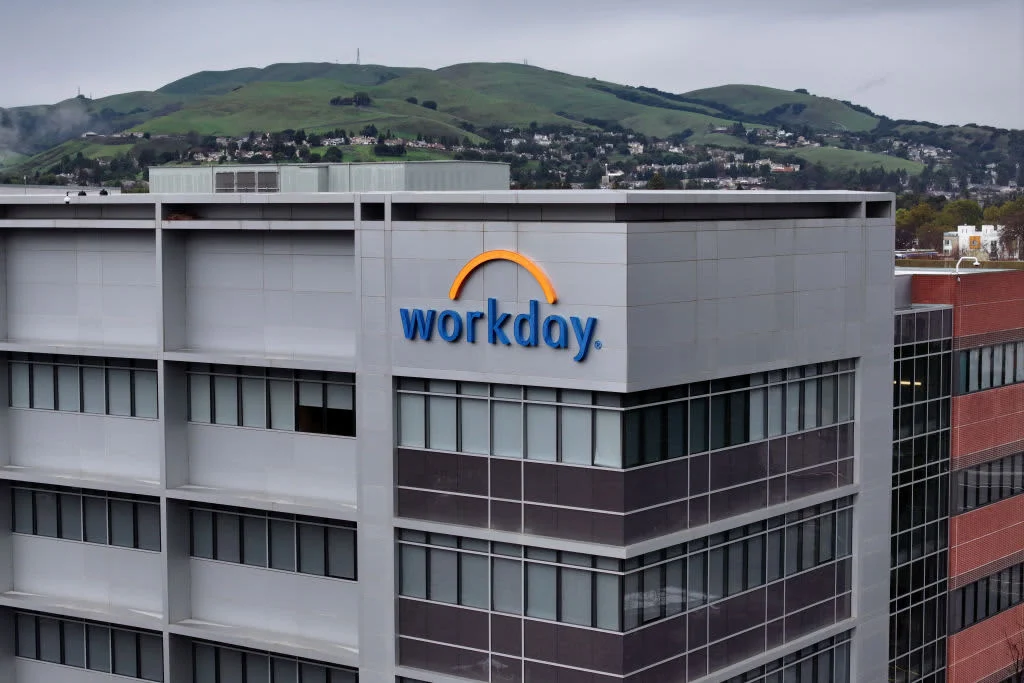
Workday Inc., a prominent leader in enterprise cloud applications for finance and human resources, experienced a dramatic surge in its stock price during Tuesday’s trading session following reports that the private equity giant Silver Lake is in advanced discussions to acquire the company. The news, which broke during the late afternoon, sent shares of the Pleasanton, California-based software firm climbing by more than 25 percent, momentarily triggering a volatility halt as investors scrambled to digest the implications of a potential take-private deal. At its peak following the report, Workday’s market capitalization surged past the $53 billion mark, reflecting a massive shift in investor sentiment for a stock that has faced significant headwinds throughout the current fiscal year.
The reported interest from Silver Lake comes at a pivotal moment for the broader software-as-a-service (SaaS) sector. While both Workday and Silver Lake have declined to provide official comments regarding the negotiations, the market reaction underscores a growing appetite for high-quality technology assets that have seen their valuations compressed by macroeconomic concerns and the perceived disruptive threat of generative artificial intelligence. If a deal were to materialize at these levels, it would represent one of the largest private equity buyouts in the history of the software industry, rivaling major historical transactions such as the acquisition of EMC by Dell or the more recent take-private of Qualtrics.
Market Dynamics and the Trading Halt
The intraday movement of Workday’s stock (NASDAQ: WDAY) was nothing short of extraordinary. Prior to the report, the stock had been trading relatively flat, consistent with a broader cautiousness in the tech-heavy Nasdaq Composite. However, as rumors of the Silver Lake talks began to circulate through financial news channels, the volume of buy orders spiked instantaneously. The rapid ascent from its daily low to a gain exceeding 25 percent necessitated a temporary suspension of trading by exchange officials to ensure an orderly market.
Upon the resumption of trading, the stock maintained much of its gains, holding steady as institutional investors and arbitrageurs weighed the probability of a finalized agreement. Analysts noted that the $53 billion valuation represents a significant premium over the company’s recent enterprise value-to-revenue multiples, which had retracted from their post-pandemic highs. The move also provided a sympathetic lift to other players in the human capital management (HCM) and enterprise resource planning (ERP) space, including competitors like Oracle, SAP, and Dayforce, as speculators began to eye the possibility of a broader consolidation wave within the sector.
Historical Context: Workday’s Evolution and Market Position
Founded in 2005 by Aneel Bhusri and Dave Duffield—both veterans of PeopleSoft—Workday was built on the premise of disrupting the legacy on-premise software model. By offering a cloud-native platform for human resources and financial management, the company successfully carved out a dominant position among Fortune 500 companies. For nearly two decades, Workday has been a bellwether for the "cloud revolution," demonstrating consistent double-digit growth as enterprises migrated their core operational data to the cloud.
Despite its historical success, the last eighteen months have proven challenging for the company. As the initial wave of cloud migration matured, Workday found itself navigating a saturated enterprise market. While its "sticky" subscription-based revenue model provided a safety net, the pace of new customer acquisitions began to moderate. Furthermore, the company has had to navigate a leadership transition, with Carl Eschenbach taking the helm as CEO to guide the firm through its next phase of growth. The potential acquisition by Silver Lake suggests that the private equity firm sees an opportunity to streamline Workday’s operations and accelerate its product roadmap away from the quarterly scrutiny of public markets.
The Silver Lake Strategy: A Proven Track Record in Tech
Silver Lake is widely regarded as one of the world’s premier technology investors, known for its ability to execute complex, large-scale buyouts of established tech firms. The firm’s portfolio history includes landmark deals such as the $24 billion take-private of Dell Inc. in 2013 and significant investments in companies like Twitter (now X), Airbnb, and Broadcom.
Silver Lake’s interest in Workday likely stems from the company’s robust cash flow and its foundational role in the enterprise tech stack. In a private setting, Silver Lake could potentially oversee a more aggressive pivot toward artificial intelligence integration without the immediate pressure of maintaining public earnings-per-share (EPS) targets. Historically, Silver Lake has focused on operational efficiencies and strategic acquisitions to bolster the value of its portfolio companies, often re-listing them on public exchanges several years later at significantly higher valuations.
The "AI Overhang" and Sector Pressures
The report of a potential buyout comes amidst a period of profound uncertainty for traditional software companies. The rapid rise of generative artificial intelligence (GenAI) has created what some analysts term an "AI overhang" on the SaaS sector. Investors have grown increasingly concerned that AI tools could eventually automate many of the tasks currently managed by software suites like Workday’s, or perhaps even allow companies to build bespoke internal tools that bypass the need for expensive third-party subscriptions.
Specifically for Workday, the concern lies in the "per-seat" licensing model. If AI allows corporations to operate with fewer human resources or finance personnel, the number of paid seats for Workday’s software could theoretically decline. These fears have contributed to a significant derating of Workday’s stock over the past year, as the market favored "AI-first" companies like Nvidia or Microsoft over "AI-adjacent" application software providers.
However, a private equity backing could signal a counter-narrative: that enterprise data remains the "moat." Workday sits on vast amounts of proprietary corporate data related to workforce productivity and financial performance. By leveraging Silver Lake’s resources, Workday could integrate advanced AI layers into its existing platform, transforming from a system of record into a system of intelligence—a move that might be more effectively executed as a private entity.
Financial Analysis and Supporting Data
To understand the magnitude of this potential deal, one must look at Workday’s recent financial performance. In its most recent quarterly earnings report, Workday posted total revenues of roughly $1.99 billion, representing a year-over-year increase of approximately 18 percent. Subscription revenue, the lifeblood of the company, grew by nearly 19 percent. While these figures are healthy, they represent a deceleration from the 25-30 percent growth rates seen in previous years.
Prior to today’s surge, Workday was trading at a forward price-to-sales (P/S) ratio that many value-oriented investors found attractive compared to its historical average. With an enterprise value (EV) to EBITDA multiple that had fallen into the mid-20s, the company appeared "cheap" relative to its dominant market share and high gross margins (which typically hover around 70-75 percent).
| Metric | Pre-Rumor Value (Approx.) | Post-Rumor Value (Approx.) |
|---|---|---|
| Share Price | $210 – $220 | $270 – $280 |
| Market Cap | $42 Billion | $53+ Billion |
| Forward P/E | 31.5x | 40.2x |
| Enterprise Value | $41.5 Billion | $52.8 Billion |
Industry observers suggest that for a deal to be finalized, Silver Lake would likely need to offer a price in the range of $290 to $310 per share, which would value the company closer to $60 billion or more. This would require a massive debt financing package, a feat that has become more expensive in the current high-interest-rate environment but remains feasible for a firm with Silver Lake’s pedigree and Workday’s reliable cash flow profile.
Reactions and Industry Implications
The news has sent ripples through the Silicon Valley ecosystem. While official statements are absent, sources close to the institutional investment community suggest a mix of relief and opportunism. "Workday has been a foundational cloud play for a long time, but it’s been stuck in a valuation rut," noted one senior analyst at a major investment bank. "A Silver Lake acquisition would validate the idea that enterprise software isn’t dead—it’s just undergoing a transformation that might be easier to manage behind closed doors."
Furthermore, the potential deal raises questions about the future of Workday’s co-founders. Aneel Bhusri, who transitioned to the role of Executive Chair, remains a significant shareholder and a visionary for the company’s culture. Any deal would likely require his blessing and could involve him rolling over a portion of his equity to remain involved in the company’s next chapter.
Timeline of Recent Events
The path to today’s volatility can be traced back through a series of strategic shifts and market pressures:
- January 2024: Workday announces a leadership transition, with Carl Eschenbach becoming the sole CEO, signaling a focus on global scaling and sales execution.
- March 2024: The company highlights its "Workday Illuminate" AI initiative, attempting to reassure investors that it is a beneficiary, not a victim, of the AI boom.
- May 2024: Software stocks across the board suffer a sell-off following disappointing guidance from other SaaS peers, dragging Workday’s valuation to multi-month lows.
- July 2024: Reports emerge of private equity firms scouting for "undervalued" cloud assets as interest rate cuts appear on the horizon.
- Today: Reports of Silver Lake talks surface, leading to a 25 percent stock surge and a trading halt.
Regulatory and Integration Considerations
If the acquisition proceeds, it will face scrutiny from regulators, though perhaps less than a strategic acquisition by a competitor like Oracle or SAP. Because Silver Lake is a financial sponsor rather than a direct competitor, the antitrust hurdles are generally considered lower. However, given Workday’s role in managing sensitive employee data for a significant portion of the global workforce, data privacy regulators in the U.S. and the E.U. may take a keen interest in the change of ownership.
Additionally, the integration of AI will remain the top priority. Silver Lake’s history suggests they will push for aggressive R&D spending. The challenge will be maintaining Workday’s reputation for high-touch customer service and seamless integration while undergoing significant structural changes.
Conclusion and Future Outlook
The surge in Workday’s shares represents more than just a reaction to a potential buyout; it is a significant barometer for the health and perceived value of the enterprise software industry. As the company and Silver Lake move forward with their reported discussions, the tech world will be watching closely. Whether this leads to a definitive merger agreement or serves as a catalyst for other bidders to enter the fray remains to be seen.
For now, Workday stands at a crossroads. The massive 25 percent jump has erased months of underperformance, but it also sets a high bar for any final deal price. Investors are advised to remain cautious as further details emerge, given that "talks" do not always result in a transaction. However, the signal sent by Silver Lake is clear: despite the noise surrounding AI disruption, the underlying value of enterprise-grade cloud software remains a cornerstone of the modern economy.
This is breaking news. Investors are encouraged to monitor official SEC filings and company press releases for further updates on the status of the negotiations.
