

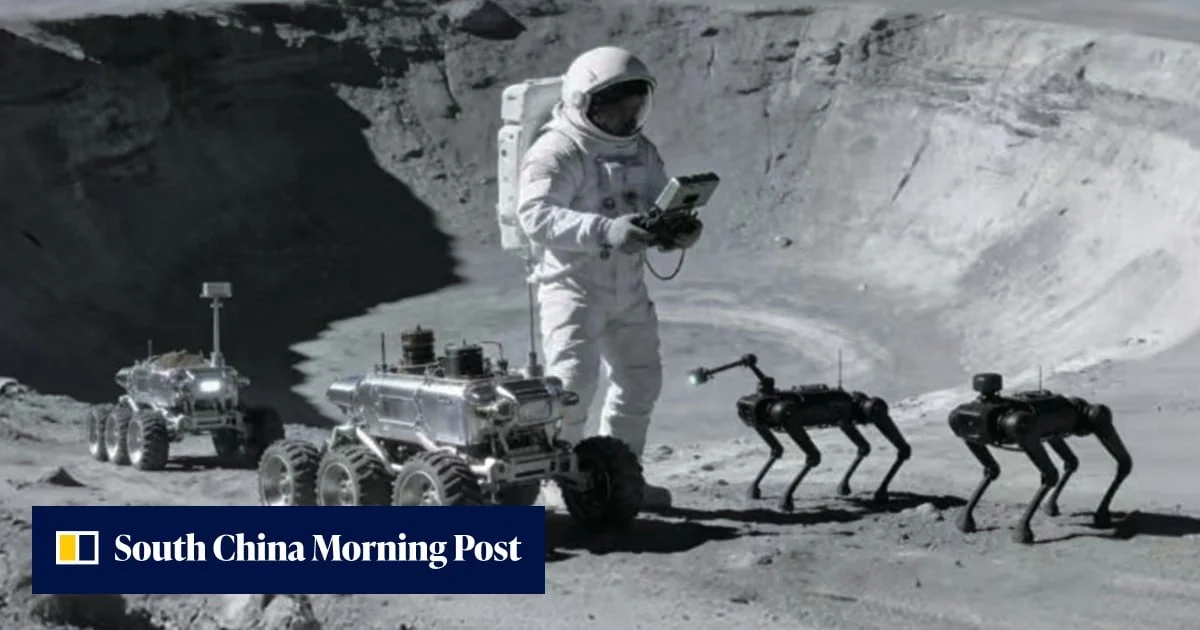
Future lunar exploration will be defined by a sophisticated synergy between human intelligence and autonomous machinery, according to a comprehensive blueprint released by researchers at the China Academy of Space Technology (CAST). The proposal, published in the peer-reviewed journal Chinese Space Science and Technology, outlines a strategic framework where quadrupedal "robot dogs" and intelligent automated systems serve as the primary labor force for China’s upcoming lunar base. These machines are envisioned to perform a wide array of functions, ranging from high-stakes geological scouting and resource extraction to maintaining the psychological well-being of astronauts stationed in the isolated lunar environment.
The CAST study represents a significant pivot in China’s space strategy, moving from short-term exploratory missions to the establishment of a permanent, sustainable presence on the moon. By delegating hazardous and repetitive tasks to robotic counterparts, the Chinese space program aims to maximize the scientific output of human crews while minimizing the risks associated with the harsh lunar surface.
The Three-Person Mission Architecture
At the heart of the CAST proposal is a specialized three-person crew model designed to operate in tandem with a fleet of autonomous units. This configuration is optimized for a van-sized pressurized rover, which serves as a mobile command center and living quarters. This "laboratory on wheels" allows the crew to traverse large distances without the constant need to return to a central stationary base, significantly expanding the mission’s geographical reach.
In this operational model, the division of labor is strictly defined to ensure maximum efficiency. One astronaut remains within the safety of the pressurized rover, serving as the mission coordinator. This individual monitors life-support systems, manages long-range communications with Earth, and provides high-level oversight for the robotic units. The second astronaut is tasked with field-based scientific research, focusing on the delicate collection of geological samples and the deployment of sensitive instruments.
The third astronaut acts as a "handler" for the quadrupedal robotic units. While the robots possess high levels of autonomy, the human handler provides real-time direction during complex maneuvers or when navigating particularly treacherous terrain. This "astronaut-led, robot-executed" paradigm ensures that human decision-making remains at the core of the mission while robots handle the physical toil and environmental exposure.
The Strategic Advantage of Quadrupedal Robotics
The decision to utilize quadrupedal "robot dogs" rather than traditional wheeled rovers marks a shift in lunar mobility philosophy. While wheeled vehicles like the Yutu-2 have proven successful on relatively flat plains, they struggle with the steep inclines, loose regolith, and jagged craters found in the moon’s more scientifically interesting regions, such as the South Pole-Aitken Basin.
Quadrupedal robots offer several distinct advantages in the lunar environment:
- Terrain Versatility: Legged robots can step over obstacles, climb steep crater walls, and navigate rocky fields that would immobilize a wheeled vehicle.
- Redundancy and Stability: If one leg is compromised, sophisticated algorithms can often allow the robot to maintain balance or continue movement on three legs.
- Multi-Functional Tool Integration: These units can be equipped with various sensors, LiDAR for 3D mapping, and even small robotic arms for clearing debris or steadying an astronaut during a traverse.
The CAST researchers emphasize that these robots will not merely be tools but "active partners." They are expected to patrol the perimeter of research stations, scout for potential hazards like hidden lava tubes or unstable ground, and act as pack mules, carrying heavy equipment and rock samples for the human crew.
Resource Extraction and In-Situ Resource Utilization (ISRU)
A critical component of China’s long-term lunar strategy is the transition from "bringing everything from Earth" to "living off the land." The CAST blueprint identifies robots as the primary agents for In-Situ Resource Utilization (ISRU). This involves harvesting water ice—believed to be trapped in permanently shadowed regions of the lunar poles—and processing it into oxygen for breathing and hydrogen for rocket fuel.
Beyond water, robots will be tasked with mining lunar minerals and processing regolith (lunar soil) to create building materials. The researchers envision robots using 3D-printing technology to construct habitats or protective shields against solar radiation. One of the more ambitious aspects of the proposal involves the conversion of lunar lava tubes—natural underground tunnels formed by ancient volcanic activity—into pressurized habitats. Robots would be deployed first to map these tubes and clear obstructions before humans ever enter.
Domestic Support and Psychological Welfare
Living in a confined, high-pressure environment millions of miles from Earth presents significant psychological challenges. The CAST proposal uniquely addresses this by integrating robots into the daily domestic life of the lunar base.
Robotic systems are expected to manage routine maintenance, such as regulating air quality and temperature, cleaning living quarters, and tending to hydroponic gardens that provide fresh food. Furthermore, the researchers suggest that AI-driven robots could serve a social function. By engaging in conversation and providing companionship, these intelligent machines could help mitigate the feelings of isolation and "space sickness" that often afflict crews on long-duration missions. This holistic approach recognizes that the success of a lunar colony depends as much on the mental health of the astronauts as it does on the integrity of the life-support systems.
Chronology of China’s Lunar Ambitions
The current proposal is the culmination of decades of steady progress within the Chang’e lunar exploration program. China’s roadmap to the moon has followed a methodical "Orbit, Land, Return" sequence:
- 2007–2010 (Chang’e 1 & 2): Successful orbital missions that mapped the lunar surface in unprecedented detail.
- 2013 (Chang’e 3): The first soft landing on the moon by a Chinese spacecraft, deploying the Yutu rover.
- 2019 (Chang’e 4): A historic achievement as China became the first nation to land a craft on the far side of the moon, utilizing the Queqiao relay satellite for communication.
- 2020 (Chang’e 5): A complex sample-return mission that brought 1.73 kilograms of lunar soil back to Earth, the first such feat since 1976.
- 2024 (Chang’e 6): The first mission to successfully collect and return samples from the lunar far side, specifically the South Pole-Aitken Basin.
The CAST blueprint looks toward the 2030s, aligning with the planned Chang’e 7 and 8 missions. Chang’e 7 is expected to search for water ice at the lunar South Pole, while Chang’e 8 will test key technologies for the International Lunar Research Station (ILRS), including 3D printing and resource utilization. China has stated its goal of landing astronauts on the moon before 2030, which would set the stage for the permanent robotic-human collaborative base described in the CAST paper.
Supporting Data and Technical Feasibility
The feasibility of using quadrupedal robots has already been demonstrated on Earth. China’s domestic robotics industry, led by companies like Unitree and Xiaomi, has produced "robot dogs" capable of navigating complex industrial sites and even climbing the rugged stairs of Mount Tai to assist with sanitation and logistics.
Adapting these machines for the moon, however, requires overcoming significant technical hurdles. The lunar environment features extreme temperature swings (ranging from 127°C in the sun to -173°C in the shade), abrasive regolith that can grind down mechanical joints, and high levels of cosmic radiation. The CAST researchers note that future iterations of these robots will require specialized thermal management systems and radiation-hardened electronics.
Furthermore, the power requirements for a fleet of robots are substantial. The blueprint suggests a combination of solar arrays and potentially small nuclear reactors—a technology China is actively developing—to provide a constant energy supply during the 14-day-long lunar nights.
Global Context and Strategic Implications
China’s push for a robotic-heavy lunar base occurs against the backdrop of a renewed global space race. The United States, through NASA’s Artemis program, is also aiming to return humans to the moon and establish a "Base Camp" at the South Pole. While the U.S. relies heavily on commercial partnerships (such as SpaceX and Blue Origin), China’s approach is characterized by a high degree of state-led integration through entities like CAST and the China National Space Administration (CNSA).
The International Lunar Research Station (ILRS), a project co-led by China and Russia, has already attracted several international partners, including Venezuela, Pakistan, and Egypt. The CAST proposal serves as a technical manifesto for the ILRS, positioning China as the leader in "intelligent" space exploration.
The implications of this technology extend beyond the moon. The autonomous systems, AI interfaces, and ISRU techniques developed for the lunar base will serve as the "proving ground" for future missions to Mars. By mastering the art of human-robot collaboration on the moon, China is building the foundational infrastructure for humanity to become a multi-planetary species.
Conclusion: A New Era of Spaceflight
The researchers at the China Academy of Space Technology have articulated a vision that moves beyond the "flags and footprints" era of the 20th century. In their view, the moon is not just a destination to be visited, but a resource-rich frontier to be developed.
"China is extending the frontier of human space flight from Earth orbit to the moon," the authors concluded in their July report. The integration of quadrupedal robots and autonomous systems represents a pragmatic response to the extreme challenges of deep space. As the 2030 deadline approaches, the sight of robotic "dogs" trotting alongside astronauts across the lunar grey-scale landscape may soon transition from the pages of scientific journals to the reality of the lunar surface. This evolution in mission design suggests that the next chapter of space exploration will be written not just by human hands, but by the coordinated efforts of biological and artificial intelligence.
