

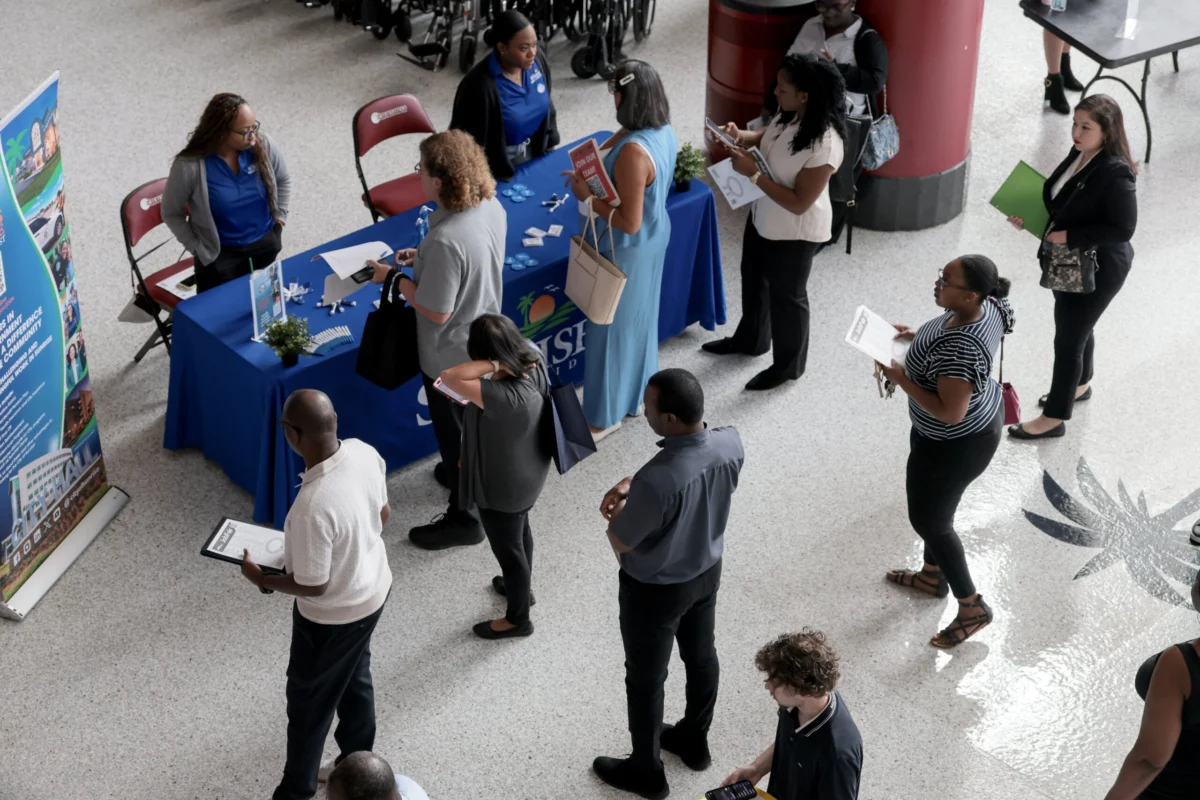
The United States labor market presented a surprisingly weak picture in July, with an unexpected decline in nonfarm payrolls and a further drop in the labor force participation rate, according to the latest report from the Bureau of Labor Statistics (BLS) released on Friday. This data point suggests a significant cooling in employment conditions, a development that could have considerable implications for Federal Reserve monetary policy and the broader economic outlook.
July Jobs Report Shocks Economists
In July, nonfarm payrolls contracted by a seasonally adjusted 23,000 jobs, a stark contrast to the consensus forecast of an 83,000 job gain. This unexpected downturn follows a downward revision for June, which saw payrolls decrease by 20,000. The figures indicate a significant deceleration in job creation compared to previous months and a potential shift in the labor market’s trajectory.
Simultaneously, the unemployment rate edged down to 4.1%. However, this decline was not driven by increased employment but rather by a further retreat from the labor force. The labor force participation rate fell to 61.4%, its lowest point in over five years. This metric, which tracks the percentage of the working-age population either employed or actively seeking employment, signifies that fewer Americans are either working or looking for work, contributing to the lower headline unemployment figure.
Revisions and Declining Averages Point to Weakening Trend
The concerning July numbers were compounded by downward revisions to previous months’ data. The final count for May was revised lower by 66,000 jobs to 63,000. These cumulative revisions have dragged the 12-month average job growth down to a mere 34,000, a significant slowdown from earlier in the year.
Nicole Bachaud, a labor economist at ZipRecruiter, commented on the report’s implications, stating, "The July employment report solidified that the labor market is not out of the woods quite yet." This sentiment underscores the growing concern among analysts about the resilience of the job market.
Sectoral Analysis Reveals Pockets of Weakness
A closer examination of the BLS data reveals specific sectors contributing to the overall decline. Local government education saw a substantial decrease of 50,000 jobs, and the retail sector shed 19,000 positions. Financial activities also experienced a contraction, losing 14,000 jobs. The leisure and hospitality sector reported a decline of 40,000 jobs, a potential consequence attributed to the conclusion of major events such as the World Cup tournament, which often boosts employment in this area.
In contrast, the healthcare sector, which has been a consistent engine of job growth, added 22,000 jobs. While this represents continued expansion, it falls short of its 12-month average of 36,000, indicating a moderating pace of hiring in this critical industry. Construction also saw an increase of 22,000 jobs, offering a glimmer of strength in an otherwise subdued report.
Breaking down the figures further, private sector payrolls did see an increase of 30,000 jobs. However, this was more than offset by a significant decline of 53,000 government jobs, particularly at the local level.
Wage Growth Stagnates Amidst Slowdown
Adding to the picture of a cooling economy, worker pay saw virtually no significant gain in July. Average hourly earnings increased by a mere 2 cents, bringing the 12-month average to 3.2%. This figure is below the forecasted increase of 3.5% and represents the lowest annual wage growth rate since May 2021. Stagnant wage growth, coupled with a slowing job market, could impact consumer spending and overall economic momentum.
Federal Reserve Policy in Focus
The unexpectedly weak jobs report arrives at a critical juncture for the Federal Reserve. Policymakers have been grappling with the challenge of high inflation, which has remained persistently above the central bank’s 2% target, while also observing signs of a cooling labor market.

In recent weeks, several Federal Reserve officials have indicated a preference for further interest rate hikes, with some suggesting a move as early as September if inflation does not show further signs of abating. The Federal Open Market Committee (FOMC) recently voted 9-3 to maintain its benchmark interest rate at its current level, reflecting a divided outlook among its members.
Market Reaction and Implications for Monetary Policy
Following the release of the July jobs report, financial markets reacted swiftly, with traders adjusting their expectations for future Fed actions. The probability of an interest rate hike in September fell to 44%, and the odds for an October increase shifted to 58.3%, according to the CME Group’s FedWatch gauge.
Stock market futures responded positively to the prospect of a more dovish Federal Reserve, with futures tied to the Dow Jones Industrial Average showing gains. Treasury yields also plummeted after trading near flat earlier in the session, as investors anticipated a potential pause or slower pace of rate hikes.
Chris Zaccarelli, chief investment officer for Northlight Asset Management, described the report as a "game changer." He explained, "Before today, many were expecting that the Fed had no choice but to raise rates in order to fight stubbornly high inflation, because the job market was so strong, but this report shows that isn’t the case." This suggests that the labor market data could now play a more significant role in the Fed’s decision-making process, potentially shifting the focus from solely combating inflation to balancing it with the risk of overtightening and triggering a recession.
Deeper Dive into Household Data
The details within the BLS report further corroborate the headline weakness. The household survey, which measures employment levels and is used to calculate the unemployment rate, indicated a decrease of 87,000 individuals holding jobs. The decline in the unemployment rate, therefore, is primarily attributable to a significant drop of 264,000 individuals leaving the labor force.
Labor Force Participation at Multi-Decade Lows
The falling labor force participation rate is a particularly concerning trend. Outside of the disruptions experienced during the COVID-19 pandemic, the participation rate is now at its lowest level since the middle of 1976. This suggests a structural shift in the labor market, potentially influenced by an aging population, early retirements, or a lack of available job opportunities that match the skills or expectations of workers.
Bill Adams, chief U.S. economist at Fifth Third Commercial Bank, highlighted the concerning nature of the falling participation rate: "While the unemployment rate is falling, that is mostly for the wrong reason—not enough workers." He further elaborated on the demographic challenges, noting that "Immigration compensated for the aging of the workforce in the first few years of the post-pandemic expansion, but that’s not happening anymore." This indicates that the demographic headwinds are becoming more pronounced, and the economy may be facing a sustained period of labor scarcity if participation rates do not recover.
The employment-to-population ratio, another key indicator of labor market health, also continued its downward trend, slipping to 58.9%. This marks its lowest level since May 2014. This ratio provides a broader measure of how many people in the working-age population are employed.
Furthermore, an alternative measure of unemployment, which includes discouraged workers and those holding part-time jobs for economic reasons (underemployment), held steady at 7.9%. This suggests that while the headline unemployment rate may be falling, a significant portion of the workforce remains underutilized or has given up looking for work.
Historical Context and Future Outlook
The current labor market conditions stand in contrast to the robust job growth experienced in the initial years of the post-pandemic economic recovery. Following the sharp downturn in 2020, the U.S. economy saw a significant rebound, characterized by strong hiring and declining unemployment. However, the Federal Reserve’s aggressive interest rate hikes aimed at curbing inflation appear to be taking a toll on economic activity.
The July jobs report provides the clearest evidence to date that these monetary policy tightening measures may be leading to a more substantial slowdown in the labor market than previously anticipated. The implications for the coming months are significant. If the trend of job losses and declining participation continues, it could force the Federal Reserve to reconsider its hawkish stance, potentially pausing or even reversing its rate hike cycle to avoid triggering a deep recession. Conversely, if inflation remains stubbornly high despite a weakening labor market, the Fed could find itself in a difficult position, facing the dilemma of combating inflation at the risk of further exacerbating unemployment. The coming months will be crucial in determining the path forward for both the labor market and U.S. monetary policy.
