

The tension between understanding the world and actively reshaping it has served as the foundational bedrock of modern political theory and governance. This intellectual conflict is perhaps most famously encapsulated in the starkly different perspectives of Georg Wilhelm Friedrich Hegel and Karl Marx, two titans of Western thought whose divergent views on the role of philosophy continue to influence global political discourse. While Hegel argued that philosophy serves as a retrospective analysis of a completed era, Marx insisted that the primary purpose of intellectual pursuit is to catalyze revolutionary change. However, as Western thinkers debated the timing of social intervention, the Eastern tradition, led by the enduring influence of Confucius, established a model where philosophy functioned as a proactive blueprint for statecraft, successfully guiding the future of dynastic China for two millennia.
The Owl of Minerva: Hegel’s Retrospective Philosophy
To understand the roots of this philosophical divide, one must look to G.W.F. Hegel’s 1820 work, Elements of the Philosophy of Right. In the preface of this seminal text, Hegel provides a poetic yet somber assessment of the philosopher’s role: “The owl of Minerva takes flight only when darkness falls.” In Roman mythology, the owl was the symbol of Minerva, the goddess of wisdom. By stating that the owl flies only at dusk, Hegel suggested that wisdom, and by extension philosophy, arrives only after a historical process has already completed its cycle.
Hegel’s metaphor posits that philosophy cannot be used to predict or dictate the future. Instead, it is a tool for understanding the "grey on grey" of a world that has already matured and begun to fade. According to Hegel, “When philosophy paints its grey on grey, then has a form of life grown old, and with grey on grey it cannot be rejuvenated, but only known.” This perspective implies that by the time a society’s intellectuals have fully grasped the essence of their culture or political system, that system is already in its twilight. Consequently, philosophy is inherently conservative in the sense that it documents what is, rather than what should be.
This "retrospective" view of history was deeply rooted in Hegel’s belief in Geist (Spirit) and the dialectical process. He viewed history as the unfolding of reason, where each era represents a necessary stage in the development of human freedom. However, because this unfolding is organic and complex, it can only be understood in hindsight. This stance placed Hegel in a position where his work was often interpreted as a justification for the existing Prussian state of his time, leading critics to label his followers on the "Right" as defenders of the status quo.
The 11th Thesis: Marx’s Call to Action
Karl Marx, once a student of Hegelian thought and a member of the "Young Hegelians," found this retrospective approach fundamentally insufficient. In 1845, Marx penned his Theses on Feuerbach, a series of eleven short philosophical notes that marked his break from traditional German idealism. The final entry, the 11th Thesis, remains one of the most quoted lines in political history: “Philosophers have only interpreted the world, in various ways; the point, however, is to change it.”
This statement was a direct refutation of Hegel’s "Owl of Minerva." For Marx, the purpose of philosophy was not to wait for the twilight of an era to understand it, but to provide the theoretical framework for "praxis"—the practical application of theory to transform society. Marx argued that if philosophy remained purely interpretive, it would serve as little more than an ideological tool for the ruling class to justify their dominance.
The 11th Thesis was so central to Marx’s identity that it was eventually engraved on his tombstone in Highgate Cemetery, London. It signifies the transition from the "Left Hegelian" obsession with religious and abstract critique to a materialist focus on economics, class struggle, and revolution. While Hegel looked to the past to find meaning, Marx looked to the future to find liberation. This shift created the modern distinction between radicalism—the desire to uproot and change the foundations of society—and conservatism—the desire to preserve or reflect upon existing structures.
The Hegelian Schism: Shaping Modern Politics
The internal collapse of Hegelianism into two warring camps—the Right and Left Hegelians—served as the precursor to the modern political spectrum. This division was not merely academic; it reflected the social upheavals of 19th-century Europe, particularly the aftermath of the French Revolution and the rise of the Industrial Revolution.
- The Right Hegelians (Old Hegelians): Figures such as Karl Rosenkranz and Eduard Gans believed that the Hegelian system was complete. They argued that the Prussian state had reached the pinnacle of rational development. For them, philosophy’s job was to reconcile the individual with the existing social order. Their focus on tradition, stability, and retrospective analysis laid the groundwork for modern conservative thought.
- The Left Hegelians (Young Hegelians): Including David Strauss, Ludwig Feuerbach, and initially Marx and Friedrich Engels, this group believed that the dialectic was not yet finished. They argued that the "rational" state Hegel spoke of had not yet been realized because of the presence of religious superstition and economic inequality. They sought to use Hegelian logic to critique the state, eventually leading to the radical revolutionary movements of the mid-19th century.
This schism defined the 1840s and 1850s, a period characterized by failed revolutions and intense censorship. The debate between "hope" (the Left’s vision of a future utopia) and "nostalgia" (the Right’s defense of historical continuity) continues to resonate in contemporary political debates regarding reform versus stability.
The Confucian Alternative: Philosophy as a State Blueprint
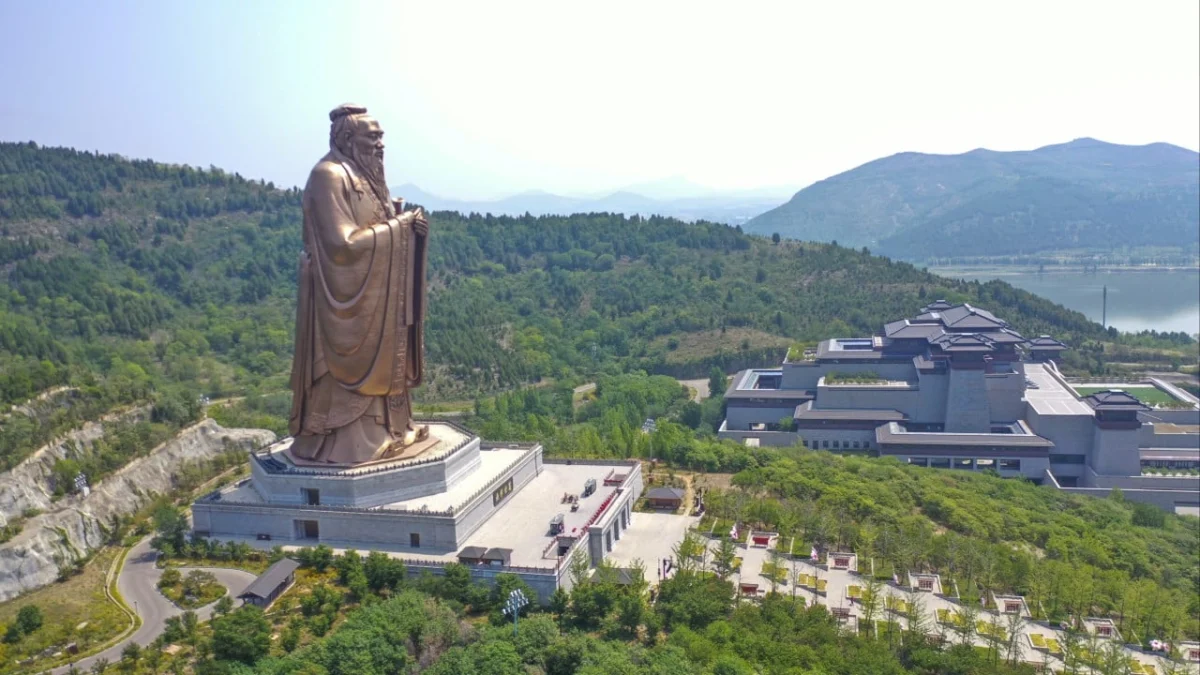
While European thinkers were embroiled in the debate over whether philosophy should follow or lead history, the Chinese tradition offered a different paradigm. Confucius (551–479 BCE), living centuries before Hegel and Marx, developed a philosophy that was neither purely retrospective nor radically revolutionary in the Western sense. Instead, Confucianism was designed as a proactive, ethical framework for social and political harmony.
During the "Spring and Autumn" period of Chinese history, Confucius sought to address the chaos of warring states by looking back to the early Zhou Dynasty’s virtues. However, unlike Hegel’s "Owl," Confucius did not believe these virtues were dead or only to be "known." He believed they could be revitalized through education, ritual (li), and filial piety (xiao) to build a stable future.
The true transformation of Confucianism from a competing school of thought into a dominant state ideology occurred during the Han Dynasty (206 BCE – 220 CE). Under Emperor Wu of Han, the state officially adopted Confucianism, effectively proscribing other rival philosophies like Legalism and Mohism. This move was a deliberate act of using philosophy to chart the future of an empire.
For the next 2,000 years, the Confucian civil service examination system ensured that the ruling elite were indoctrinated in a specific philosophical framework. In this model, philosophy did not arrive "too late" as Hegel suggested; it was the prerequisite for governance. It provided a roadmap for the future that emphasized continuity and moral leadership, successfully maintaining the structure of dynastic China through dozens of successions and external invasions.
Chronology of Philosophical Evolution
The following timeline highlights key moments in the development of these competing worldviews:
- 5th Century BCE: Confucius develops his teachings during the Spring and Autumn period, focusing on social harmony and ethical governance.
- 136 BCE: Emperor Wu of Han establishes Confucianism as the official state ideology of China, beginning its two-millennium reign over Eastern statecraft.
- 1820: G.W.F. Hegel publishes Elements of the Philosophy of Right, introducing the "Owl of Minerva" metaphor and the retrospective nature of philosophy.
- 1831: Hegel dies, leading to the split between Right and Left Hegelians.
- 1845: Karl Marx writes Theses on Feuerbach, including the 11th Thesis, marking a shift toward revolutionary praxis.
- 1848: Marx and Engels publish The Communist Manifesto, applying the "change the world" philosophy to the global labor movement.
- 1954: Marx’s famous 11th Thesis is inscribed on his new monument at Highgate Cemetery, cementing the phrase as a cornerstone of radical thought.
Data and Historical Analysis: The Impact of Philosophical Application
The effectiveness of these philosophies can be measured by their longevity and the scale of their implementation. Data from historical political systems reveals a stark contrast:
- Longevity of Influence: The Confucian state model lasted approximately 2,100 years (from the Han Dynasty to the fall of the Qing in 1911). In contrast, the direct application of Marx’s revolutionary theories in the form of state communism has had a volatile history, with the Soviet Union lasting 74 years and other states undergoing significant market-based reforms within decades.
- Educational Impact: The Chinese Imperial Examination system, based entirely on Confucian philosophy, was the world’s longest-running meritocratic system. At its peak during the Song and Ming dynasties, it processed hundreds of thousands of candidates, ensuring that the philosophy was not merely "interpreted" but lived by the administrative class.
- Political Identity: A 2021 study on political psychology suggests that the Hegelian-Marxist split remains the primary driver of Western political alignment. Approximately 65% of modern political rhetoric in Western democracies can be traced back to the tension between "preserving the rational" (Right Hegelianism/Conservatism) and "transforming the material" (Marxism/Progressivism).
Analysis: The Implications of Philosophical Timing
The fundamental difference between these thinkers lies in their perception of time. Hegel’s philosophy is "dusk-oriented"—it seeks the peace of understanding after the struggle is over. Marx’s philosophy is "dawn-oriented"—it seeks the heat of the struggle to bring about a new day. Confucius, however, represents a "perpetual noon"—a philosophy intended to maintain a constant state of social equilibrium through the repetitive practice of virtue.
The implications for modern governance are profound. Modern technocratic states often lean toward a Hegelian model, analyzing data and historical trends to manage society as it currently exists. Conversely, activist movements worldwide adopt the Marxian mandate, viewing any philosophy that does not lead to tangible social change as a failure.
Meanwhile, the "Confucian model" has seen a resurgence in East Asia. The "developmental state" model used by Singapore, South Korea, and modern China often blends Confucian emphasis on social stability and education with modern economic practices. This suggests that the Eastern approach of using philosophy as a proactive blueprint remains a potent alternative to the Western dialectic of interpretation versus revolution.
Conclusion: The Unending Dialogue
The debate between Hegel, Marx, and Confucius is far from settled. As the world faces unprecedented challenges—from climate change to the rise of artificial intelligence—the question of whether philosophy should simply "know" the world or "change" it has never been more relevant.
If Hegel is correct, we may only truly understand our current era once it has passed into history. If Marx is correct, we have a moral obligation to use our understanding to intervene and prevent future crises. And if the Confucian legacy teaches us anything, it is that a philosophy integrated into the very fabric of state administration can provide a level of stability that neither pure interpretation nor pure revolution can achieve. The Owl of Minerva may take flight at dusk, but for those who seek to build the future, the work begins long before the sun sets.
