

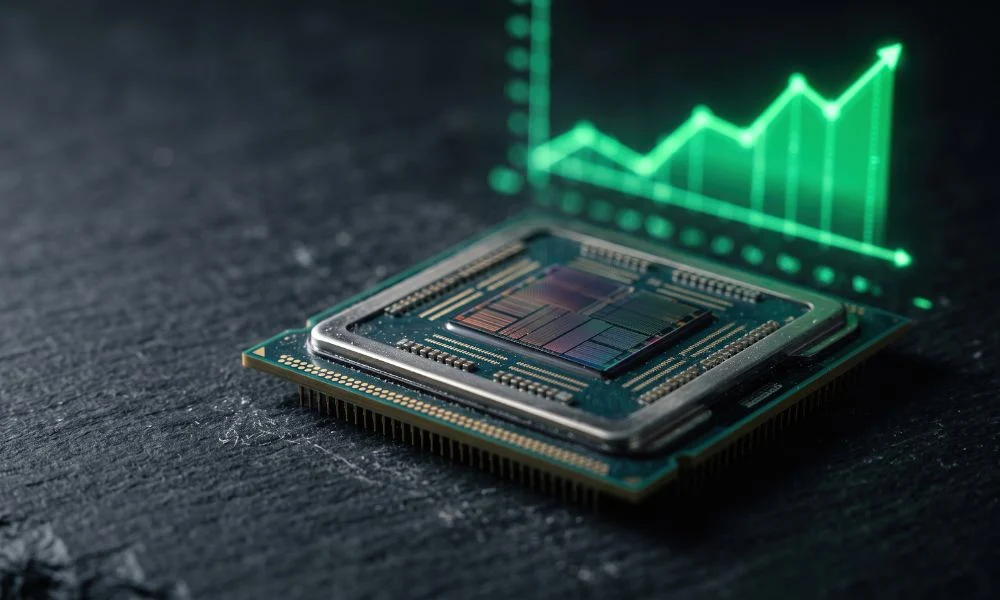
The global stock markets recently experienced a seismic shift, with over a trillion US dollars in market capitalization vanishing in a matter of days. Prominent semiconductor or "chip" stocks, including industry giants like Nvidia, and leading memory manufacturers such as SK Hynix, Samsung Electronics, and Micron, each saw their valuations plummet by hundreds of billions. This dramatic sell-off followed an unprecedented period of stellar performance for the sector. Despite this recent correction, exchange-traded funds (ETFs) tracking the Philadelphia Semiconductor Index remain up an impressive nearly 80 percent year-to-date and significantly over 100 percent in the past twelve months, a testament to the enduring demand for semiconductors fueled by the ongoing artificial intelligence (AI) buildout. The recent downturn, however, is largely attributed to shifting market expectations.
James Learmonth, Co-Chief Investment Officer and Portfolio Manager at Harvest ETFs, observed that many of these chip stocks experienced significant declines even after reporting earnings that surpassed published analyst expectations. He explained that as stock prices soared, unstated but widely anticipated "whisper numbers" – higher earnings expectations not formally released but understood within the investment community – began to emerge. It was the failure to meet these elevated, informal benchmarks that ultimately triggered the sell-off. Consequently, investors who had benefited from the substantial run-up in semiconductor stocks began to take profits.
"Ultimately, that is healthy for markets," Learmonth stated. "For the long-term potential of any bull market, you want to have these resets. They never feel good, and it’s never easy to just say ‘everything’s still fine, keep calm and carry on.’ But I think that’s what the case is here." He pointed to recent announcements from major technology players as evidence of sustained investment in AI infrastructure. "We saw Google and Meta raise their capex forecasts again. Microsoft and Amazon took a little more measured approach and got rewarded for that by the market, but the expectation that spending is going to continue to increase is still very much there. I don’t take that as an indication that we’re at peak spending growth yet. I think that spending trajectory is still very much in place, and I think the AI infrastructure buildout is likely still relatively early, mid to early cycle."
The Resilience of Chip Stocks Amidst Market Volatility
The recent pullback, which saw memory stocks emerge as some of the most significant decliners, has inevitably brought to the forefront the historical cyclicality of the memory manufacturing industry in the minds of many investors. However, Learmonth contends that the long-term imbalances between supply and demand for memory chips are so profound that the industry may have transcended its traditional cyclical patterns. Any substantial shift, he argues, would likely take considerably longer to materialize than in previous cycles. The three primary manufacturers of the vast majority of memory chips essential for AI development still wield considerable pricing power. Furthermore, the immense scale of production required to meet or exceed the ever-growing demand is a goal that remains years away for potential new entrants.
Learmonth believes this fundamental picture of sustained demand and constrained supply is broadly applicable across the entire semiconductor space as the construction of AI data centers continues unabated. While acknowledging that market sentiment can play a role in short-term price movements, he asserts that the underlying strength of earnings within the hardware and semiconductor sectors will ultimately propel them back into a growth phase. He does anticipate, however, that the pace of this growth will likely be more measured than the stratospheric rise witnessed previously. This moderation, he suggests, could prove to be a healthier, more sustainable trajectory for the sector as a whole.
Moreover, within the broader technology sector, Learmonth sees no readily apparent replacements for the leadership role currently occupied by AI-enabling hardware and semiconductors. Software, with the notable exception of companies like Palantir, has demonstrated a tendency to struggle with the disruptive risks posed by AI rather than capitalize on its adoption. This contrast underscores the foundational importance of the hardware infrastructure in the current technological landscape.
Navigating Volatility and the Inevitability of AI
The recent correction in chip stocks offers more than just a lesson in market dynamics for advisors and investors; it serves as a potent reminder of the psychological pitfalls of market participation. The pervasive influence of the Fear Of Missing Out (FOMO) and the ingrained tendency to chase past performance were vividly replayed by some of the investors who entered the sector late. This FOMO has been amplified by the widespread public discourse surrounding AI, often framed as an "inevitable" force, its buildout as "generational," and its promise to investors as "transformational."
Amidst these powerful narratives urging clients to invest heavily in today’s leading AI contenders, Learmonth highlights the recent pullback as a crucial object lesson in the importance of diversification. He notes that prominent momentum stocks can experience sharp corrections, while previously underperforming assets may rebound. A diversified and balanced investment approach, he argues, can effectively mitigate these swings. Furthermore, Learmonth advocates for more equal-weight allocations when utilizing index funds for this sector. The significant market capitalization run-up in some leading names has resulted in market-cap-weighted index funds becoming disproportionately concentrated, potentially masking a lack of true diversification. Equal-weighted funds, he contends, offer a more accurate reflection of diversified exposure.
From this perspective, Learmonth emphasizes the critical role of advisors in helping their clients maintain a long-term investment horizon. While this sustained focus is challenging, it is essential for ensuring clients are well-served over time.
"That’s probably the hardest thing for most people to do, to disassociate themselves from the short-term gyrations in the market and stay focused on the longer term," Learmonth commented. "We’ve liked the technology sector for a long time, even before AI became the dominant theme. And we think there are still many themes within the technology sector. A lot of them link to AI, but AI becomes an enabling factor for things like autonomous vehicles, continued buildout of communication networks, data storage and cloud-based infrastructure, and cybersecurity. And so from that fundamental perspective, I think maintaining that long-term perspective is very important."
The AI Investment Landscape: A Historical Perspective
The surge in AI-related investments over the past year has been nothing short of extraordinary. Driven by the perceived potential of generative AI and the need for robust computing infrastructure, the semiconductor sector, particularly companies involved in manufacturing advanced chips like GPUs and AI accelerators, experienced unprecedented demand. This demand fueled a significant rise in stock prices, drawing in both institutional and retail investors eager to capitalize on what was widely considered a revolutionary technological shift.
The timeline of this AI-driven boom can be traced back to late 2022 and early 2023, coinciding with the public release of advanced large language models. Nvidia, in particular, became a focal point, with its stock price soaring as its specialized chips proved indispensable for training and deploying AI models. Other memory manufacturers also benefited from the increased demand for high-bandwidth memory (HBM) and other components necessary for AI systems.
However, as Learmonth points out, the market’s reaction to earnings reports has become increasingly nuanced. The concept of "whisper numbers" highlights how market expectations can outpace official guidance. When companies deliver results that, while strong, fall short of these unstated, elevated expectations, the market can react negatively. This phenomenon was observed in the recent sell-off, where even companies beating consensus estimates found their stock prices declining as investors recalibrated their positions. This suggests a market that, having experienced such rapid growth, is now seeking more sustainable, albeit potentially slower, expansion.
Broader Implications for the Tech Sector and Investment Strategies
The implications of this market correction extend beyond the semiconductor industry. The recalibration of AI hardware valuations may influence investment decisions across the broader technology landscape. Companies that are direct beneficiaries of AI infrastructure buildouts, such as cloud service providers and data center operators, could see their growth trajectories adjusted. Conversely, companies that leverage AI as a tool for efficiency or innovation might gain renewed investor interest, provided they can demonstrate clear pathways to monetization and differentiation.
Learmonth’s emphasis on diversification and equal-weighting strategies offers a critical framework for navigating this evolving market. In a sector where a few dominant players can significantly influence index performance, equal-weighting provides a more balanced exposure to the underlying growth drivers. This approach can help investors avoid over-concentration in a limited number of stocks, thereby reducing portfolio risk.
The broader economic impact of sustained AI investment is also a significant consideration. The ongoing buildout of AI infrastructure is expected to drive demand for electricity, cooling systems, and specialized manufacturing equipment, potentially creating ripple effects across various industries. Furthermore, the development and deployment of AI technologies are likely to spur innovation and productivity gains, though the precise timing and magnitude of these effects remain subjects of ongoing analysis and debate among economists.
The recent market turbulence serves as a timely reminder that even in the face of seemingly inevitable technological advancements, market dynamics are complex and subject to shifts in sentiment, expectations, and profit-taking. As James Learmonth suggests, the current period of adjustment, while uncomfortable, may ultimately pave the way for more sustainable and robust long-term growth in the hardware and semiconductor sectors, albeit on a trajectory that prioritizes balanced expansion over hyper-accelerated gains. The focus for investors, therefore, remains on understanding the fundamental drivers of demand, managing risk through diversification, and maintaining a disciplined, long-term perspective.
