

The launch and subsequent operation of the James Webb Space Telescope (JWST) in late 2021 marked the beginning of a transformative era in observational astronomy, one that has systematically challenged and expanded the fundamental laws of astrophysics. Since its first images were released in 2022, the observatory has provided an unprecedented look into the "Cosmic Dawn," the period when the first stars and galaxies ignited in a previously dark and featureless universe. Among the most perplexing discoveries are the "little red dots"—mysterious, compact objects that appeared in significant numbers approximately 650 million years after the Big Bang—and a population of supermassive black holes and galaxies that seem far too mature for their chronological age. As researchers at institutions such as the Cosmic Dawn Center in Copenhagen and the Flatiron Institute in New York grapple with these findings, a new framework of cosmological theory is beginning to emerge, suggesting that the early universe was a far more dynamic and efficient engine of creation than previously theorized.
The Mystery of the Little Red Dots
One of the most striking phenomena identified by JWST is a class of objects colloquially known among astrophysicists as "little red dots." These entities, which were entirely invisible to previous observatories like the Hubble Space Telescope, began appearing in JWST’s deep-field infrared surveys shortly after the telescope achieved full operational status. Charlotte Mason, an astrophysicist at the Cosmic Dawn Center, has been at the forefront of investigating these anomalies. The "redness" of these dots is a result of extreme redshift; as the universe expands, the light from these distant objects is stretched into longer, redder wavelengths.
Current hypotheses regarding these dots suggest they may represent a transitional phase in cosmic evolution. One leading theory is that they are supermassive black holes cocooned within exceptionally thick shrouds of gas and dust. This dense environment would trap most of the light, allowing only the longest, reddest wavelengths to escape, potentially creating a "black hole star"—an object where the surrounding gas envelope mimics the atmosphere of a star while being powered by the gravitational energy of a central black hole.

However, recent spectroscopic analyses conducted by Mason and her colleagues have complicated this picture. When light passes through a dense gas cloud, it typically leaves a specific chemical fingerprint or alteration in its spectrum. In several observed little red dots, these expected signatures are missing. This has led to the development of more complex models, such as "clumpy" gas clouds where gaps in the interstellar medium allow certain types of radiation to escape unfiltered. The diversity of these objects suggests that the early universe was not a uniform environment but rather a chaotic laboratory of competing physical processes.
The Black Hole Growth Paradox and the Eddington Limit
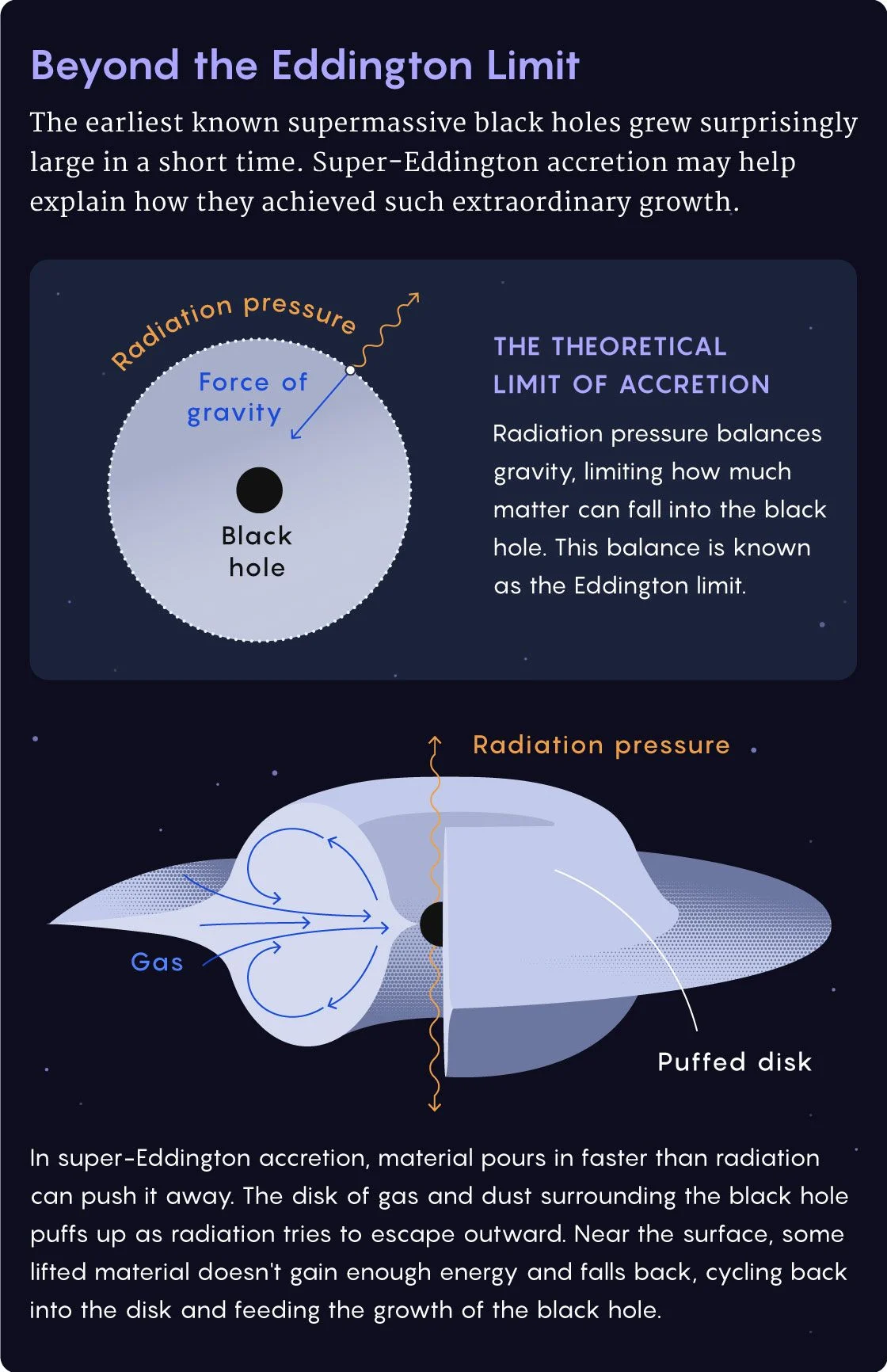
Perhaps the most significant challenge to modern cosmology is the discovery of supermassive black holes that existed less than a billion years after the Big Bang. According to established models, black holes grow by consuming surrounding matter, but this process is governed by the Eddington Limit. This physical principle dictates a maximum rate of accretion; as matter falls into a black hole, it heats up and emits radiation. If the black hole "eats" too quickly, the outward pressure of this radiation becomes strong enough to push away incoming gas, effectively starving the black hole and slowing its growth.
Jenny Greene, an astrophysicist at Princeton University, notes that JWST has observed black holes with masses equivalent to a billion suns in the very early universe. To reach such a staggering size in such a short timeframe, these objects would have had to bypass the Eddington Limit. Recent computer simulations and JWST observations from 2024 have provided evidence of "super-Eddington" accretion, where specific geometries in the accretion disk allow gas to funnel into the black hole at rates up to 40 times the theoretical limit.
An alternative explanation involves the nature of the "seeds" from which these black holes grew. If the first black holes formed from the collapse of massive stars, they would have started at roughly 100 solar masses—a size that makes reaching a billion solar masses within 600 million years nearly impossible, even with rapid feeding. However, the "direct collapse" model suggests that gargantuan clouds of primordial gas could have collapsed directly into black holes of 10,000 to 100,000 solar masses, bypassing the stellar phase entirely. The recent discovery of a "naked" supermassive black hole—one with an estimated mass of 50 million suns but no discernible surrounding galaxy—lends significant weight to the direct collapse theory, implying that black holes may have predated the galaxies that now host them.

Galaxy Formation and the Diversity of the Early Cosmos
The traditional timeline of galaxy formation has also been scrutinized. Prior to JWST, it was believed that galaxies began as small, chaotic clusters of stars that slowly merged over billions of years. Observations from the telescope’s Mid-Infrared Instrument (MIRI) have instead revealed a surprising diversity of mature-looking galaxies at redshifts as high as 15 (approximately 270 million years after the Big Bang).
Rachel Somerville of the Flatiron Institute has utilized advanced numerical simulations to interpret these findings. The data suggests that star formation in the early universe was not a steady process but occurred in violent, periodic "bursts." In this "bursty" model, a galaxy would rapidly fuse gas into stars, leading to a series of massive supernova explosions. These explosions would temporarily blow the remaining gas out of the galaxy, halting star formation until gravity could pull the material back in to begin the cycle anew.
This explains why some early galaxies appear "naked"—consisting almost entirely of stars with very little interstellar dust—while others are choked with gas. Furthermore, the detection of an overabundance of nitrogen in certain early galaxies suggests the presence of a population of "supermassive stars" that lived fast and died young, seeding the young cosmos with the heavy elements necessary for the eventual formation of planets and life.
Chronology of Cosmic Discovery: A Three-Year Trajectory
The impact of JWST can be mapped through a rapid timeline of scientific milestones:

- December 2021: JWST launches from French Guiana, beginning its journey to the second Lagrange point (L2).
- July 2022: The first deep-field images are released, revealing galaxies that existed over 13 billion years ago.
- Early 2023: The "Universe Breaker" crisis emerges as initial data suggests early galaxies are much more massive than the Standard Model of Cosmology (Lambda CDM) predicts.
- 2024: High-resolution spectroscopy identifies super-Eddington accretion and "little red dots," shifting the focus from "how do these exist?" to "what are the mechanisms of their rapid growth?"
- 2025-2026: Large-scale international conferences, such as the 2026 meeting in Helsingør, Denmark, begin to consolidate these findings into a "New Cosmology" that emphasizes bursty star formation and direct-collapse black holes.
Technical Context: Why Infrared Matters
The reason JWST has succeeded where other telescopes failed lies in its mastery of the infrared spectrum. Because the universe is expanding, the light from the most distant objects is "redshifted" out of the visible spectrum and into the infrared. Hubble, which primarily observes visible and ultraviolet light, was unable to see through the cosmic dust clouds of the early universe. JWST’s 6.5-meter gold-coated primary mirror and its suite of cryogenically cooled instruments, including NIRCam and MIRI, allow it to peer through dust and capture the faint heat signatures of the first light in the cosmos.
Broader Implications: Reionization and the Origins of Matter
The era JWST is currently mapping is known as the Epoch of Reionization. This was the second time the universe’s hydrogen was ionized, a process driven by the intense radiation from the first galaxies and black holes. This period ended the "Cosmic Dark Ages" and set the stage for the modern universe.
The broader implications of this research extend beyond pure physics. By observing the first supernovas, scientists are witnessing the birth of the elements—carbon, oxygen, and iron—that comprise the human body. As Lise Christensen of the Cosmic Dawn Center notes, these observations are a form of cosmic genealogy. The "quintessence of dust" that William Shakespeare’s Hamlet once pondered is now being measured and quantified by an observatory orbiting 1.5 million kilometers from Earth.
The discovery that the early universe was more efficient, more diverse, and more violent than expected does not "break" physics; rather, it refines it. The ongoing analysis of JWST data continues to bridge the gap between the smooth, featureless radiation of the Big Bang and the complex, structured universe we inhabit today. As simulations catch up to observations, the story of our origins is being rewritten in real-time, one little red dot at a time.
