

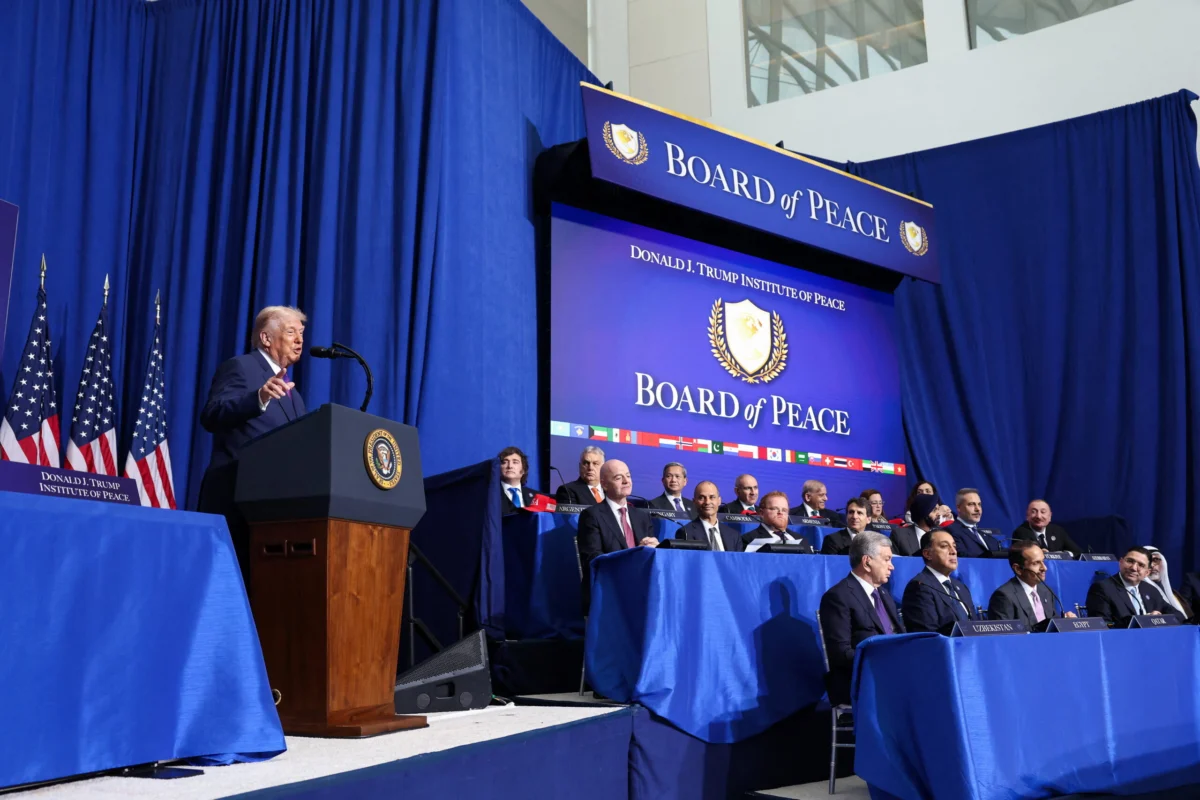
United States President Donald Trump’s recent announcement that Hamas has agreed to a comprehensive disarmament as part of a transition to the next phase of the Gaza ceasefire deal has been met with both cautious optimism from regional allies and sharp criticism from observers on the ground. While the President characterized the development as a “historic agreement,” significant obstacles remain that threaten the viability of the plan. Critics argue that the disarmament is unlikely to manifest in reality because Hamas has explicitly conditioned the relinquishing of its arsenal on Israel’s adherence to its own obligations—obligations that many analysts claim have been systematically ignored since the ceasefire was first brokered in October. Central to this controversy is the Board of Peace, the administrative body established to oversee the reconstruction of the Gaza Strip and the implementation of the peace process, which is now facing intense scrutiny for its perceived lack of efficacy and legal transparency.
The Board of Peace was conceptualized as a cornerstone of the Trump administration’s 20-point peace plan, specifically under the provisions of Article 9. Its mandate was ambitious: to supervise a temporary Palestinian technocratic government and manage an International Stabilization Force (ISF) comprised of multinational peacekeepers. In theory, this board was designed to facilitate a gradual Israeli withdrawal while transforming Gaza into a modern urban landscape. However, six months into its existence, the board has failed to produce tangible results, leading many to view it as a diplomatic facade that provides political cover for the continued military occupation and expansion within the territory.
A Chronology of Diplomatic Stagnation
The timeline of the current crisis reveals a widening gap between diplomatic rhetoric and the reality of life in Gaza. The 20-point plan was unveiled in October, following a period of intense regional volatility. The agreement initially promised a cessation of hostilities and a path toward reconstruction.
By November, the Board of Peace was officially inaugurated, with high-level representatives and the promise of billions in international aid. However, by January, the initial momentum began to stall. While Hamas ceased recorded attacks against Israeli targets, the Israeli military continued its operations, citing security concerns. In February, reports surfaced that the funding mechanisms intended to fuel reconstruction were not being utilized, and by March, the board began to scale back its ambitious goals, replacing comprehensive reconstruction plans with a small-scale "pilot project" near the Rafah border.
In April and May, the situation deteriorated further as the "Yellow Line"—the boundary of Israeli military control—began to shift deeper into Palestinian territory. By June, the Board of Peace faced a crisis of legitimacy, culminating in the recent draft resolution seeking legal immunity for its members. This move has been interpreted by legal scholars as an attempt to operate outside the constraints of international law, further alienating the board from the United Nations and other international stakeholders.
Data and Displacement: The Human Cost of Policy Failure
The statistical reality in Gaza paints a grim picture of the Board of Peace’s tenure. Since the ceasefire was formally established in October, more than 1,100 Palestinian civilians have been killed in regular bombardments and military incursions. Furthermore, the territorial landscape of Gaza has been radically altered. At the start of the ceasefire, Israel maintained control over approximately 53 percent of Gaza’s territory. Today, that figure has risen to 70 percent, as the military continues to move the "Yellow Line" and demolish Palestinian homes to make way for security buffers and administrative zones.
The promised reconstruction has also failed to materialize for the vast majority of the population. Despite the Trump administration’s vision of a modern Gaza, hundreds of thousands of Palestinians continue to live in tents and makeshift shelters under abhorrent conditions. The Rafah pilot project, the only active reconstruction effort, remains under heavy Israeli influence. Under this arrangement, Israel maintains the right to vet any Palestinian allowed to reside in the development, a move critics describe as a form of social engineering and population control. Furthermore, the board has sought the authority to confiscate Palestinian property or utilize it "free of charge," signaling a departure from traditional property rights and international standards of compensation.
Funding Discrepancies and Institutional Fragility
One of the most significant failures of the Board of Peace lies in its financial management and lack of international backing. While the United States pledged $10 billion and other international partners promised an additional $7 billion, these funds have largely remained inaccessible. The World Bank account established for the board’s operations reportedly contains no funds. Instead, the board has operated using a private JP Morgan account containing only a few million dollars.
Evidence suggests that much of this limited capital has been diverted toward administrative overhead and the salaries of high-ranking officials rather than being used for civilian protection or infrastructure repair. This lack of financial transparency has led to a collapse of confidence among the international community. Major global powers, including China and several key European nations, have declined to join the board or contribute to the International Stabilization Force. States that had initially signaled a willingness to provide peacekeepers have since frozen or withdrawn their commitments, citing the board’s lack of a clear legal mandate and its failure to adhere to international legal norms.
Official Responses and the Rhetoric of Obstruction
The Board of Peace, led by High Representative Nickolay Mladenov, has consistently framed the lack of progress as a result of Palestinian intransigence. Mladenov has repeatedly identified Hamas as the "principal obstacle" to the ceasefire’s implementation, despite the fact that there have been no recorded Palestinian attacks since the October agreement began. This one-sided scrutiny has drawn fire from human rights organizations, which argue that the board is ignoring blatant violations of the agreement by the Israeli military.
The Israeli government, for its part, has maintained that its actions are necessary for the security of its citizens and that the expansion of control is a logistical requirement for the eventual deployment of the ISF. However, the board’s failure to condemn the demolition of homes or the continued loss of civilian life has reinforced the perception that it serves as a tool for the status quo rather than a vehicle for peace.
The Case for a United Nations Intervention
Given the systemic failures of the Board of Peace, a growing coalition of international actors is calling for the process to be returned to the oversight of the United Nations. The argument for a UN-led framework is grounded in the need for accountability, transparency, and the application of international law. Unlike the Board of Peace, the United Nations possesses a robust legal infrastructure and established agencies, such as UNRWA (the United Nations Relief and Works Agency for Palestine Refugees in the Near East), which are uniquely equipped to handle the humanitarian crisis in Gaza.
The return of UNRWA is viewed as essential not only for the provision of basic services but also for the protection of the legal status of Palestinian refugees. Furthermore, a UN mandate for the International Stabilization Force would likely encourage broader international participation. If the ISF were deployed under a UN banner, it could be stationed in both Gaza and the West Bank, providing a buffer against settler violence and creating the conditions necessary for a genuine Israeli withdrawal from occupied territories.
Broader Implications and Future Outlook
The continued existence of the Board of Peace in its current form represents a significant risk to regional stability. By providing a veneer of diplomatic progress while the humanitarian situation worsens and territorial control shifts, the board may be inadvertently paving the way for the permanent displacement of the Palestinian population. The "uninhabitability" of Gaza is becoming a permanent state, driven by the lack of infrastructure and the constant threat of military action.
For a ceasefire to be sustainable, it must be grounded in an enforceable mechanism that holds all parties accountable to the same standards. The current "historic agreement" touted by the Trump administration lacks the enforcement mechanisms necessary to ensure that disarmament is met with reciprocal withdrawal and reconstruction. Without a shift back to the international legal framework provided by the UN, the cycle of violence and displacement is likely to continue, further distancing the region from a viable two-state solution.
The international community now faces a critical juncture. The decision to either maintain the current trajectory under the Board of Peace or to empower the United Nations will determine the fate of Gaza’s population for years to come. As the Board of Peace seeks legal immunity to shield itself from the consequences of its failures, the urgency for a transparent, law-based alternative has never been greater. The path forward requires a collective commitment to international law and a rejection of administrative structures that prioritize political cover over human rights and genuine peacemaking.
