

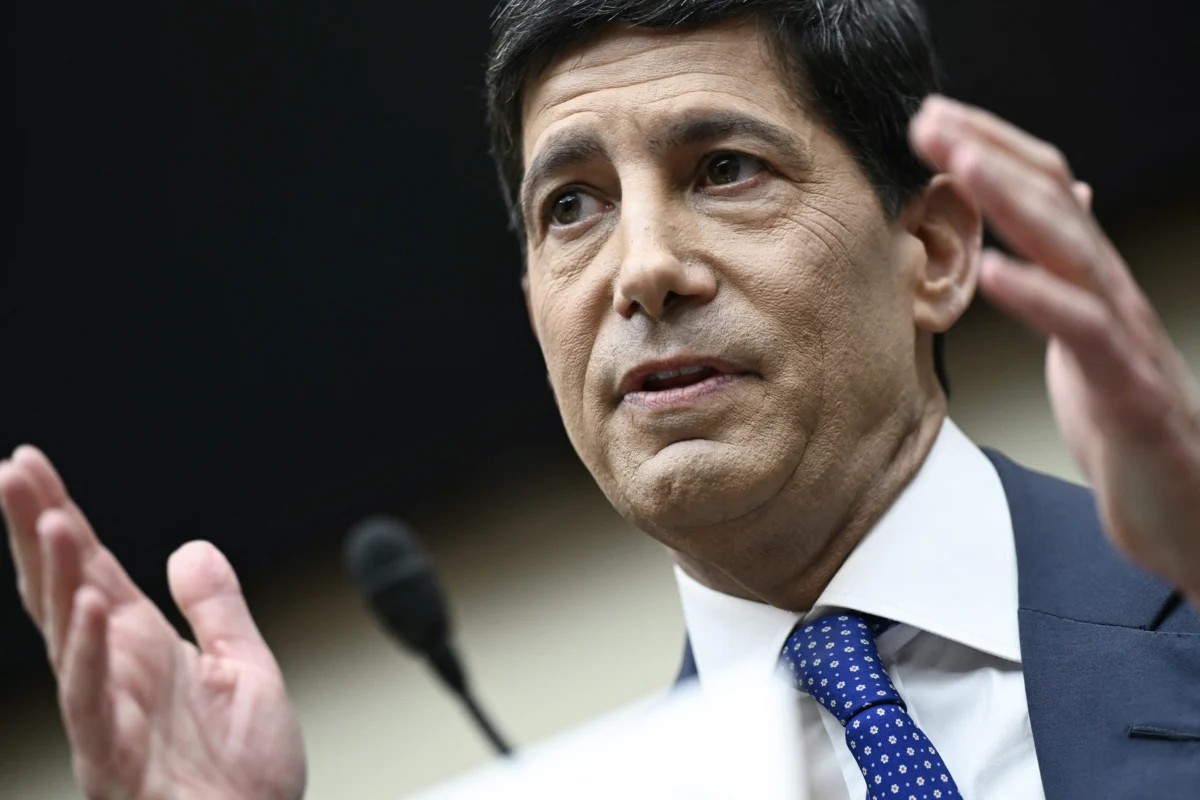
Kevin Warsh, the new Federal Reserve Chairman, has quickly established a speaking style marked by a distinct set of recurring phrases that, while seemingly straightforward, carry significant weight in the complex world of monetary policy. Unlike the often-enigmatic pronouncements of his predecessor, Alan Greenspan, Warsh’s chosen words, though fewer, demand careful interpretation. A close examination of his public statements reveals a consistent reliance on "family fight," "first principles," and "inflation is a choice." These phrases, uttered across his nomination hearing, inaugural press conference, a roundtable in Portugal, and two congressional testimonies, offer a window into his evolving approach to the nation’s central bank, prompting close observation from economists, market participants, and policymakers alike.
Warsh’s deliberate choice of language, coupled with a more reserved public demeanor than some of his predecessors, amplifies the importance of dissecting these recurring themes. In the five public appearances analyzed, Warsh employed the term "family fight" 13 times, invoked "first principles" 11 times, and stated "inflation is a choice" six times. While the sheer frequency of these phrases provides a quantitative measure of their significance, their qualitative meaning for the future direction of monetary policy remains a subject of intense scrutiny.
To decipher the potential implications of Warsh’s favored lexicon, CNBC consulted five prominent Federal Reserve watchers, offering diverse perspectives on the nuanced meanings embedded within these recurring expressions. Their insights illuminate the potential shifts in the Fed’s operational philosophy and its broader role in the U.S. economy.
"A Good Family Fight": Fostering Debate or Managing Dissent?
The phrase "family fight" has emerged as a cornerstone of Warsh’s public discourse, suggesting a desire for a more robust internal debate within the Federal Open Market Committee (FOMC).
Dan Greenhaus, chief strategist at Solus Alternative Asset Management, interprets this as a positive development, believing that "if Chair Warsh encourages more open debate around policy and creates an environment where prevailing assumptions can be challenged rather than simply accepted, that should ultimately lead to better policymaking." He emphasizes that the benefit lies not in altering individual meeting outcomes but in "improving the quality of the decision-making process over time."
Loretta Mester, former president of the Cleveland Fed, echoes this sentiment, noting that her experience on the FOMC already fostered an environment where all arguments were heard. However, she cautions that with "19 people around the table," structure is essential to prevent the loudest voices from dominating, potentially limiting the expression of diverse viewpoints.
Claudia Sahm, chief economist at New Century Advisors, views Warsh’s inclination towards a "lively back-and-forth" as a stylistic preference that aligns with his comfort level. She suggests that while the format might not directly influence policy decisions, the large number of participants makes a truly free-flowing discussion challenging.
Mark Spindel, a Fed author and chief investment officer at Potomac River Capital, offers a more critical perspective. He posits that "family fight" is Warsh’s aphorism for the "natural debate going on inside the FOMC and the Board," implying disagreements best kept within the institution. Spindel finds this problematic, as committee members have shown a greater willingness to express their opinions openly than Warsh’s framing might suggest. He also sees it as a potential tactic to "deflect his responsibility from external pressure."
Michael Feroli, chief U.S. economist at JPMorgan, views the phrase as an attempt at a "folksy" approach that doesn’t deviate from the tradition under former Chairman Ben Bernanke of welcoming dissenting opinions.
"First Principles": A Return to Core Economic Tenets or a Radical Rethink?
Warsh’s repeated invocation of "first principles" signals a desire to re-examine the foundational assumptions underpinning modern monetary policy. This theme appears to be deeply intertwined with his critique of the Fed’s recent performance and its theoretical underpinnings.
Spindel interprets "first principles" as a broad mandate for decision-making and structural reform. He references Warsh’s statement that central banking leaders share a "willingness to go back to first principles" as he questioned the entire process of monetary policy making. Spindel links this to Warsh’s renewed interest in monetary aggregates and his assertion that "monetary policy should have something to do with money." He laments that traditional economic tools like the Phillips Curve and economic forecasting may be sidelined in this approach, and points to Warsh’s criticism of past inflation misses as evidence of a departure from these "first principles."
Sahm views "first principles" as code for "question everything," aligning with Warsh’s stated goal of "regime change" at the Fed. However, she expresses skepticism about Warsh’s ability to fundamentally rewrite these principles, arguing that identifying flaws is insufficient without offering viable alternatives. She anticipates incremental improvements rather than a complete overhaul.

Mester sees "first principles" as an invitation to "rethink the way the Fed goes about achieving its dual mandate goals… without preconceived notions or assumptions." This involves a fundamental re-evaluation of communication strategies, inflation and labor market assessments, balance sheet operations, and data sources, with a focus on transitioning to new approaches. She notes that the FOMC has historically favored incremental changes, and this call for rethinking from first principles allows for consideration of more significant shifts.
Feroli connects "first principles" to Warsh’s comments about PhDs from elite institutions not keeping pace with monetary policy, suggesting a belief that academic focus has distracted the Fed from fundamental economic principles.
Greenhaus interprets this as a call for a more "originalist" approach to the Fed’s mandate, potentially leading to a more limited role beyond monetary policy, including skepticism towards regulatory and climate-related initiatives. He suggests a reassessment of the Fed’s expanded role since the Global Financial Crisis.
"Inflation is a Choice, and the Fed Must Take Responsibility for It": Accountability and Control
Warsh’s assertion that "inflation is a choice" and that the Fed must accept responsibility for it is a direct nod to the monetarist school of thought, particularly the teachings of Milton Friedman.
Mester connects this phrase to Friedman’s famous dictum that "Inflation is always and everywhere a monetary phenomenon." She emphasizes that in the long run, the Fed must ensure aggregate demand does not outpace aggregate supply to maintain price stability. While acknowledging short-term supply disruptions, she argues that persistent inflation necessitates a monetary policy restrictive enough to align demand with supply.
Sahm also links the phrase to Friedman, noting that the Fed’s existing framework already acknowledges that inflation is primarily determined by monetary policy in the long run. She highlights Warsh’s omission of the timeframe, arguing that short-term supply shocks can influence inflation irrespective of Fed actions. She believes Warsh’s phrasing, while restating an existing tenet, may confuse the public regarding the Fed’s capabilities.
Greenhaus interprets this as a signal that Warsh will be "less willing to attribute prolonged inflation overshoots primarily to exogenous factors such as tariffs, fiscal stimulus, or supply shocks." He believes Warsh’s message is that "the buck stops with us," implying a Fed that takes ownership of persistent inflation.
Feroli finds an apparent contradiction between Warsh’s "inflation is a choice" statement and his remark that "I don’t believe that we have a cruel choice." He argues that while the long-run control of inflation by the central bank is a widely accepted tenet, the absence of a short-run tradeoff between growth and inflation raises questions about why the Fed would ever "choose" inflation. He posits that the independence of central banks rests on their ability to resist the temptation to exploit this short-run tradeoff for political gain.
Spindel views this phrase as flexible, aligning with the FOMC’s restatement of its inflation mandate. He notes Warsh’s difficulty in elaborating on specific actions when questioned by Senator John Kennedy, ultimately suggesting that higher interest rates might be necessary. Spindel agrees with Warsh’s premise, stating, "At its simplest, the Fed sets the price of money, and if money is too cheap, the Fed has to act."
Broader Implications and the Road Ahead
Kevin Warsh’s chosen phrases are more than just rhetorical flourishes; they represent a potential recalibration of the Federal Reserve’s operational philosophy and its public communication strategy. The emphasis on "family fight" suggests a desire for a more dynamic and perhaps contentious internal debate, a departure from the more consensus-driven approach of recent years. This could lead to more robust policy discussions, but also raises questions about managing dissent and maintaining a cohesive public message.
The call to return to "first principles" signals a potential re-evaluation of the theoretical underpinnings of monetary policy, possibly questioning established doctrines and seeking a more grounded approach. This could lead to innovative policy solutions but also carries the risk of discarding valuable insights gained over decades of economic research. The implications for the Fed’s role in areas beyond traditional monetary policy, such as financial regulation and climate change, remain a significant area of observation.
Finally, the declaration that "inflation is a choice" places a strong emphasis on accountability, aligning the Fed with a more direct responsibility for price stability. While this echoes historical economic thought, the nuances of short-term versus long-term inflation and the interplay of monetary policy with external shocks will continue to be critical areas of focus for understanding the practical application of this principle.
As Warsh navigates his tenure, the market and economic observers will be keenly watching how these recurring themes translate into concrete policy actions. The interplay between his stated principles and the complex realities of the global economy will undoubtedly shape the future trajectory of U.S. monetary policy and its impact on domestic and international financial markets. The careful dissection of his language is not merely an academic exercise but a vital component of understanding the direction of one of the world’s most influential economic institutions.
