

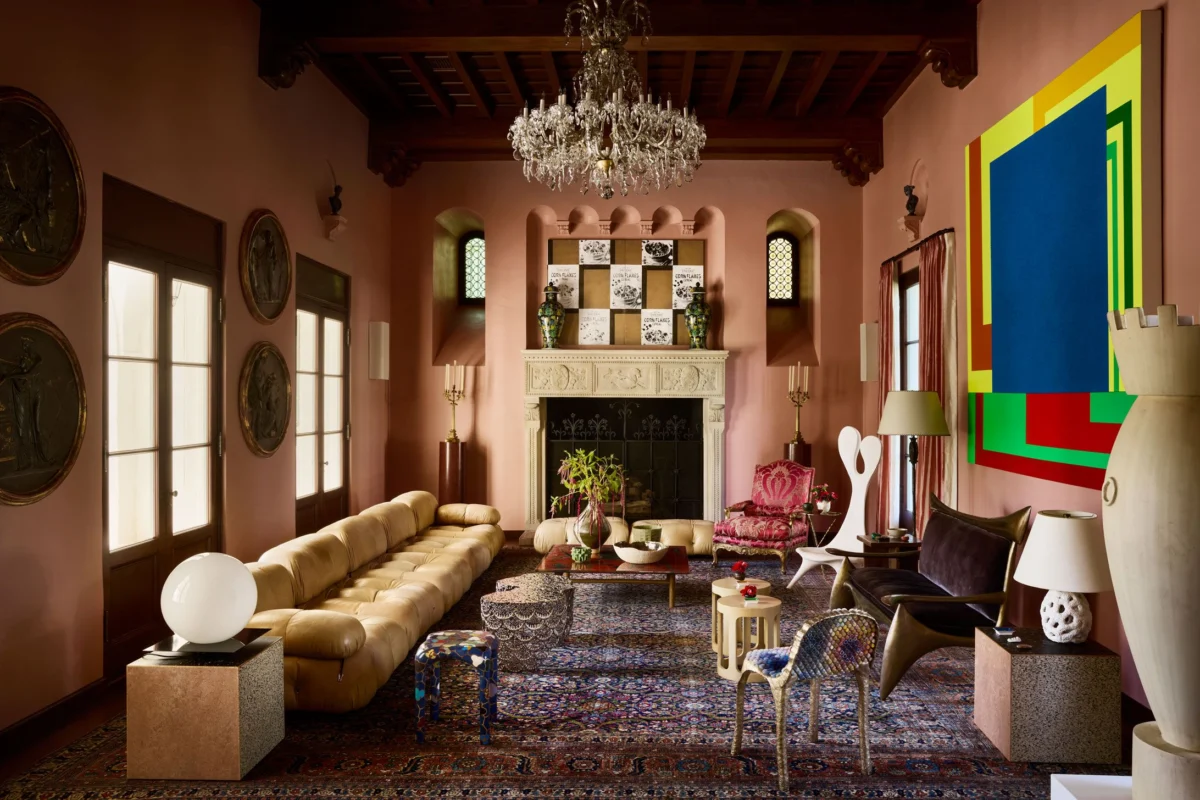
The acquisition of the 1928 Spanish Colonial Revival residence in Los Angeles’s historic Hancock Park neighborhood was as swift as its subsequent restoration was exhaustive. Purchased in a matter of minutes via a FaceTime call, the property became a multi-year labor of love for its new owners—a former beauty executive and her husband, a prominent film and television producer. Eschewing the traditional label of "homeowners," the couple approached the project as "stewards" of a significant piece of California’s architectural history. To realize their vision of a home that honored its past while embracing a highly idiosyncratic, modern sensibility, they collaborated with local designer Barry Fox and architect Sonny Ward of June Street Architecture.

The residence, originally designed by James Dolena—the architect celebrated for the Walt Disney Estate and various landmarks of Hollywood’s Golden Age—is a quintessential example of the Spanish Colonial Revival style that defined Los Angeles’s elite residential enclaves in the early 20th century. The project represents a broader trend in luxury real estate where preservation is not merely about maintenance, but about the "historicist ideology" of inhabiting the mindset of the original builders while integrating contemporary lifestyle requirements.
Architectural Stewardship and the James Dolena Legacy
Hancock Park remains one of the most architecturally protected and prestigious neighborhoods in Los Angeles. Established in the 1920s by the Hancock family, the area was designed around the Wilshire Country Club, attracting the city’s most influential figures. The Dolena-designed residence sits as a testament to this era, featuring a protected edifice, a lush central courtyard, and an unusually deep circular swimming pool.

Architect Sonny Ward oversaw the structural updates, which required a delicate balance between modern engineering and historical fidelity. "We didn’t see it as our right, frankly, to dramatically alter the home," the wife explained, reflecting a growing sentiment among owners of historic properties who prioritize architectural conservation over radical modernization. The intervention included the discreet expansion of living spaces, most notably the addition of a subterranean three-tier screening room—a necessity for a producer’s home that remained entirely hidden from the street-level profile of the 1928 structure.
The restoration process was characterized by a series of debates over original details. One primary point of contention was the cream ceramic flooring in the entry hall. While some suggested replacement, the owners insisted on its preservation. Designer Barry Fox noted that the floor possessed a specific patina that modern materials could not replicate, regardless of budget. This decision set the tone for the entire project: a commitment to the "good" bones of the house, even when they appeared aged.

A Design Philosophy of "Chopped and Screwed" Elegance
The interior design, led by Barry Fox, moved away from the "floppy" cream-colored sofas and neutral palettes that have dominated California interior design for the last decade. Instead, the owners sought what they described as a "chopped and screwed Mongiardino" aesthetic—a reference to the legendary Italian designer Renzo Mongiardino, known for his layered, theatrical, and historically dense interiors.
The wife further articulated the design direction through a unique analogy, asking: "What if Jacques Grange, instead of being a French Burgundy, were a funky natural orange wine?" This philosophy resulted in a "mix of weirdness" that blended blue-chip antiques with contemporary art and "counter-trend" furniture.

In the entry hall, this eclectic vision is immediately apparent. An 18th-century Russian mahogany table is paired with a Kashan Mohtasham rug from Beauvais Carpets. This classical foundation is juxtaposed with a sculptural vase by Built By Gattas, vintage parchment stools in the style of Jean-Michel Frank, and contemporary artworks by Brian Belott and Mary Louise Schrodt. Overhead, a plaster-and-bronze pendant from the Lamp Workshop provides a soft, artisanal glow.
The Kitchen as a Futuristic Laboratory
While much of the house adheres to a historicist aesthetic, the kitchen represents a deliberate departure. The owners envisioned a space that a 1920s family would have considered "ultramodern." The result is a laboratory-like environment clad in Calacatta marble and reflective brass.

This "futuristic envelope-push" incorporates high-end Miele and Sub-Zero appliances concealed behind brass cabinetry. Lighting is provided by Noguchi Akari and Lumfardo pendants, while Olson Kundig stools and Waterworks plumbing fixtures anchor the room. The wife noted that the space was intended to feel like a "laboratory for food," prioritizing sleekness and efficiency while serving as a bold counterpoint to the more traditional sequence of public rooms.
Chronology of a Curated Collection
The husband, a lifelong collector of fine art and antiques, worked closely with Fox to integrate pieces from his childhood home on Fifth Avenue in New York with new acquisitions. This created a sense of continuity and personal history within the newly restored Los Angeles walls.

In the dining room, the "right mix of weirdness" reaches its zenith. Fox sourced George III painted dining chairs from the personal collection of Queen Victoria at a Christie’s auction. These royal artifacts surround a 1970s Milo Baughman burlwood table, all set beneath a large Sol LeWitt watercolor. The walls are wrapped in Clarence House fabric, creating a formal yet vibrant atmosphere.
The library, painted in Farrow & Ball’s deep red "Incardine," centers on a 1960s Atelier Braun-Fortuna desk from Belgium. It is flanked by Josef Hoffmann leather Kubus chairs and a Philippe Hiquily side table made of gilt resin and petrified wood. This room, like the rest of the house, relies on a strict organizing principle. The owners believe that a formal house with clearly defined room uses actually enhances comfort by providing distinct environments for different aspects of family life.

The Primary Suite and Whimsical Personalization
The primary suite continues the theme of quiet restraint mixed with high-value curation. The bedroom features a vintage George Nakashima headboard and a Louis Cane dressing table and stool from Galerie du Passage. An 18th-century Régence beechwood fauteuil, a relic from the husband’s childhood, is upholstered in Le Manach fabric. The walls, painted in Farrow & Ball’s "Matchstick," serve as a neutral backdrop for works by Veronica Gelbaum, SoiL Thornton, and Magnus Peterson Horner.
Perhaps the most talked-about detail of the home is located in the downstairs powder room. In a move that exemplifies the couple’s playful approach to luxury, they commissioned P.E. Guerin to design and cast a custom bronze faucet. The fixture is an exact likeness of the family’s cat, Buns (named after Bunny Mellon). The process took two years to complete, resulting in a one-of-a-kind functional sculpture that sits atop a Calacatta Monet countertop.

Broader Impact and Market Analysis
The restoration of the Las Palmas residence serves as a case study in the evolving "High-End Preservation" market in Los Angeles. As many historic homes in neighborhoods like Hancock Park and Beverly Hills face the threat of "white-boxing"—the process of stripping historical interiors to create minimalist, speculative real estate—this project demonstrates an alternative path.
By investing in multi-year restorations and commissioning custom artisanal fixtures, homeowners are increasingly viewing their properties as long-term cultural assets. The collaboration between Barry Fox, June Street Architecture, and Hartman Baldwin (the contractor) highlights the specialized workforce required to maintain LA’s architectural integrity.

Furthermore, the project underscores the importance of art curation in modern interior design. Collaborating with Jessica Witkin of Witkin Art Advisory, the owners ensured that their collection of Sol LeWitt, Jenny Holzer, and Peter Halley works were not just "decor," but integral components of the home’s linguistic idiom.
In a city often criticized for its "disposable" culture, the meticulous stewardship of this 1928 James Dolena home stands as a significant contribution to the preservation of the Los Angeles landscape. It proves that the "right mix of weirdness" can, in fact, be the most sophisticated way to honor the past while living firmly in the present.
