

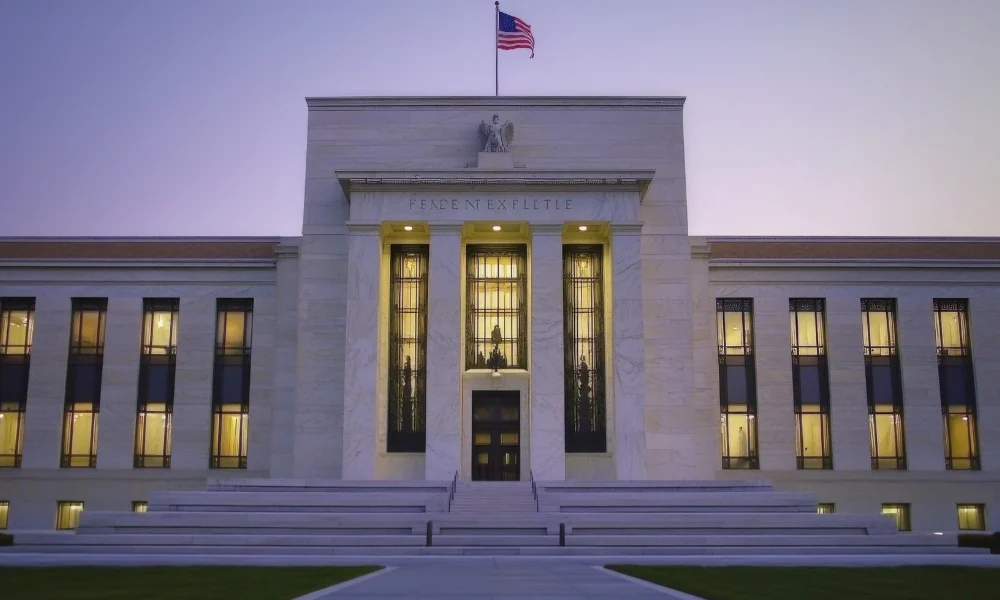
Washington D.C. – The Federal Reserve’s Federal Open Market Committee (FOMC) concluded its second meeting under Chairman Kevin Warsh on Wednesday, electing to maintain the benchmark federal funds rate within the target range of 3.5 to 3.75 percent. This decision, largely anticipated by financial markets and economic analysts, underscores the central bank’s delicate balancing act between fostering economic expansion and combating elevated inflationary pressures, exacerbated by ongoing geopolitical tensions in the Middle East.
The FOMC’s official statement acknowledged the "solid pace" of economic activity, attributing its resilience, in part, to robust productivity growth and strong capital investment. The labor market also received a positive assessment, with job gains keeping pace with workforce expansion and the unemployment rate exhibiting relative stability. However, the committee explicitly noted that "inflation remains elevated relative to the Committee’s 2 percent goal," a situation it attributed, in part, to "supply shocks that have driven price increases in certain sectors, including energy." The statement concluded with a firm commitment: "The Committee will deliver price stability."
This dual focus on growth and inflation control has become the defining challenge for the Fed in recent months. While the economy has demonstrated a capacity to absorb higher interest rates, the persistent upward trend in consumer prices, particularly for energy, presents a formidable obstacle. The decision to hold rates steady signals the Fed’s cautious approach, opting to observe the evolving economic landscape before contemplating further policy adjustments.
A Divided Committee: The Dissenting Voices
While the majority of the FOMC members supported the decision to maintain the current interest rate, the meeting was not without its internal debate. Notably, Governors Hammack, Kashkari, and Logan cast dissenting votes, advocating for a 25-basis-point increase in the federal funds rate. This divergence of opinion highlights the ongoing discussion within the central bank regarding the appropriate pace and magnitude of monetary tightening required to bring inflation back to the Fed’s long-term target of 2 percent.
The dissenting votes suggest that a significant portion of the committee believes that more aggressive action is necessary to curb inflationary expectations and prevent a further entrenchment of high prices. Their inclination towards a rate hike underscores the perceived urgency of addressing inflation, even at the potential risk of slowing economic momentum.
Inflationary Headwinds: The PCE Picture
The Fed’s preferred measure of inflation, the Personal Consumption Expenditures (PCE) price index, has been a key indicator guiding the FOMC’s deliberations. In May, PCE inflation reached a three-year high of 4.1 percent. Core PCE inflation, which excludes volatile food and energy prices, stood at 3.4 percent for the same month. Both figures remain substantially above the Fed’s 2 percent target.
However, there is a potential mitigating factor on the horizon. A statistical revamp by the Bureau of Economic Analysis (BEA) may lead to a downward revision of these PCE metrics by approximately 0.2 percent, according to reports in the Financial Times. This recalibration, if it materializes, could offer the Fed some statistical breathing room. Furthermore, preliminary data for June’s PCE inflation indicated a slight softening, a trend that could provide additional leeway for the committee in its monetary policy decisions.
Despite these potential statistical adjustments, the persistent elevated level of inflation remains a primary concern. The upward pressure on prices has been significantly influenced by supply-side shocks, with the energy sector being a particularly prominent contributor.
Geopolitical Ripples: The Impact of Middle Eastern Tensions
The decision to hold rates steady is intrinsically linked to the escalating geopolitical tensions in the Middle East, particularly the ongoing conflict involving Iran. The Strait of Hormuz, a critical chokepoint for global oil and gas shipments, remains under Iran’s control, raising concerns about potential disruptions to supply.
In the weeks leading up to the FOMC meeting, crude oil prices experienced a notable surge, with Brent crude rising by over 15 percent during July. This price appreciation is a direct reflection of the heightened uncertainty and the perceived risk of supply disruptions stemming from the escalating standoff between the United States and Iran. Fluctuations in energy prices have a cascading effect on the broader economy, impacting transportation costs, manufacturing expenses, and ultimately, consumer prices. The Fed’s decision to refrain from a rate hike can be interpreted, in part, as an acknowledgment of the external shocks influencing inflation, which are beyond the direct control of monetary policy.
Market Reactions: A Muted Response
The financial markets had largely priced in the Fed’s decision to hold interest rates steady. In the lead-up to the announcement, stock markets exhibited a degree of caution. Major indices saw declines, with the Dow Jones Industrial Average down around 1.5 percent, the S&P 500 off by approximately 0.7 percent, and the Nasdaq Composite trading 0.8 percent lower on the day. This downward movement suggests investor apprehension about the economic outlook and the ongoing inflationary challenges.
Following the FOMC announcement, the reaction in the bond market was relatively muted. Two-year Treasury bond yields, which are particularly sensitive to interest rate expectations, had been slightly higher in anticipation of the decision. However, they reversed course immediately after the announcement, trading 0.02 percent lower. This modest decline in yields indicates that the market’s expectations for future interest rate hikes may have been tempered by the Fed’s current stance, or that the decision was perceived as a confirmation of existing market sentiment.
A Look Back: The Fed’s Tightening Cycle
To understand the current decision, it is crucial to contextualize it within the Fed’s recent monetary policy trajectory. The FOMC has been engaged in a tightening cycle aimed at combating the highest inflation rates seen in decades. This cycle began in March of the previous year, with the Fed initiating a series of rate hikes to cool an overheated economy.
- March [Previous Year]: The FOMC announces its first rate hike of 25 basis points, signaling the start of a new monetary policy phase.
- May [Previous Year]: A more aggressive 50-basis-point hike is implemented as inflation concerns intensify.
- June [Previous Year] – [Most Recent Month Before Current Meeting]: A series of 75-basis-point hikes follow, marking the most rapid pace of monetary tightening in decades.
- [Month Prior to Current Meeting]: The FOMC moderates its approach with a 50-basis-point hike, reflecting an assessment of the cumulative impact of previous tightening measures and evolving economic data.
- [Current Meeting]: The decision to hold rates steady represents a pause in the tightening cycle, allowing the Fed to assess the full impact of its past actions and the prevailing economic conditions.
This historical progression demonstrates the Fed’s commitment to using its monetary policy tools to achieve price stability. The current pause, however, does not necessarily signify the end of the tightening cycle. It allows for a period of observation and recalibration in response to a complex and dynamic economic environment.
The Fed’s Mandate: Price Stability and Maximum Employment
The Federal Reserve operates under a dual mandate: to promote maximum employment and to maintain price stability. In recent times, the pursuit of price stability has taken center stage as inflation has surged well beyond the Fed’s 2 percent target. The current economic landscape presents a challenge to achieving both objectives simultaneously.
While the labor market has shown resilience, the persistent upward pressure on prices risks eroding purchasing power and distorting economic decision-making. The Fed’s commitment to price stability is paramount, as unchecked inflation can have detrimental long-term consequences for economic growth and stability.
Analysis of Implications: Navigating the Path Forward
The Fed’s decision to hold interest rates steady carries several important implications:
- Continued Economic Support: By not raising rates, the Fed is providing continued support for economic activity. Businesses and consumers can operate with a degree of certainty regarding borrowing costs in the short term, which can encourage investment and spending.
- Inflationary Vigilance: The statement clearly indicates that the fight against inflation is far from over. The Fed remains committed to its 2 percent target and will not hesitate to resume rate hikes if inflationary pressures persist or re-accelerate. The dissenting votes serve as a strong signal that the debate on further tightening is ongoing.
- Geopolitical Risk Management: The Fed’s decision implicitly acknowledges the significant role of external factors, such as geopolitical events and supply chain disruptions, in driving inflation. While monetary policy can influence demand, it has limited direct control over supply-side shocks. The Fed will likely continue to monitor global developments closely and their potential impact on domestic inflation.
- Market Expectations Management: The pause in rate hikes allows the Fed to manage market expectations more effectively. It signals a data-dependent approach, where future policy decisions will be guided by incoming economic information rather than a predetermined schedule. This can help to avoid unnecessary market volatility.
- Potential for a "Higher for Longer" Scenario: If inflation proves more persistent than anticipated, and geopolitical risks continue to exert upward pressure on prices, the Fed might be forced to maintain interest rates at their current restrictive levels for an extended period. This "higher for longer" scenario could have implications for asset valuations and corporate profitability.
The coming months will be critical for the Fed. The central bank will be closely scrutinizing key economic data, including inflation reports, labor market statistics, and consumer spending trends. The evolution of the geopolitical situation in the Middle East will also be a significant factor. The FOMC’s ability to navigate these complex dynamics will be crucial in steering the U.S. economy towards a path of sustainable growth and price stability. The dissenting voices on the committee underscore the difficult choices that lie ahead, as the Fed grapples with the dual challenge of taming inflation without unduly stifling economic expansion.
