

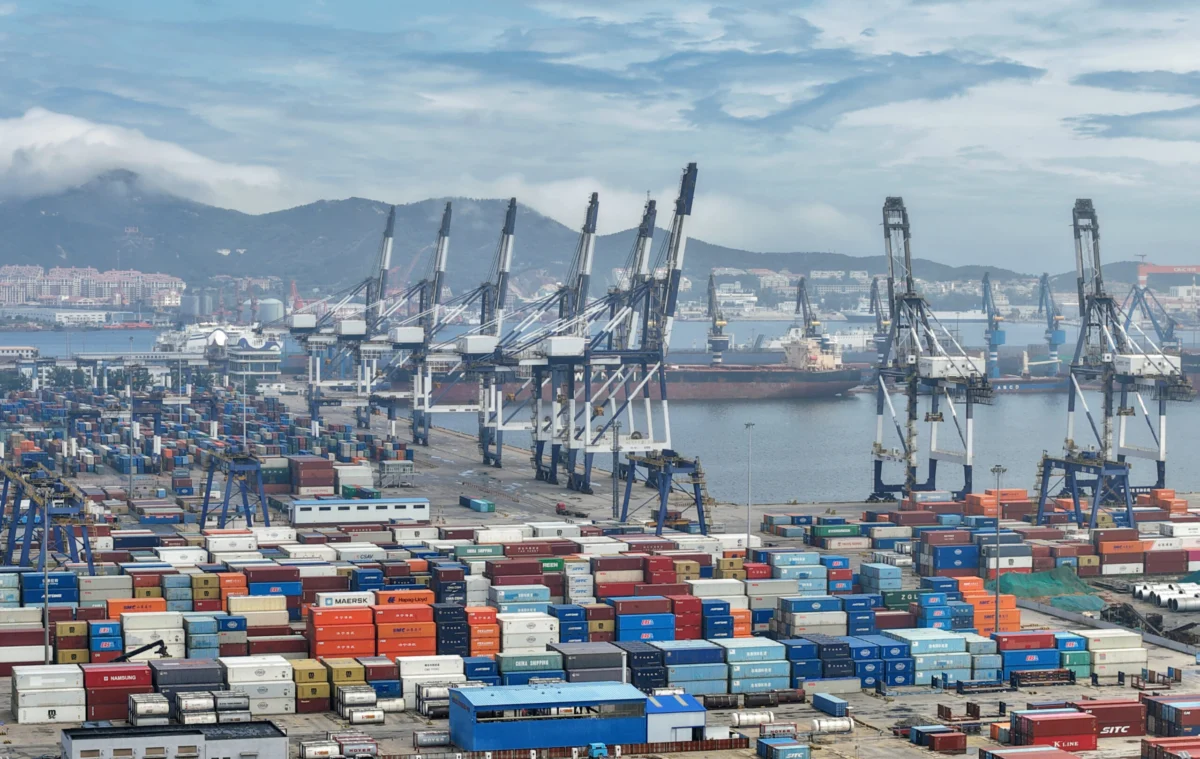
YANTAI, CHINA – JULY 14, 2026 – Containers are meticulously arranged at the Yantai Port International Container Terminal in Yantai City, Shandong Province, China, a visual testament to the nation’s complex economic landscape. The image, captured on July 14, 2026, by Cfoto | Future Publishing | Getty Images, serves as a backdrop to a narrative of decelerating growth, intensifying calls for policy intervention, and a widening gap between industrial might and domestic demand.
China’s economic engine sputtered in the second quarter of 2026, expanding at its slowest pace since the final three months of 2022. Gross Domestic Product (GDP) grew by a mere 4.3% between April and June, falling short of the 4.5% forecast by economists in a Reuters poll and marking a significant deceleration from the 5% expansion recorded in the first quarter. This downturn has amplified pressure on Beijing to implement substantial policy stimulus, as an accelerating slide in investments deepens the strain on growth, while consumption continues to exhibit a subdued trajectory.
The second-quarter performance places China below its annual growth target range of 4.5% to 5%, a goal described as the least ambitious in decades. This target is being pursued amidst persistent geopolitical tensions with key trade partners, including the United States and the European Union, and a lingering weakness in domestic demand. The stark contrast between robust industrial output and exports, often driven by global technological surges, and the faltering domestic economy highlights a deepening supply-demand imbalance that the National Statistics Bureau has explicitly acknowledged as "acute."
Investment Slump Deepens, Fueling Stimulus Calls
The most significant drag on China’s economic momentum appears to be the precipitous decline in urban fixed-asset investment. In the first six months of 2026, this critical component of the economy, which encompasses real estate development and infrastructure projects, contracted by 5.7% year-on-year. This figure was worse than the 4.9% drop anticipated in a Reuters poll, signaling a more severe downturn than previously estimated.
Tianchen Xu, senior economist at Economist Intelligence Unit, anticipates that this disappointing growth trajectory will necessitate a ramp-up in stimulus measures during the third quarter. "We expect to see a policy rate cut to stimulate investment demand," Xu stated, underscoring the urgency to rekindle economic activity. He attributed the accelerating investment slump to local governments prioritizing debt restructuring and a scarcity of viable projects in the development pipeline. "Boosting infrastructure investment will be a key focus for stabilizing growth," Xu added, emphasizing the government’s likely pivot towards large-scale public works.
Sarah Tan, an economist at Moody’s Analytics, echoed concerns about the investment climate, pointing to Beijing’s ongoing campaign to rein in excess industrial capacity and end bruising price wars. This strategic rebalancing, while aimed at long-term economic health, is expected to weigh on private investment in the near term. Official data corroborates these concerns, revealing significant contractions in key investment sectors: real estate investment plunged by 18%, infrastructure investment fell by 2.4%, and manufacturing investment declined by 1.2%.
Consumption Shows Tentative Signs of Recovery, Industrial Output Steadfast
While the investment landscape presents a somber picture, consumption indicators offer a glimmer of hope, albeit cautiously. In June, China’s retail sales grew by 1%, a welcome rebound from the 0.6% drop recorded in May. This figure also exceeded economists’ forecasts for a 0.1% fall, suggesting a modest recovery in consumer spending. However, the preceding month’s decline in May marked the first monthly contraction in retail sales since late 2022, a downturn attributed to tepid demand and aggressive discounting by merchants.
Industrial output, a consistent driver of China’s economic performance, demonstrated resilience. In June, it expanded by 5.3% year-on-year, surpassing the forecast of 4.7% growth and accelerating from the 4.5% expansion seen in May. This robust industrial performance, coupled with strong export figures, has been instrumental in propping up headline GDP growth, even as domestic demand falters.
A Tale of Two Economies: Exports Power Growth Amidst Domestic Weakness
The Chinese economy is currently characterized by a pronounced dichotomy: a robust export sector fueled by global technological demand, juxtaposed against a weakening domestic economy grappling with a prolonged property downturn and volatile energy prices. The global AI investment boom, in particular, has provided a significant tailwind for China’s export-oriented industries, compensating for headwinds stemming from geopolitical conflicts.
The National Statistics Bureau’s assessment of an "acute" imbalance between excess supply and sluggish demand underscores the challenges policymakers face. The bureau’s call for stepped-up "counter- and cross-cyclical adjustments" signals an acknowledgment of the need for more proactive and targeted interventions.

The intensity of the investment pullback has been described as "unprecedented" by Li Daokui, a professor of economics at Tsinghua University and former advisor to China’s central bank. Speaking at a macroeconomics seminar earlier in the week, Li advocated for a substantial expansion of government borrowing, suggesting a doubling of this year’s planned 12 trillion yuan ($1.7 trillion) in new debt issuance to finance crucial infrastructure projects and stimulate economic activity.
Divided Opinions on Stimulus Response
Economists remain divided on whether the current slowdown will compel Beijing to enact significant stimulus measures. Zhiwei Zhang, president and chief economist at Pinpoint Asset Management, believes the weaker headline growth is unlikely to trigger a substantial policy shift in the immediate months. He points to a strong first quarter and resilient exports as factors that will likely keep the annual growth target within reach.
Conversely, David Chao, global market strategist at Invesco, suggests that better-than-expected retail sales and industrial output figures provide policymakers with "more wiggle room" regarding near-term stimulus decisions. This suggests that while stimulus is likely, its timing and scale might be influenced by evolving economic data.
Exports Face Growing International Scrutiny
Despite being a bright spot for the Chinese economy, the surge in exports is increasingly drawing scrutiny and contributing to trade tensions with key international partners. In June, China’s export growth surpassed expectations, registering its strongest rise since late 2021. This expansion was largely driven by robust demand for chips, computers and parts, and power equipment, sectors directly benefiting from the global AI infrastructure buildout.
The surge in exports of technology-related goods also points to a deepening AI infrastructure cycle within China. Alongside autos and consumer goods, these sectors have collectively contributed to the export momentum. However, this export strength has widened China’s trade surplus with key partners. Larry Hu, chief China economist at Macquarie, reported that China’s surplus with the European Union expanded by 24% in the first half of 2026, primarily due to increased shipments of machinery and vehicles.
"Despite a three-month trade truce," Hu cautioned, "the growing surplus keeps the risk of a China-EU trade conflict elevated." This sentiment highlights the delicate balance China must strike between leveraging its export prowess and managing its international trade relationships, particularly in an environment already marked by geopolitical uncertainties and trade disputes.
Income Squeeze and Lingering Unemployment Concerns
The dual-speed nature of China’s economic recovery is also evident in its labor market and household incomes. Workers in companies with significant overseas revenue streams appear more optimistic about their job prospects than those employed by domestically focused firms, according to research by Morgan Stanley.
The bank estimates that pay cuts remain the top concern for Chinese households, projecting a moderation in income growth to approximately 5% over the next 12 months, down from a previous forecast of 5.8%. This income squeeze, coupled with the broader economic slowdown, could further dampen domestic consumption.
The official urban unemployment rate, which excludes individuals who have migrated from cities to rural areas, remained steady at 5% in June. This figure aligns with Beijing’s target of maintaining an unemployment rate below 5.5% over the next five-year period. However, a separate, more comprehensive survey conducted by Li Daokui’s team, which includes individuals who have been jobless for two years and are no longer counted in official labor force surveys, paints a starkly different picture. This broader measure indicates China’s unemployment rate stands at a much higher 10.2%.
Of particular concern is the demographic breakdown of the long-term unemployed, with more than half of the roughly 24 million individuals in this category aged between 16 and 24. Youth unemployment has been a persistent challenge for official statistics. Beijing controversially discontinued the publication of the youth unemployment rate in 2023 after it reached a record high of 21.3%, before reinstating it months later with a revised methodology that resulted in a lower reported rate. The youth unemployment rate did show some improvement, falling to 15.6% in May, its lowest level in nearly a year, suggesting that while challenges persist, some positive adjustments may be underway in the youth labor market.
The confluence of these economic indicators—slowing GDP growth, a deep investment slump, tentative consumption recovery, robust but scrutinized exports, and persistent income and unemployment concerns—paints a complex picture of China’s economic trajectory. The coming months will be critical in determining the effectiveness of Beijing’s policy response and its ability to navigate these multifaceted challenges to achieve sustainable and balanced growth. The world watches closely as the Chinese economy seeks to recalibrate in the face of both internal structural shifts and evolving global economic dynamics.
