

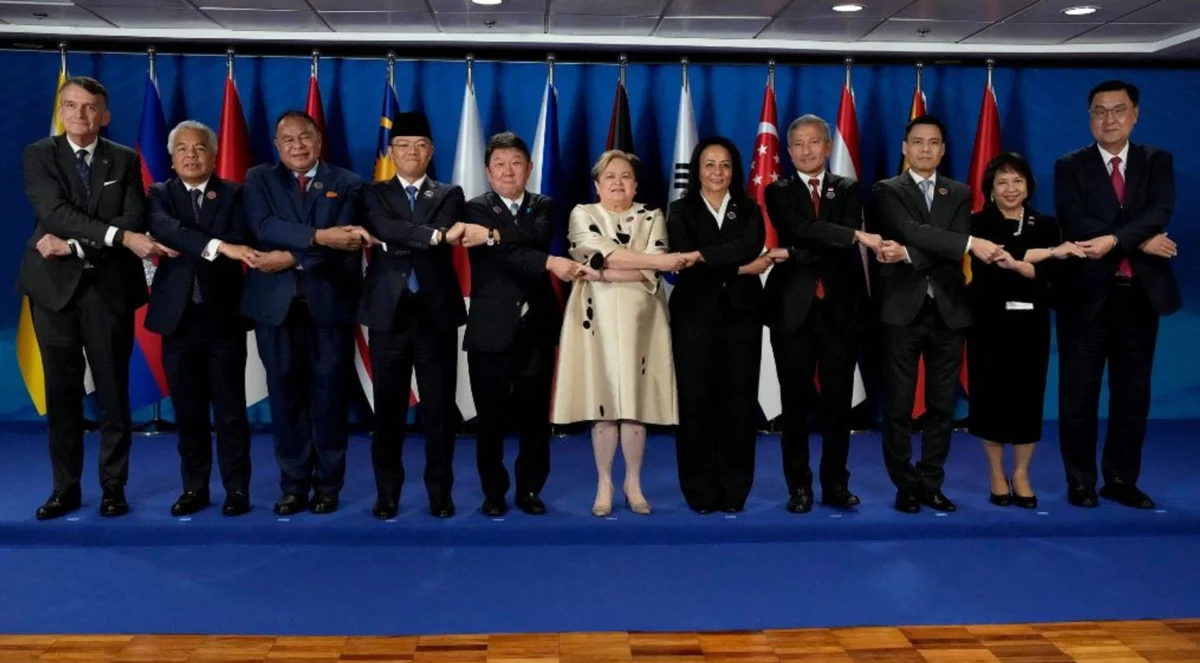
Manila, Philippines – A critical gathering of foreign ministers from the Association of Southeast Asian Nations (ASEAN) in Manila has been significantly overshadowed by a dramatic escalation of hostilities between the United States and Iran, diverting international attention and raising profound concerns over global stability and economic repercussions. The Philippines, as the host nation, convened the high-level meeting with an ambitious agenda focused on pressing regional security challenges, including the protracted civil war in Myanmar and the complex territorial disputes in the South China Sea. However, the resurgence of conflict in the Middle East has forcefully redirected the diplomatic discourse, compelling ASEAN ministers to issue urgent calls for an immediate cessation of hostilities amidst fears of widespread economic disruption and a potential global slowdown.
The Shadow Over Manila: ASEAN’s Critical Agenda
The ASEAN Foreign Ministers’ Meeting (AMM) and related meetings, a cornerstone of Southeast Asian diplomacy, commenced with the customary pomp and expectation of substantive discussions on matters critical to the region’s peace and prosperity. These annual gatherings serve as crucial platforms for member states—Brunei, Cambodia, Indonesia, Laos, Malaysia, Myanmar, Philippines, Singapore, Thailand, and Vietnam—to coordinate policies, build consensus, and engage with key dialogue partners. The 2024 iteration, hosted in Manila, was initially poised to tackle an array of internal and external pressures.
High on the original agenda was the dire humanitarian and political crisis in Myanmar, which has been mired in civil conflict since the military coup in February 2021. ASEAN has struggled to implement its "Five-Point Consensus" plan for peace, with ongoing violence and a lack of access for humanitarian aid exacerbating an already catastrophic situation. Ministers were expected to review progress, or lack thereof, and explore renewed strategies to foster dialogue and alleviate suffering.
Concurrently, the persistent and complex territorial disputes in the South China Sea—involving multiple ASEAN claimants (Brunei, Malaysia, Philippines, Vietnam) against China—were slated for extensive discussion. These disputes, which encompass vast swathes of resource-rich waters and crucial shipping lanes, continue to pose significant challenges to regional stability, demanding diplomatic ingenuity and adherence to international law. Issues such as freedom of navigation, resource exploitation, and the Code of Conduct negotiations with China were anticipated to dominate bilateral and multilateral sessions.
Beyond these immediate regional concerns, the ministers were also expected to deliberate on broader strategic issues, including economic integration, climate change, transnational crime, and ASEAN’s central role in the evolving Indo-Pacific security architecture. The presence of key dialogue partners, including the United States, China, Russia, Japan, South Korea, and the European Union, typically transforms these meetings into a nexus of global diplomacy, where regional priorities intersect with broader geopolitical currents. However, the renewed US-Iran conflict has dramatically shifted the focus, underscoring the interconnectedness of global security challenges and the vulnerability of regional agendas to external shocks.
Escalating Tensions: A Chronology of Recent US-Iran Hostilities
The latest flare-up between the United States and Iran represents a dangerous intensification of long-standing animosities, rooted in historical grievances, ideological differences, and divergent strategic interests in the Middle East. While specific details of the "renewed fighting" remain subject to ongoing reports, a hypothetical chronology leading up to the ASEAN meeting might include:
- [Date – 3 weeks prior to AMM]: Reports emerge of a suspected Iranian-backed drone attack on a US military facility in a neighboring Gulf state, causing casualties and prompting immediate US condemnation.
- [Date – 2.5 weeks prior to AMM]: The US responds with targeted airstrikes against facilities in Syria allegedly used by Iran-backed militias, emphasizing a policy of deterrence.
- [Date – 2 weeks prior to AMM]: A major oil tanker, flagged to an Asian nation and traversing the Strait of Hormuz, reports a suspicious incident, later attributed by Western intelligence to Iranian naval forces attempting to harass commercial shipping. Oil prices begin to tick upwards.
- [Date – 1.5 weeks prior to AMM]: Iran announces it has significantly increased its uranium enrichment activities beyond previous limits, citing a response to perceived US aggression and a lack of progress in nuclear deal negotiations.
- [Date – 1 week prior to AMM]: A cyberattack attributed to state-sponsored actors disrupts critical infrastructure in a Gulf ally of the US, with Washington pointing fingers at Tehran.
- [Date – Days leading up to AMM]: Both the US and Iran conduct separate, highly visible military exercises in the Persian Gulf, showcasing advanced weaponry and sending clear signals of readiness, further ratcheting up regional anxieties and drawing global attention just as the ASEAN meeting commences.
This sequence of events, real or hypothetical, illustrates a pattern of tit-for-tat escalation that pushes both nations closer to a direct, open confrontation, with severe implications for the international community.
Geopolitical Flashpoint: The Roots of US-Iran Conflict
The current tensions are deeply embedded in decades of complex relations, marked by the 1979 Iranian Revolution, the hostage crisis, and subsequent periods of sanctions, proxy conflicts, and on-again, off-again diplomatic engagement. The US maintains a significant military presence in the Middle East, primarily aimed at ensuring regional stability, counter-terrorism, and safeguarding vital energy routes. Iran, conversely, views the US presence as a hegemonic intrusion and seeks to assert its regional influence, often through a network of allied non-state actors.
Key points of contention include Iran’s nuclear program, its ballistic missile development, its support for groups designated as terrorist organizations by the US (such as Hezbollah and various Iraqi militias), and its human rights record. The US withdrew from the Joint Comprehensive Plan of Action (JCPOA), or Iran nuclear deal, in 2018, reimposing stringent sanctions aimed at crippling Iran’s economy and compelling it to renegotiate a broader agreement. Iran has consistently denied seeking nuclear weapons, asserting its right to peaceful nuclear technology, but has gradually reduced its compliance with the JCPOA in response to US sanctions.
The Strait of Hormuz, a narrow waterway connecting the Persian Gulf to the open ocean, stands as a critical choke point. Approximately 20% of the world’s total petroleum liquids consumption and a significant portion of liquefied natural gas (LNG) transits this strait daily. Any disruption here, whether through direct conflict, mining, or harassment of shipping, has immediate and profound global economic consequences, particularly for energy-dependent economies in Asia.
Economic Ripples Across Asia and Beyond
The immediate and tangible impact of renewed US-Iran hostilities is most acutely felt in global energy markets. Even the threat of disruption in the Persian Gulf can send crude oil prices soaring, reflecting investor fears over supply shortages. A hypothetical 10-15% increase in Brent crude prices, reaching levels perhaps exceeding $90-100 per barrel, would directly translate into higher fuel costs for consumers and businesses worldwide. For energy-importing nations in Asia, this is a particularly dire prospect.
ASEAN, with a collective GDP exceeding $3.6 trillion (2023 estimates) and a population of over 680 million, is heavily reliant on imported energy. Nations like Singapore, Thailand, and the Philippines are net oil importers, making them acutely vulnerable to price shocks. Higher oil prices translate into increased operational costs for industries, inflated transportation expenses, and ultimately, higher inflation for consumer goods. This can dampen economic growth, strain national budgets, and potentially exacerbate social unrest. For instance, a sustained $10 increase in oil prices could shave off 0.1-0.2 percentage points from global GDP growth forecasts.
Beyond energy, the conflict disrupts international commerce. Increased insurance premiums for shipping through the Middle East, rerouting of vessels to avoid perceived danger zones, and potential delays at major ports all add to the cost of trade. Asia’s manufacturing powerhouses, which depend on global supply chains and efficient maritime transport for both raw materials and finished goods, face significant headwinds. Major shipping routes through the Suez Canal and Strait of Hormuz are integral to connecting Asian economies with Europe and Africa. Any impediment there would lead to cascading effects across global supply chains.
The broader implications extend to a potential global economic slowdown. Investor confidence wanes in times of geopolitical instability, leading to capital flight from emerging markets and a general contraction in investment. Central banks, already grappling with post-pandemic inflation and interest rate hikes, would face renewed pressure to balance economic stability with inflationary pressures. This scenario risks undermining the fragile global economic recovery and could trigger a recessionary environment in vulnerable economies.
ASEAN’s United Front: Calls for De-escalation
Faced with this external crisis, ASEAN foreign ministers swiftly shifted their focus. The official statement released post-meeting, or inferred from ministerial comments, would undoubtedly reflect a unified call for immediate de-escalation. Ministers from various member states, including Indonesian Foreign Minister Retno Marsudi, Malaysian Foreign Minister Zambry Abd Kadir, and Singaporean Foreign Minister Vivian Balakrishnan, are likely to have stressed the urgent need for restraint from all parties.
Their statements would typically emphasize:
- Adherence to International Law: Urging all parties to respect sovereignty, territorial integrity, and principles of non-interference.
- Dialogue and Diplomacy: Calling for a return to diplomatic channels and negotiations to resolve differences peacefully, underscoring that military confrontation benefits no one.
- Protection of Civilians and Commerce: Stressing the importance of ensuring the safety of civilians and the unimpeded flow of international trade, particularly through vital maritime passages.
- Regional Stability: Expressing deep concern over the potential for the conflict to spill over and destabilize other regions, including Southeast Asia.
- Humanitarian Impact: Highlighting the potential for a new wave of humanitarian crises and displacement.
While ASEAN operates on principles of non-interference, its collective voice on matters of global peace and stability carries diplomatic weight. The bloc’s consistent emphasis on multilateralism and peaceful dispute resolution serves as a counterpoint to unilateral actions and military adventurism. However, the diverse geopolitical alignments of individual ASEAN member states – some with closer ties to the US, others seeking closer engagement with Iran or maintaining strict neutrality – can complicate the formulation of a robust, unified response beyond general calls for peace.
Distraction and Dilemmas: Impact on ASEAN’s Regional Focus
The US-Iran conflict presents a significant distraction and dilemma for ASEAN’s internal agenda. The Myanmar crisis, a humanitarian catastrophe on ASEAN’s doorstep, demands sustained attention and concerted action. The South China Sea disputes require careful, continuous diplomatic engagement to prevent escalation and progress towards a binding Code of Conduct. When global attention and diplomatic capital are diverted to the Middle East, the momentum for resolving these critical regional issues can dissipate.
For instance, the Myanmar crisis, already a source of internal division within ASEAN, might find itself further marginalized on the international stage. Resources and diplomatic efforts that could have been marshaled to address the humanitarian situation or engage with various stakeholders in Myanmar may now be redirected. Similarly, progress on the South China Sea Code of Conduct, which requires intense negotiation and trust-building among claimants and China, could slow down if the focus of key external partners, particularly the US, shifts dramatically.
Furthermore, the conflict underscores ASEAN’s vulnerability to external geopolitical shocks. The bloc aims to build a resilient and self-reliant community, but its economic openness and strategic location make it susceptible to events far beyond its borders. The challenge for ASEAN is to maintain its centrality and agency in addressing its own regional issues, even as global crises compete for attention and resources.
The Broader Geopolitical Chessboard: Indo-Pacific Dynamics
As highlighted by guests like Richard Heydarian, a political scientist and author of "Indo-Pacific: Trump, China and the New Struggle for Global Mastery," and Don McLain Gill, an Indo-Pacific Research fellow, the US-Iran conflict is not merely a Middle Eastern crisis but a significant variable in the broader Indo-Pacific geopolitical chessboard. The US, a crucial security partner for many ASEAN nations and a proponent of a "free and open Indo-Pacific," finds its strategic bandwidth stretched. A prolonged engagement in the Middle East could potentially impact its ability to project power and maintain its commitments in Asia, creating perceived vacuums that other major powers might seek to fill.
Phar Kim Ben, a Professor in ASEAN studies and former Director of Political & Security Community at the ASEAN Secretariat, would likely emphasize how such conflicts test ASEAN’s non-aligned stance and its ability to navigate complex power dynamics. ASEAN traditionally seeks to maintain good relations with all major powers, avoiding being drawn into great power rivalries. However, a direct conflict between the US and Iran could force difficult choices or at least intensify pressures on individual member states to align.
The Indo-Pacific concept itself, which emphasizes interconnectedness from the Indian Ocean to the Pacific, means that instability in one part of this vast region inevitably affects others. The economic arteries connecting East Asia to Europe and the Middle East run through these contested waters. Thus, the security of the Persian Gulf is intrinsically linked to the economic security of the Indo-Pacific.
Looking Ahead: A Precarious Path for Regional Diplomacy
The renewed US-Iran hostilities present a stark reminder of the fragile nature of global peace and the intricate web of interdependencies that define the modern world. For ASEAN, the immediate future is marked by a precarious balance: addressing urgent regional concerns while simultaneously grappling with the far-reaching consequences of a conflict thousands of miles away.
The Manila meeting, while overshadowed, served as a crucial platform for ASEAN to collectively voice its concerns and underscore the global imperative for de-escalation. The challenge now lies in translating these calls into tangible diplomatic pressure and ensuring that the pursuit of peace in the Middle East does not come at the expense of stability and progress in Southeast Asia. As the world watches the Middle East with bated breath, ASEAN’s efforts to steer its region through its own complexities will be tested by the persistent, unwelcome shadow of external conflict. The ability of the bloc to maintain unity, advocate for its interests, and advance its agenda amidst these global headwinds will be a defining measure of its resilience and relevance in an increasingly unpredictable world.
