

The already volatile geopolitical landscape of the Middle East has plunged into a new state of acute crisis following a stark threat from former U.S. President Donald Trump to launch a "very heavy" strike against a suspected Iranian nuclear facility, reportedly codenamed "Pickaxe Mountain." This incendiary declaration comes amidst a dangerous escalation of hostilities, with fresh attacks targeting key U.S. military installations and allied infrastructure in Bahrain and Kuwait, igniting widespread fears of a broader regional war that could engulf major global powers and disrupt international stability.
Escalating Regional Tensions and Direct Attacks
Reports from regional security sources and official statements confirm a series of coordinated attacks on critical sites in Bahrain and Kuwait late on July 20th and into the early hours of July 21st, 2026. In Bahrain, the primary target appeared to be the U.S. Naval Support Activity Bahrain, home to the U.S. Fifth Fleet, which sustained what U.S. Central Command (CENTCOM) described as "significant but contained" damage from a drone swarm attack. While initial assessments reported no U.S. casualties, several Bahraini security personnel were injured. Simultaneously, Kuwait experienced missile strikes on the Ali Al Salem Air Base, another crucial hub for U.S. air operations in the region, and a major oil refinery in Mina Al Ahmadi. Kuwaiti authorities confirmed at least two fatalities among civilian workers at the refinery and several injuries at the airbase.
These attacks follow earlier CENTCOM reports on July 20th of retaliatory strikes against what it described as "Iranian-backed militia infrastructure" within Syria and Iraq, believed to be responsible for previous assaults on U.S. personnel and assets. The rapid succession of these events underscores a perilous cycle of escalation, with each strike seemingly provoking a more forceful response, pushing the region closer to open conflict.
Trump’s Ominous Warning and the "Pickaxe Mountain" Target
The most alarming development, however, came from former President Donald Trump, who, in a widely publicized statement, vowed to bomb "Pickaxe Mountain," a site he identified as a critical Iranian nuclear facility, "pretty soon, and very heavily." While the precise nature and location of "Pickaxe Mountain" remain officially unconfirmed by current U.S. authorities or international watchdogs, intelligence community sources have long speculated about a deeply buried, highly fortified site in central Iran dedicated to advanced uranium enrichment or clandestine nuclear weapons development research. Such a facility, if confirmed and targeted, would represent a dramatic expansion of the conflict and a direct assault on Iran’s most sensitive strategic assets.
Trump’s statement, delivered through a digital platform and amplified by his political allies, has been widely interpreted as a clear signal of intent, raising questions about the degree of influence he still wields over U.S. foreign policy debates and potentially even future military actions. While not currently in office, his pronouncements carry significant weight given his past presidency and ongoing political prominence.
Background: A Decades-Long Rivalry at a Boiling Point
The current crisis is the latest and arguably most dangerous chapter in a nearly five-decade-long antagonistic relationship between the United States and Iran, marked by mutual suspicion, proxy conflicts, and intermittent direct confrontations. The roots of this animosity stretch back to the 1979 Islamic Revolution, which overthrew the U.S.-backed Shah and established an anti-Western theocracy.
Key milestones in this fraught history include:
- 1979-1981: The Iran hostage crisis, where 52 American diplomats and citizens were held for 444 days, fundamentally altering U.S. perceptions of Iran.
- 1980s: Covert U.S. support for Iraq during the Iran-Iraq War, further deepening Iranian resentment.
- 2000s: U.S. accusations of Iran’s pursuit of nuclear weapons, leading to international sanctions and the emergence of the "nuclear issue" as a central point of contention.
- 2015: The Joint Comprehensive Plan of Action (JCPOA), a landmark international agreement between Iran and the P5+1 nations (U.S., UK, France, China, Russia, Germany), designed to limit Iran’s nuclear program in exchange for sanctions relief. This deal, a product of extensive diplomacy under the Obama administration, offered a temporary respite from escalating tensions.
- 22018: The Trump administration’s unilateral withdrawal from the JCPOA, followed by the implementation of a "maximum pressure" campaign, reimposing and expanding sanctions. This move was widely criticized by European allies but lauded by regional adversaries of Iran, such as Israel and Saudi Arabia.
- 2019-2020: A series of retaliatory actions, including attacks on oil tankers in the Persian Gulf, a drone strike on Saudi oil facilities, and the U.S. assassination of Iranian General Qasem Soleimani, which brought both nations to the brink of war.
- 2021-2025: Attempts by the Biden administration to revive the JCPOA largely failed amidst intractable disagreements, particularly regarding sanctions relief and Iran’s continued advancements in uranium enrichment. During this period, Iran significantly expanded its enrichment capabilities, enriching uranium to near weapons-grade levels (60% purity) and installing advanced centrifuges, dramatically reducing its "breakout time" – the time it would theoretically take to produce enough fissile material for a nuclear weapon. International Atomic Energy Agency (IAEA) reports during this period consistently highlighted Iran’s lack of transparency and restricted access for inspectors.
Chronology of Recent Escalation (May-July 2026)
The current flashpoint did not emerge in a vacuum but is the culmination of several months of heightened activity:
- May 2026: Intelligence reports, widely circulated by Israeli and U.S. sources, suggest Iran is accelerating its nuclear program, with claims of advancements in weaponization studies at covert facilities. The IAEA expresses "grave concern" over Iran’s non-cooperation.
- Early June 2026: A major cyberattack, attributed to Iran, targets critical infrastructure in an unspecified Gulf nation, causing temporary disruptions to power grids.
- Mid-June 2026: Iranian-backed militias in Iraq launch a series of rocket attacks on facilities hosting U.S. forces, injuring several personnel. CENTCOM retaliates with airstrikes on militia strongholds along the Iraq-Syria border.
- Late June 2026: A drone believed to be Iranian is shot down by U.S. forces over the Strait of Hormuz. Iran claims it was a reconnaissance drone operating in international airspace.
- July 15, 2026: A high-level diplomatic push by European nations and Oman to de-escalate tensions fails, with both Washington and Tehran reiterating their maximalist positions.
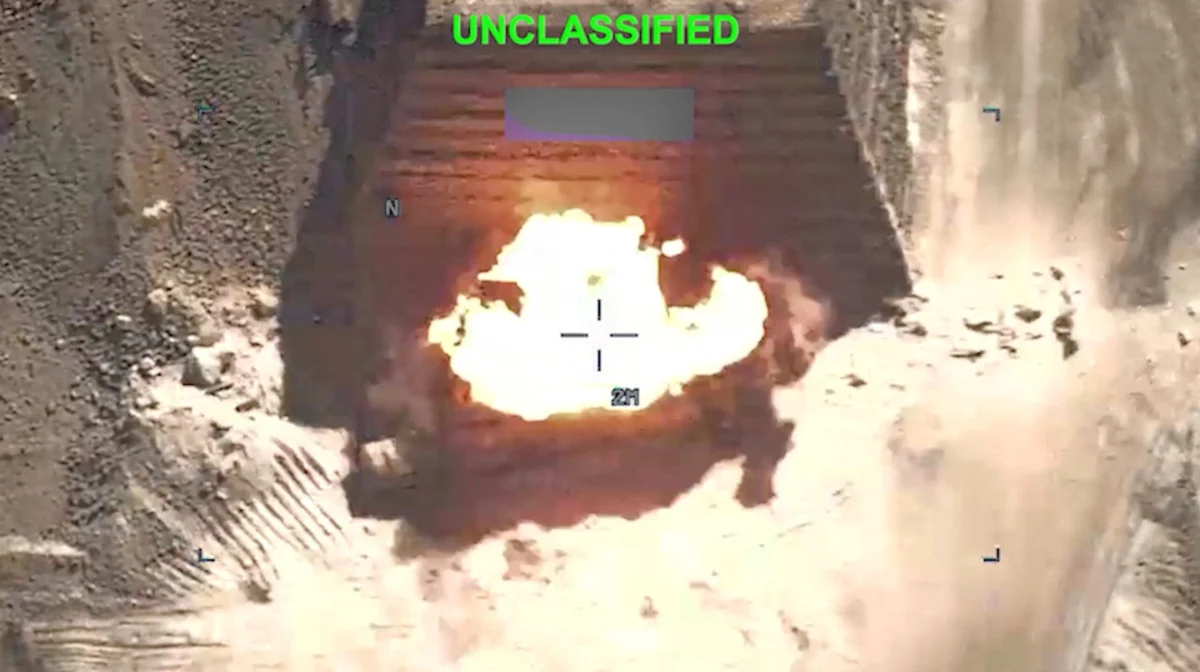
- July 20, 2026 (Morning UTC): U.S. Central Command announces it has conducted precision strikes against targets in eastern Syria and western Iraq, described as "command and control facilities and weapons depots" used by Iran-backed groups responsible for recent attacks on U.S. interests. A video, purportedly a screengrab from CENTCOM, shows an explosion at an unknown location, consistent with these strikes.
- July 20, 2026 (Evening/Night UTC): Coordinated drone and missile attacks strike U.S. and allied facilities in Bahrain and Kuwait, causing casualties and damage.
- July 21, 2026 (Early Morning UTC): Former President Donald Trump issues his threat regarding "Pickaxe Mountain," injecting an unprecedented level of direct military rhetoric into the crisis.
Official Responses and International Condemnation
The international community has reacted with alarm to the escalating crisis:
- U.S. Administration (Current): While not directly endorsing Trump’s specific threat, official statements from the Pentagon affirmed the U.S. military’s "unwavering commitment to protect U.S. personnel and interests in the region" and stated that "all options remain on the table" to prevent Iran from acquiring nuclear weapons. The State Department issued a travel advisory for the entire Middle East, urging U.S. citizens to exercise extreme caution and consider immediate departure from certain high-risk areas. Secretary of State called for "immediate de-escalation" but also warned Iran against further provocations.
- Iran: Iranian Foreign Ministry spokesperson vehemently denied any involvement in the attacks in Bahrain and Kuwait, labeling them "false flag operations" designed to create a pretext for aggression against Iran. The Islamic Revolutionary Guard Corps (IRGC) issued a statement condemning U.S. "adventurism" and warned of a "crushing and decisive response" to any direct attack on Iranian soil or its nuclear facilities, reiterating that such actions would be a "declaration of total war."
- Bahrain and Kuwait: Both nations condemned the attacks on their sovereignty and infrastructure, calling for international support and a unified response against aggression. They urged the U.S. and Iran to exercise maximum restraint to prevent further destabilization of the region.
- United Nations: UN Secretary-General António Guterres expressed "profound concern" over the deteriorating situation, calling on all parties to "step back from the brink" and prioritize diplomatic solutions. The UN Security Council is expected to convene an emergency session to discuss the crisis.
- European Union: EU High Representative for Foreign Affairs and Security Policy issued a statement emphasizing the "catastrophic consequences" of a military confrontation and renewed calls for a return to multilateral negotiations to resolve the nuclear issue. Germany, France, and the UK have reportedly initiated urgent diplomatic consultations to avert war.
- China and Russia: Both permanent members of the UN Security Council issued statements urging restraint, with Russia warning against "unilateral actions" that could ignite a wider conflict and China calling for all parties to respect international law and work towards peace.
Military Capabilities and Strategic Realities
Any direct military confrontation between the U.S. and Iran would be devastating.
- United States: Possesses overwhelming conventional military superiority, including advanced airpower, naval assets (carrier strike groups, guided-missile destroyers), long-range precision-guided munitions, and a vast network of regional bases. CENTCOM maintains a robust presence, constantly monitoring Iranian activities.
- Iran: Lacks comparable conventional power but possesses a sophisticated arsenal of ballistic and cruise missiles capable of reaching targets across the region, a significant drone program, fast-attack naval vessels, and an extensive network of proxy forces (Hezbollah, various Iraqi and Syrian militias, Houthis in Yemen) that could be activated to strike U.S. interests and allies. Its nuclear program, while officially civilian, has demonstrated the capacity to enrich uranium to high purities. "Pickaxe Mountain," if it exists as described, is presumed to be a deeply buried, hardened target, posing significant challenges for conventional airstrikes and potentially requiring specialized bunker-buster munitions.
Broader Impact and Implications
The potential implications of a full-scale U.S.-Iran conflict are profound and far-reaching:
- Economic Catastrophe: The Strait of Hormuz, through which approximately 20% of the world’s petroleum liquids pass, would likely be severely disrupted or closed, sending global oil prices skyrocketing and triggering a worldwide economic recession. Supply chains would be fractured, and insurance costs for shipping would become prohibitive.
- Humanitarian Crisis: A large-scale conflict would inevitably lead to massive civilian casualties, internal displacement, and refugee flows, exacerbating existing humanitarian crises in the region and placing immense strain on international aid organizations.
- Regional Destabilization: The conflict would almost certainly draw in regional allies and adversaries, potentially igniting a proxy war across multiple fronts (Iraq, Syria, Lebanon, Yemen) and further destabilizing an already fragile Middle East. Israel, Saudi Arabia, and other Gulf states would be on high alert, potentially becoming direct targets.
- Nuclear Proliferation: A direct attack on Iran’s nuclear facilities, particularly if unsuccessful in completely dismantling its program, could paradoxically accelerate Iran’s determination to acquire nuclear weapons, seeing them as the ultimate deterrent against future attacks. It could also set a dangerous precedent for pre-emptive strikes against suspected nuclear programs globally.
- International Law and Diplomacy: A unilateral strike on Iran would severely strain international law and the already weakened multilateral system, making future diplomatic resolutions to global crises even more challenging. It would further polarize global powers and potentially deepen the divide between the U.S. and some of its traditional allies.
As the world watches with bated breath, the situation remains extremely fluid. The attacks in Bahrain and Kuwait, coupled with the explicit threat against "Pickaxe Mountain," have pushed the U.S. and Iran closer to a direct military confrontation than at any point in recent history. The coming hours and days will be critical in determining whether diplomacy can still prevail or if the region is on the precipice of a conflict with unimaginable consequences.
