

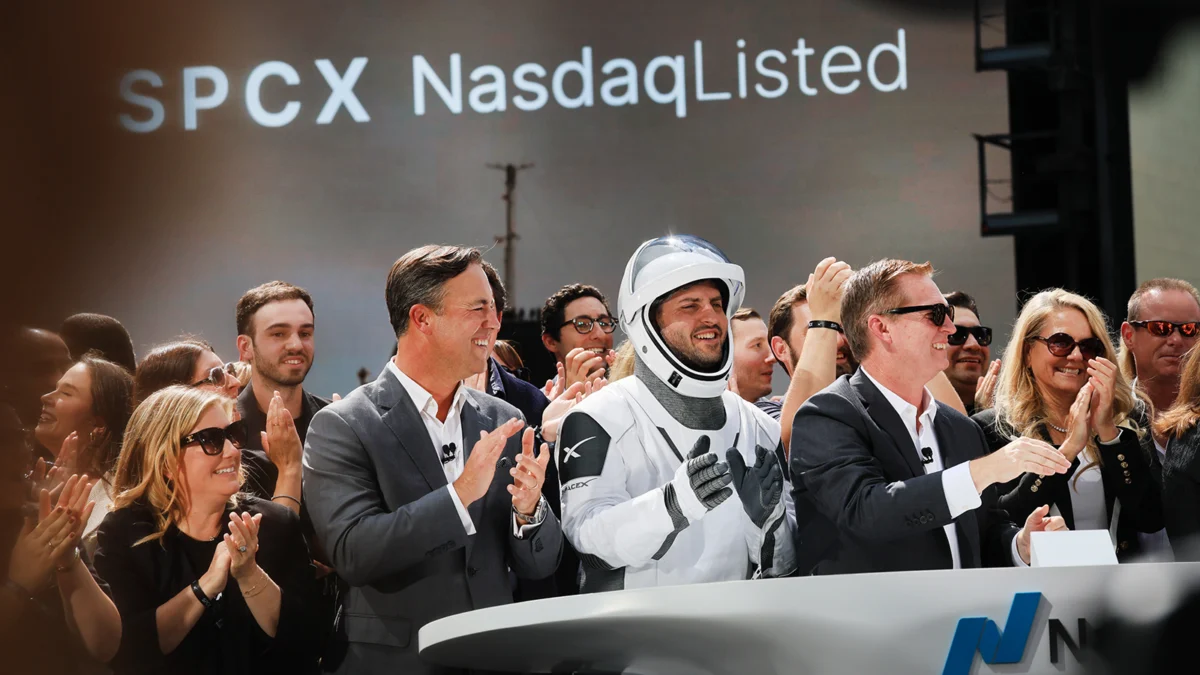
Over a month after SpaceX’s highly anticipated debut in the public markets, financial advisors are maintaining a cautious stance, advising investors against a hasty entry into the stock. The consensus among experts is that potential investors must conduct a thorough self-assessment to understand their motivations for seeking exposure to the aerospace and telecommunications giant. This measured approach comes as the company’s stock price has experienced a significant downturn following its initial public offering (IPO), prompting a more rational reassessment of its valuation based on underlying earnings and fundamental financial health.
Initial Market Reception and Financial Realities
SpaceX, a company synonymous with ambitious space exploration and disruptive technological innovation, embarked on its public market journey with considerable fanfare. The stock initially launched at $135 per share, quickly soaring to a high of $226. However, the momentum proved unsustainable, and the stock has since seen a precipitous decline, now trading below its IPO price. As of midday Tuesday, the stock was hovering around $127 per share.
This price correction coincided with the public release of SpaceX’s crucial S-1 filing, which offered investors an unvarnished look at the company’s financial performance. The filing revealed a substantial net loss of over $4 billion in the first quarter of 2026. This significant deficit was primarily attributed to the substantial investments and operational costs associated with its xAI artificial intelligence initiative.
David Busch, Chief Investment Officer at Trajan Wealth LLC in Scottsdale, Arizona, articulated this sentiment, stating, "The one profitable segment is Starlink, and that’s kind of the silver lining within the SpaceX IPO. So, I would say the valuation really still assumes near flawless execution across a very capital-intensive business." Starlink, SpaceX’s satellite internet constellation, remains the company’s current revenue-generating engine, offering a glimmer of profitability amidst broader investment in future ventures.
Navigating the Complexities of SpaceX’s Business Model
The inherent capital intensity of SpaceX’s operations, encompassing rocket development, manufacturing, launch services, and satellite deployment, necessitates substantial and sustained investment. This reality is a key factor influencing advisor recommendations. The company’s ambitious roadmap, which includes ambitious plans for Mars colonization, lunar missions, and the expansion of its Starlink service, requires billions of dollars in upfront capital expenditure.
Busch acknowledges the compelling narrative surrounding SpaceX, indicating his intention to closely monitor the company’s upcoming earnings calls. However, he emphasizes the paramount importance of discipline during this phase. "This is the time for discipline," he noted, especially considering the looming expiration of lock-up periods for early SpaceX investors, which could lead to further selling pressure on the stock.
Analyst Perspectives and Strategic Considerations
The cautious outlook is echoed by analysts at Janus Henderson. In a commentary released on July 16, analysts Taylor Portman and David Chung cautioned that while SpaceX’s long-term vision, including its concept of "orbital data centers," might hold merit, investors should approach these aspirations with a degree of skepticism. They advised that such prospects should be viewed as "optionality rather than a base case, with the timeline and scale still very much open questions."
Portman and Chung highlighted that sectors such as communications, defense, and infrastructure are poised for significant growth driven by strong secular trends in the coming years. However, they stressed that when evaluating specific companies within these sectors, investors must prioritize rational valuations and concrete evidence of a company’s ability to execute on its growth strategies. The aerospace industry, in particular, is characterized by long development cycles and significant technological hurdles, making sustained execution a critical determinant of long-term success.
Investor Psychology: Conviction vs. Fear of Missing Out (FOMO)
Gina Martin Adams, Chief Market Strategist at HB Wealth, an Atlanta-based RIA, pointed out a common pattern in post-IPO performance. She noted that publicly traded companies often tend to underperform the broader market for at least a year following their IPO, and sometimes for considerably longer. For investors who believe in the long-term growth potential of the space exploration industry as a whole, Adams suggested that investing in an exchange-traded fund (ETF) focused on innovation, which includes space-oriented companies like SpaceX, might offer a more diversified and potentially less volatile approach.
For those eager to invest directly in SpaceX stock, Adams posed a critical question: "If I get into SpaceX today and we go through a 20% correction, am I still going to be a happy owner of SpaceX?" She emphasized that an affirmative answer to this question indicates a strong conviction in the company’s long-term prospects. Conversely, she warned against allowing the "fear of missing out" (FOMO) to dictate investment decisions.
Matthew Parenti, Managing Director at Hightower Signature Wealth in Chicago, shared a similar perspective. He believes that for clients with a well-diversified portfolio and a long-term investment horizon, investing in SpaceX might be appropriate. However, he cautioned that these investors should temper their expectations regarding the explosive growth witnessed in earlier-stage Elon Musk ventures that went public. SpaceX’s IPO occurred at a more mature stage of its corporate lifecycle compared to previous companies led by Musk, such as Tesla.
Diversified Exposure and the Role of ETFs
Investors already have indirect exposure to SpaceX through various investment vehicles. The Nasdaq 100 index, for instance, fast-tracked SpaceX into its constituents following a revision of its methodology. However, Sam Huszczo, CIO at SGH Wealth Management in Lathrup Village, Michigan, advised investors to remember that due to the float-adjusted nature of indices, SpaceX’s public float would likely represent a small fraction of its total market value.
Furthermore, according to XA Investments, at least six closed-end funds, including an interval fund and two tender offer funds, hold SpaceX allocations ranging from 0.74% to 16.41%. Despite these options, Parenti recommended ETFs for clients seeking exposure through a fund, citing their greater liquidity and ease of access. Currently, Morningstar data indicates that over 150 ETFs include SpaceX in their holdings.
Busch cautioned against investing in funds where SpaceX is the primary holding, echoing the advice to postpone direct investment in the stock until a clearer understanding of its future prospects is established.
The Influence of FOMO and Market Dynamics
Both Martin Adams and Huszczo suspect that FOMO is a significant driver for many current investors in SpaceX. The prolonged private status of many prominent tech companies before their IPOs has provided retail investors with a more comprehensive understanding of their business models and potential economic impact. "There is a lot of pent-up demand for ownership, but it’s difficult to distinguish that from a fear of missing out in this environment. I think it’s a little bit of both," Martin Adams commented.
Huszczo pointed to the rapid proliferation of leveraged products and options activity surrounding SpaceX stock shortly after its IPO as evidence of FOMO influencing investor behavior. The trading of over a million SpaceX options on June 16, and the launch of at least 11 leveraged SpaceX ETFs by the same date, suggest a surge in speculative interest. "Whenever investors become more excited about the wrapper than the underlying investment, it’s worth slowing down," he wrote.
SpaceX’s Long-Term Vision and Investment Landscape
SpaceX’s journey from a private entity to a publicly traded company marks a significant milestone in the burgeoning space economy. The company’s ambitious goals extend beyond satellite internet and space tourism. Its Starship program is central to its long-term vision, aiming for fully reusable rocket systems capable of transporting large payloads and significant numbers of people to Earth orbit, the Moon, and eventually Mars. The success of these endeavors hinges on continued technological innovation, regulatory approvals, and substantial capital infusion.
The financial performance detailed in the S-1 filing, particularly the substantial losses attributed to xAI, underscores the high-risk, high-reward nature of SpaceX’s investment profile. While Starlink offers a tangible revenue stream, the profitability of its more ambitious ventures, such as interstellar travel and extensive orbital infrastructure, remains speculative and years, if not decades, away from fruition.
The Broader Implications for the Investment Community
The SpaceX IPO has ignited a broader conversation within the financial community about investing in transformative, capital-intensive technology companies. It highlights the inherent tension between the allure of groundbreaking innovation and the pragmatic need for sustainable profitability and rational valuation.
Financial advisors are increasingly emphasizing the importance of due diligence, risk tolerance assessment, and long-term strategic planning for their clients. The SpaceX situation serves as a salient reminder that even the most compelling technological visions require robust financial discipline and a clear path to monetization to justify their market valuations.
The company’s performance in the coming quarters and years will be closely scrutinized, not only by its investors but also by the broader industry. Its trajectory will likely influence future IPO strategies for similarly ambitious ventures and shape investor expectations for the evolving landscape of space exploration and technology. The coming months will undoubtedly provide further clarity on whether SpaceX can navigate its ambitious roadmap while delivering sustainable value to its shareholders.
