

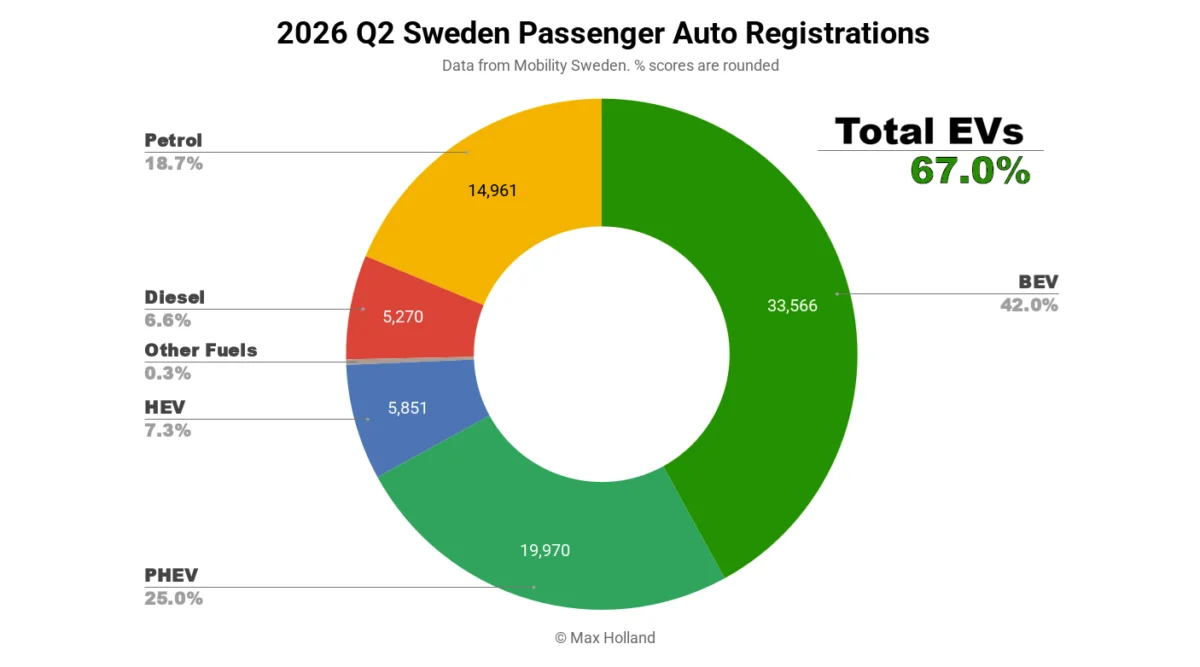
Sweden’s automotive sector reached a significant milestone in the second quarter of 2026, with plugin electric vehicles (EVs) capturing 67.0% of the total passenger vehicle market. This represents a notable increase from the 62.5% market share recorded during the same period in 2025, signaling a robust return to growth for the nation’s electrification transition. The quarterly data reveals a total of 79,891 new passenger vehicle registrations, marking a 22% year-over-year increase in overall market volume. Within this expanding market, battery electric vehicles (BEVs) emerged as the primary driver of growth, accounting for 42.0% of all registrations, while plugin hybrid electric vehicles (PHEVs) maintained a steady presence with a 25.0% share.
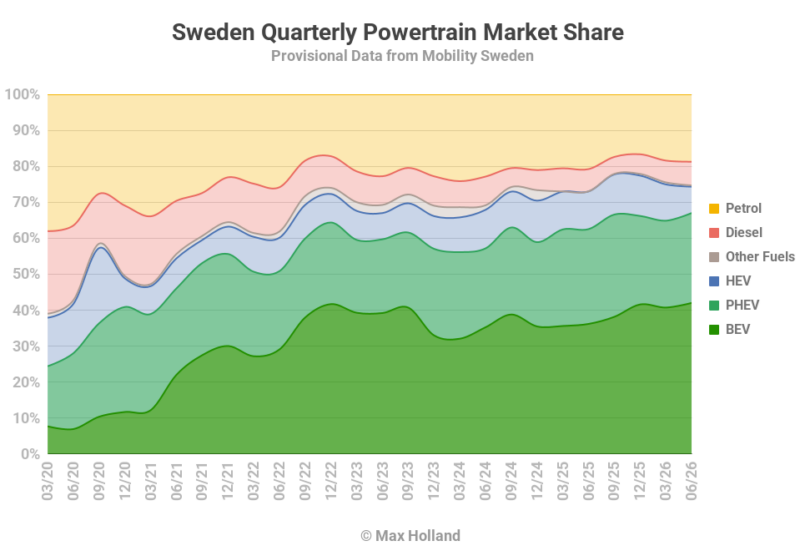
The performance in Q2 2026 suggests that the Swedish market has successfully navigated the stagnation observed between late 2022 and 2025. Following the abrupt removal of previous climate bonuses in late 2022, the trajectory for BEVs had largely plateaued. However, the second quarter of 2026 saw BEV volumes surge by 42% compared to the previous year, while PHEV volumes grew by a more modest 16%. This shift indicates a strengthening consumer preference for fully electric powertrains over hybrid alternatives, even as the total market for internal combustion engine (ICE) vehicles continues to contract, now sitting at a combined share of just 25.7%.
Quarterly Performance and Market Composition
The detailed breakdown of the second quarter results highlights a divergent performance among major automotive groups. While the overall market grew, the composition of that growth was dictated by brand-specific product cycles and strategic regional allocations. Kia, BMW, Toyota, and Volvo all reported substantially stronger year-over-year performances, bolstered by the introduction of refreshed models and more competitive electric lineups.

In contrast, the Volkswagen Group experienced a significant downturn in volume compared to Q2 2025. Market analysts suggest this decline may be attributed to temporary shifts in market-allocation priorities, where inventory might have been diverted to other European regions to meet specific regulatory targets or fleet demands. Despite this, the broader market remained resilient, supported by the entry of new brands and the expansion of existing electric portfolios.
The growth in BEV share—rising from 36.2% in Q2 2025 to 42.0% in Q2 2026—is particularly significant given the macroeconomic headwinds facing the Swedish consumer. With total plugin share now at two-thirds of the market, industry experts believe Sweden is on track to see BEV share approach the 50% threshold in the final months of the year, provided current adoption rates and supply levels remain stable.
Dominant Models and Emerging Contenders
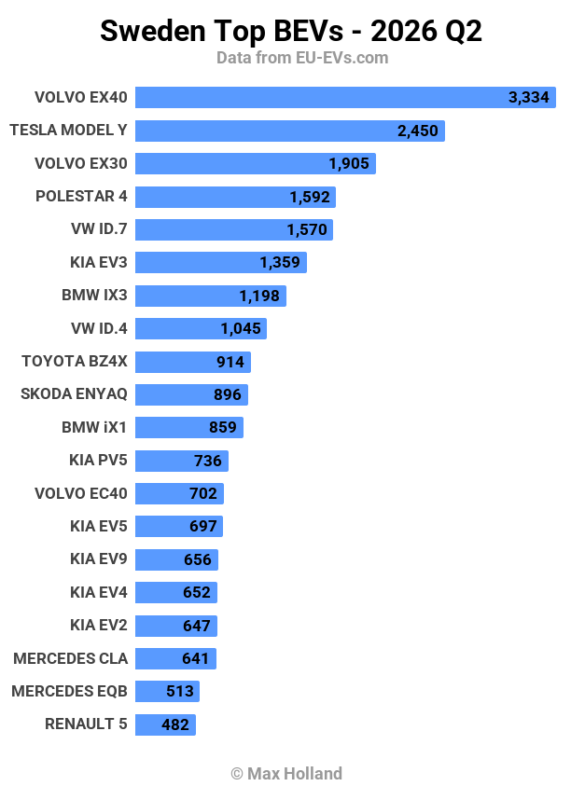
The Volvo EX40 continued its dominant streak in the Swedish market, securing the top spot among BEVs for the fourth consecutive quarter. With 3,334 units registered in Q2, the EX40 remains the preferred choice for Swedish consumers, benefiting from brand loyalty and its reputation for safety and versatility. Following closely in second place was the Tesla Model Y, which recorded 2,450 units—a figure nearly identical to its first-quarter performance, indicating a stabilized demand for the American crossover.
The Volvo EX30 rounded out the top three with 1,905 units, reinforcing Volvo’s stronghold on its home market. The consistency of the top three rankings from Q1 to Q2 suggests a maturing market where established leaders have secured a firm grasp on consumer interest. However, the mid-tier rankings showed significant movement.

The refreshed BMW iX3 emerged as a standout performer, climbing to 7th place with 1,198 units. While some of this volume is attributed to pent-up demand following the model’s update in late Q1, the iX3 is expected to maintain higher baseline sales than its predecessor. Kia also demonstrated significant momentum with its new "PV" and "EV" series. The Kia PV5, which debuted in late 2025, rose to 12th place with 736 units. Its smaller sibling, the Kia EV2, saw the most dramatic ascent, jumping from single-digit showroom volumes in the first quarter to 17th place with 647 units in Q2.
New Market Entrants and Pricing Dynamics
The second quarter of 2026 was characterized by a wave of new model debuts, diversifying the options available to Swedish buyers across various price points. Notable newcomers included the Subaru Uncharted, Subaru Outback (electric variant), Cupra Raval, Porsche Cayenne (EV), Xpeng P7+, Lexus ES, and the Zeekr 7GT.
The Cupra Raval, positioned as a more accessible entry into the electric segment, launched with its 52 kWh battery variant priced at 368,900 SEK (approximately €33,400) before incentives. A more affordable 37 kWh version is slated for an autumn release, with an expected starting price of 320,900 SEK (€29,070).
Industry observers have noted that while these prices are competitive within the Swedish context, they remain higher than in other European markets, such as Spain. This pricing disparity has led to discussions regarding the impact of national incentive schemes on manufacturer pricing strategies. Critics argue that subsidies intended to make EVs more affordable for consumers are sometimes absorbed by manufacturers through higher base prices, effectively subsidizing corporate margins rather than reducing the total cost of ownership for the average citizen.
Policy Drivers: The 2026 Rural Incentive Scheme
A pivotal factor in the renewed growth of the BEV sector is the 2026 incentive scheme introduced by the Swedish government. Unlike previous broad-based subsidies, this program specifically targets below-average-income households in rural areas. The policy aims to address the geographical disparity in EV adoption, ensuring that the benefits of lower operating costs and reduced emissions reach populations outside of major urban centers like Stockholm and Gothenburg.
Early data suggests the scheme is effectively stimulating demand in regions where ICE vehicles have traditionally remained more entrenched due to concerns over charging infrastructure and vehicle range. By lowering the financial barrier for rural commuters, the government has managed to restart the momentum that had stalled following the 2022 policy shifts. This targeted approach is seen as a more sustainable model for achieving long-term electrification goals without overextending the national budget.
Macroeconomic Context and Market Outlook
The resurgence of the EV market comes amidst a cooling macroeconomic environment in Sweden. GDP growth has slowed over the past year, with official figures showing a year-over-year increase of 2.0% in the first quarter of 2026, down from 2.3% in the third quarter of 2025. Despite the slowdown, other indicators suggest a level of stability that supports major consumer purchases.
Headline inflation stood at 0.7% at the end of June 2026, a slight increase from 0.5% in March. Interest rates have remained steady at 1.75% since September 2025, providing a predictable environment for vehicle financing. Furthermore, the Manufacturing Purchasing Managers’ Index (PMI) rose to 58.3 points in June, indicating a healthy expansion in the industrial sector and improving business confidence.
However, the automotive industry remains wary of potential political and economic volatility. Some analysts have raised concerns regarding the frequent revision of economic data, which can complicate long-term strategic planning for manufacturers and retailers.
Strategic Implications and the Path to 2030
The Q2 2026 results reinforce Sweden’s position as a leader in the global transition to sustainable transport. With plugin vehicles now accounting for two out of every three new cars sold, the infrastructure and energy sectors are under increasing pressure to keep pace with the rapidly expanding fleet.
The continued decline of internal combustion engines—which saw their share drop as plugin volumes rose—suggests that the "tipping point" for the Swedish market has not only been reached but surpassed. The primary challenge moving forward will be maintaining this growth trajectory as the market moves beyond early adopters and into the mass-market segments where price sensitivity is higher.
Looking ahead to the second half of 2026, the industry will be watching closely to see if the Kia EV2 and Cupra Raval can drive volume in the entry-level segment, and whether Volvo can maintain its double-digit market lead with its EX-series lineup. If current trends hold, Sweden is well-positioned to achieve its goal of a fossil-fuel-free passenger fleet, providing a blueprint for other nations navigating the complexities of the green energy transition. The combination of targeted government policy, a diversifying product range, and a resilient—if cooling—economy has created a fertile ground for the continued dominance of electric mobility in the Swedish landscape.
