

The global landscape of labor has undergone a seismic shift since the onset of the COVID-19 pandemic, giving rise to a mobile workforce of approximately 40 million individuals known as digital nomads. While the promise of "working from paradise" has been heavily marketed by tourism boards and social media influencers, a growing body of evidence suggests that the influx of high-income remote workers into developing economies and historic European cities is creating a complex web of environmental degradation, social displacement, and infrastructure strain. From the rice fields of Bali to the historic quarters of Mexico City and Lisbon, the "remote work revolution" is being re-evaluated not just as an economic boon, but as a significant challenge to local sustainability and social cohesion.
The phenomenon of digital nomadism is predicated on "geographic arbitrage"—the practice of earning a salary in a strong currency, such as the U.S. dollar or the Euro, while living in a location with a significantly lower cost of living. This economic disparity allows remote workers to enjoy a high standard of living that often remains out of reach for the local population. In Canggu, Bali, a town of roughly 9,000 residents that has become a global hub for the "laptop class," the disparity is stark. While a digital nomad might pay $16 to $50 a night for a hotel or villa, local workers often earn just a few hundred dollars a month. This influx of capital has spurred rapid, often unregulated development, with new villas and coworking spaces rising over traditional agricultural land, fundamentally altering the built environment and local ecosystems.
The chronology of this movement reveals a rapid acceleration. Prior to 2020, digital nomadism was a niche lifestyle largely reserved for freelance writers, software developers, and early cryptocurrency adopters. However, the 2020-2022 period saw a global pivot toward remote work as a corporate necessity. By 2023, over 50 countries, including Thailand, Spain, Indonesia, and Costa Rica, had introduced specialized "digital nomad visas" to attract high-spending temporary residents. These policies were designed to offset the loss of traditional short-term tourism revenue during the pandemic, but they have inadvertently created long-term pressures on local resources that many host communities were unprepared to manage.
Environmental concerns are at the forefront of the critique against untethered remote work. In many popular nomad hubs, the infrastructure for waste management and sanitation has not kept pace with the population growth driven by tourism. In Bali, for example, the visible reality of "paradise" often includes beaches choked with plastic litter and the pervasive scent of burning garbage—a result of a waste management system that cannot contain the volume of refuse generated by thousands of temporary residents. Furthermore, the reliance on air travel is a significant contributor to the carbon footprint of the nomad lifestyle. Many remote workers engage in "visa runs," flying to neighboring countries and returning the same day to reset their legal stay. Given that aviation accounts for approximately 2.4% of global carbon emissions, the cumulative impact of millions of individuals moving across borders several times a year is substantial.
The digital nature of the work itself also carries an environmental price tag. A significant portion of the nomad community is involved in energy-intensive sectors such as cryptocurrency trading, drop-shipping, and the development of artificial intelligence. These industries rely heavily on data centers, which are massive consumers of electricity and water for cooling. While a nomad may believe their footprint is small because they lack a commute or a permanent office, their digital activities may be doubling their environmental impact. OpenAI has reported that 92% of Fortune 500 companies utilize its data-center-reliant products; when individual nomads adopt these tools for their own entrepreneurial ventures, they contribute to a global surge in energy demand that offsets the benefits of reduced office commuting.
From an economic perspective, the presence of digital nomads is often described as a "force for good" by organizations such as The Economist. The data supports the claim that nomads contribute significantly more to local economies than traditional tourists. In Medellín, Colombia, research indicates that digital nomads spend nearly $1,000 more per month than local residents, circulating capital into the hospitality and service sectors. In Mexico City, nomad-related spending was calculated at over $532 million in 2021, accounting for roughly 15% of all tourist spending. However, this economic stimulus is a double-edged sword. The increased demand for high-end housing and amenities has led to "touristification" and gentrification, driving up rents and property taxes to the point where local families are being forced out of their ancestral neighborhoods.
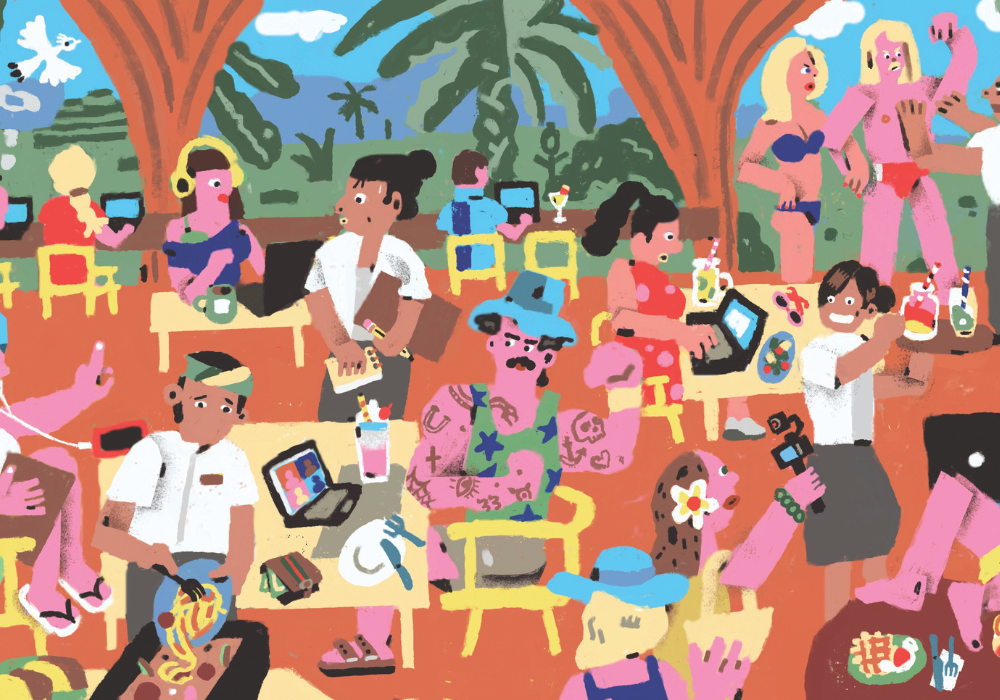
Socially, the digital nomad lifestyle is often characterized by a lack of integration. Daniel Schlagwein, a professor at Chulalongkorn University and the University of Sydney, has studied the "emancipation" of digital nomads and notes a sense of "self-reflective guilt" among some workers. While some nomads use their technical skills to assist local communities with projects like waste separation or decentralized facilities, many remain within a "nomad bubble," interacting primarily with other foreigners and remaining disconnected from local politics and social issues. This isolationism can lead to a lack of accountability; because nomads do not intend to stay for the long term, they may feel less invested in the long-term health of the community’s infrastructure or environment.
Infrastructure strain extends beyond housing to basic necessities like water and electricity. In arid or island environments, the high water consumption associated with Western-style villas—complete with private pools and lush gardens—can deplete local groundwater supplies, leaving residents with shortages. In Southeast Asia and parts of Latin America, the sudden surge in electricity demand to power air conditioning and high-speed internet in nomadic enclaves can lead to frequent brownouts, affecting local businesses and households that cannot afford backup generators.
Despite these challenges, some researchers argue that digital nomadism could be more sustainable than traditional corporate lifestyles if managed correctly. A study from researchers in Bangladesh suggests that remote work can lower office-related energy consumption and eliminate the daily carbon emissions of commuting. The average passenger vehicle generates approximately 4.6 metric tons of carbon dioxide annually. If a digital nomad adopts a "slow travel" approach—staying in one location for six months to a year and utilizing public transit—their footprint could theoretically be lower than that of a suburban commuter in North America. Furthermore, many nomads adopt a "post-materialist" approach to consumption, owning fewer physical goods and furniture, which reduces the resource drain associated with manufacturing and shipping consumer products.
The shift toward more sedentary remote work may be the natural evolution of the trend. As the "novelty" of the lifestyle wears off, many nomads choose to settle in one location, find a partner, or return to their home countries. Professor Schlagwein notes that as nomads tire of the constant logistics of travel, they often become "time-limited" in their mobility, eventually contributing to a more stable and integrated presence in their chosen communities. This transition from "nomad" to "remote resident" may be the key to mitigating the negative impacts of the movement, as it encourages longer-term investment in local social and environmental health.
In response to the growing backlash, some local governments are beginning to implement stricter regulations. Barcelona has seen massive protests against over-tourism and short-term rentals, leading to city-wide debates on capping the number of Airbnb licenses. In Indonesia, officials have toyed with the idea of a "quality tourism" model, which would prioritize high-net-worth individuals who stay longer and contribute to sustainable development goals. The challenge for these nations is to find a balance between the immediate economic benefits of foreign capital and the generational necessity of preserving their environment and social fabric.
As the remote-work revolution continues to mature, the burden of responsibility is increasingly falling on the nomads themselves. Ethical frameworks for digital nomadism are beginning to emerge in the form of "sustainable travel" blogs and community guidelines. These frameworks emphasize supporting local businesses over international chains, obeying local laws, and engaging in "slow travel" to minimize aviation emissions. However, individual action may not be enough to counter the systemic pressures of the global housing market and climate change.
Ultimately, the rise of digital nomadism serves as a microcosm of the broader tensions in a globalized world. It highlights the conflict between individual freedom and collective responsibility, and between short-term economic gain and long-term environmental sustainability. For host communities, the challenge is to harness the "force for good" that nomads represent without sacrificing their own residents’ ability to live affordably and sustainably. For the nomads, the task is to recognize that they do not exist in a vacuum; every "refreshing coconut" and every "beachside office" carries a cost that is often paid by those who call these destinations home long after the laptops are closed and the flights have departed.
