

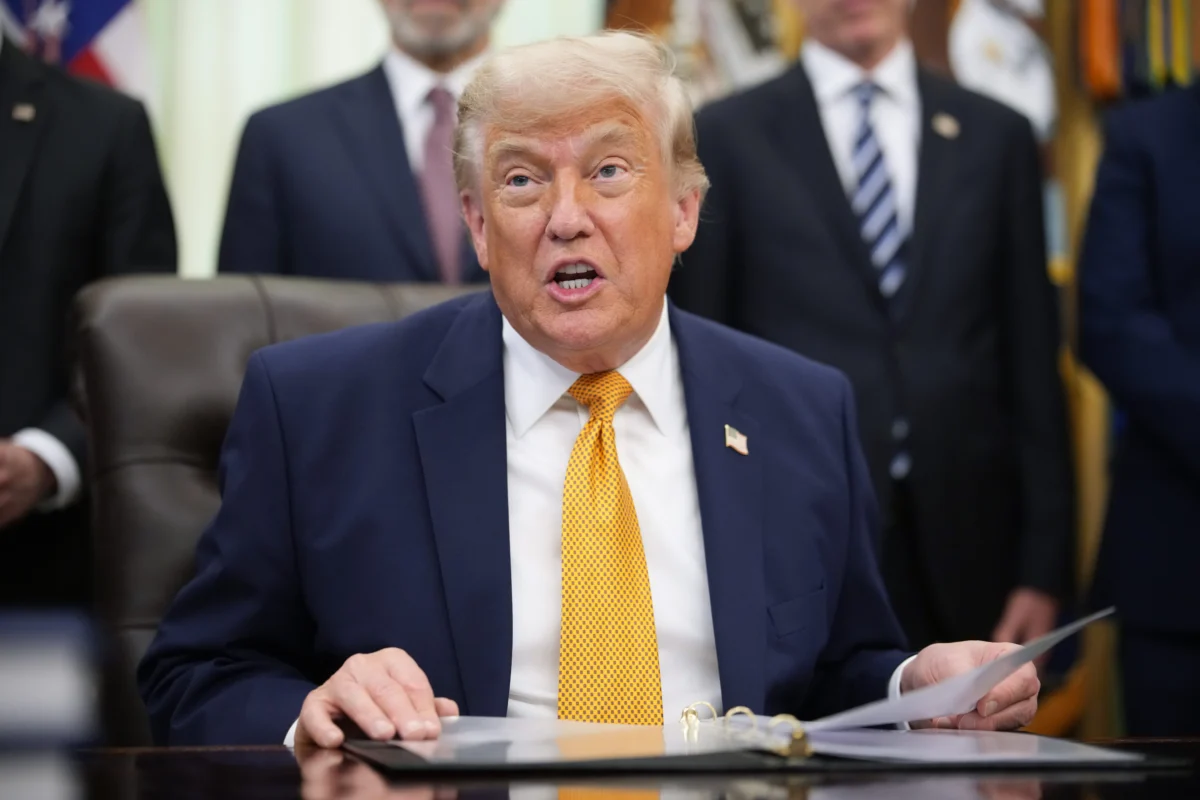
President Donald Trump on Wednesday ignited a firestorm of congressional contention and cast a shadow of uncertainty over a rare bipartisan legislative triumph by abruptly canceling the scheduled signing of a landmark housing bill. The eleventh-hour decision, announced via his Truth Social platform barely an hour before the ceremony on Capitol Hill, linked the popular housing initiative to the immediate passage of the contentious "SAVE America Act," an election measure broadly opposed by Democrats. This move sent shockwaves through Washington, underscoring the former president’s enduring influence over Republican legislative priorities and his willingness to leverage policy achievements for his own agenda.
The housing package, which had garnered overwhelming bipartisan support in both the House and Senate, was heralded by leaders from across the political spectrum as a significant win addressing critical affordability issues plaguing American families. Its sudden deferral has left the future of the bill in limbo, raising questions about legislative strategy, party unity, and the prospects for addressing the nation’s pressing housing crisis.
An Unexpected Veto by Fiat: The Day’s Tumultuous Events Unfold
The day began with anticipation surrounding what many saw as a moment of cross-party cooperation in a deeply divided Congress. House Speaker Mike Johnson (R-La.) and Senate Majority Leader John Thune (R-S.D.) had both championed the housing bill, which cleared both chambers with significant majorities, an increasingly uncommon feat in contemporary Washington. The stage was set for President Trump to sign the measure into law in Statuary Hall at noon ET, a ceremony intended to celebrate a tangible legislative achievement.
However, the celebratory mood quickly evaporated. In a series of posts on Truth Social earlier Wednesday morning, Trump first downplayed the significance of the housing bill, then followed up with a definitive cancellation notice. "Today’s Housing News Conference and Signing is hereby cancelled until such time as we pass the desperately needed SAVE AMERICA ACT, which I consider to be a National Emergency. Thank you for your attention to this matter!" Trump declared, effectively holding the widely supported housing legislation hostage to his demands for a separate, unrelated bill.
This dramatic intervention sent Capitol Hill scrambling. The housing bill, designed to boost housing supply, enhance affordability, and curb the acquisition of single-family homes by private equity firms, had been a key focus for lawmakers seeking to address soaring costs of living ahead of the 2026 midterm elections. The measure’s provisions, aimed at increasing access to affordable housing, resonated deeply with constituents grappling with rising rents and home prices across the country.
The SAVE America Act: A Political Imperative for Trump
At the heart of President Trump’s surprising demand lies the "SAVE America Act," a legislative proposal centered on what he and many Republicans describe as election integrity. The act primarily seeks to prevent noncitizen voting in U.S. elections – an act already illegal in federal contests and documented as exceedingly rare – and to implement nationwide voter identification laws. While the House of Representatives passed the SAVE America Act in February with broad Republican support, its path through the Senate remains effectively blocked.
The fundamental hurdle in the Senate is the filibuster rule, which typically requires 60 votes to advance most legislation. With Democrats staunchly opposed to the SAVE America Act, citing concerns about voter suppression and the lack of evidence of widespread noncitizen voting, Republicans are far short of the necessary supermajority. This legislative stalemate has led Trump to exert significant pressure on congressional Republicans, urging them to either abolish the filibuster entirely or attach the measure to a larger, must-pass bill. His move on Wednesday demonstrated his readiness to use high-profile, bipartisan successes as leverage in this ongoing battle.
A Day of Tensions and Confrontations on Capitol Hill
The cancellation of the housing bill signing was merely the prelude to a tumultuous afternoon for President Trump on Capitol Hill. He was scheduled to meet with Senate Republicans for a lunch, an invitation extended by Sen. Rick Scott (R-Fla.) rather than the customary GOP leadership, signaling a shift in influence dynamics. The meeting, intended to foster party unity, quickly devolved into a tense exchange.
One notable confrontation occurred between Trump and Sen. Bill Cassidy (R-La.), who had recently lost his GOP primary after Trump endorsed his opponent. Cassidy reportedly challenged the former president over the Iran memorandum of understanding, a separate foreign policy issue that has drawn sharp criticism from some Republicans, including Cassidy himself. Accounts from those present depicted a heated discussion. MS NOW reported Cassidy "yelled" at the president, citing an unnamed source. Cassidy later told reporters, "I’m not going to be bullied when I feel like I’m asking a question the American people need to know. And so at that point it began to escalate."
Other senators offered varying descriptions of the exchange. Sen. Ted Cruz (R-Texas) characterized it as a "spirited discussion," while Sen. Jim Justice (R-W.V.) described it as "not super combative, but very passionate." Justice added that both Cassidy and Trump "expressed their feelings and didn’t hold back," though he believed it concluded respectfully. Emerging from the meeting, Trump offered a cryptic assessment: "I think we had a really great meeting… We like our leader. … I don’t like a few people, but that’s OK. I think you know who they are." His remarks fueled speculation about lingering divisions within the Republican caucus.
Housing Uncertainty and the Legislative Labyrinth
The immediate fallout from Trump’s decision is profound uncertainty surrounding the future of the bipartisan housing package. Coming out of the Senate Republican meeting, there was little clarity on a path forward. Sen. John Husted (R-Ohio), a supporter of the package, noted that the housing bill "wasn’t really discussed." President Trump has a 10-day window to either sign or veto the bill. Without swift action to pass the SAVE America Act, a scenario deemed highly improbable given Democratic opposition and the Senate’s procedural rules, the housing bill risks expiring without his signature.
Senate Majority Leader John Thune, who had celebrated the bill’s passage, expressed hope for its eventual signing. "It’s a great piece of legislation that increases the supply of housing and the availability of credit to afford homes, so it’s an affordability issue, and eventually I hope he finds a way to sign it," Thune stated earlier in the day.

Speaker Johnson, addressing reporters at a House GOP news conference, acknowledged the significant challenges in advancing the SAVE America Act. He suggested that the "only path" to passage might be through budget reconciliation, a complex congressional process that allows certain spending and budgetary measures to bypass the Senate filibuster and pass with a simple majority. However, serious questions exist about whether an election bill like the SAVE America Act would even qualify under the strict rules governing reconciliation, which typically apply only to measures with direct budgetary impact. Furthermore, the reconciliation process itself is notoriously lengthy and arduous, making it an unlikely vehicle for quick passage.
"He’s laser focused on SAVE America Act, as most common-sense Americans are," Johnson said, reiterating Trump’s priorities. "The only path, I think, to get that done … you have to put it on a reconciliation bill."
Rep. French Hill (R-Ark.), who chairs the House Financial Services Committee and was a key architect of the housing bill in the House, reacted philosophically to the cancellation. Trump "picked the day, and now he’s chosen to change the day. So we’ll let him do that, and we’ll see what he decides to do," Hill told CNBC. His remarks reflect the delicate political maneuvering required when dealing with the former president’s unpredictable demands.
A Pattern of Leverage and Disruption
Wednesday’s incident was not an isolated event but rather the latest in a series of instances where President Trump has used unrelated legislative priorities as leverage, disrupting congressional Republican plans at the last minute. Just the previous week, Trump intervened in the confirmation process of Jay Clayton, his permanent nominee for Director of National Intelligence (DNI). Hours before Clayton’s scheduled Senate confirmation hearing, Trump posted on Truth Social, directing Clayton not to appear.
This move complicated Republican efforts to fast-track Clayton’s nomination, partly to prevent Bill Pulte, the Federal Housing Finance Agency head, from serving as acting DNI. Pulte had faced opposition from Democrats and some Republicans due to his perceived willingness to attack Trump’s political opponents while leading the housing agency.
Trump’s intervention in the DNI nomination also derailed negotiations for an extension of Section 702 of the Foreign Intelligence Surveillance Act (FISA), a critical foreign surveillance provision that had lapsed earlier in the month. Democrats vowed to oppose any extension as long as Pulte remained in the DNI role. Trump then explicitly linked FISA to his election bill: "[T]o add a slight bit of intrigue but, for the Good of the Nation, and the People of our Country, I will not approve FISA without THE SAVE AMERICA ACT going along with it," he posted on June 17, further entangling unrelated policy issues.
These repeated interventions have generated frustration among some congressional Republicans, who find themselves caught between supporting legislative achievements and adhering to Trump’s evolving demands.
Broader Implications: Political Fallout and Policy Gridlock
The cancellation of the housing bill signing carries significant political and policy implications. For President Trump, the move reinforces his image as a decisive leader who prioritizes his core issues, particularly "election integrity," even at the expense of bipartisan consensus. It signals to his base that he remains committed to these concerns, using all available leverage to push them forward.
However, the decision also risks alienating more moderate Republicans and those who prioritize legislative accomplishments over partisan battles. Republican leaders like Johnson and Thune, who had invested political capital in the housing bill, now face the difficult task of explaining its limbo and managing Trump’s demands, potentially exposing divisions within the party ahead of crucial elections. The ability of Republicans to campaign on tangible legislative successes, particularly on an issue as salient as housing affordability, has been severely hampered.
Democrats, meanwhile, quickly seized on the cancellation as evidence of Trump’s perceived indifference to the economic struggles of average Americans. Senator Elizabeth Warren (D-Mass.), who co-led the housing bill in the Senate, sharply criticized Trump’s actions during an appearance on CNBC’s "Squawk on the Street." "This just doesn’t make any sense, other than whatever it is he wants to do is a complete indifference to the cost squeeze on American families and to genuine efforts to do something about it," Warren stated. "He could be over here trying to claim a victory lap. And instead he’s saying, no, no, he doesn’t want anything to do it. It’s because he really doesn’t care about American families."
The incident underscores the deep legislative gridlock that continues to plague Congress. The tactic of linking unrelated bills, particularly when one faces insurmountable opposition, further complicates the legislative process and diminishes the prospects for bipartisan cooperation on critical national issues. The housing crisis, characterized by soaring median home prices, dwindling supply, and increasingly unaffordable rental markets across the country, demands urgent attention. The bipartisan bill was seen as a meaningful step, however incremental, to address these challenges. Its potential demise due to political maneuvering could leave millions of Americans facing continued economic strain and exacerbate the very affordability issues lawmakers sought to alleviate.
The coming days will reveal whether Congress can navigate this latest political minefield, or if a significant bipartisan achievement will fall victim to the escalating demands of a powerful political figure. The episode serves as a stark reminder of the complex and often unpredictable dynamics shaping legislative outcomes in Washington.
— CNBC’s Emily Wilkins contributed to this story.
