

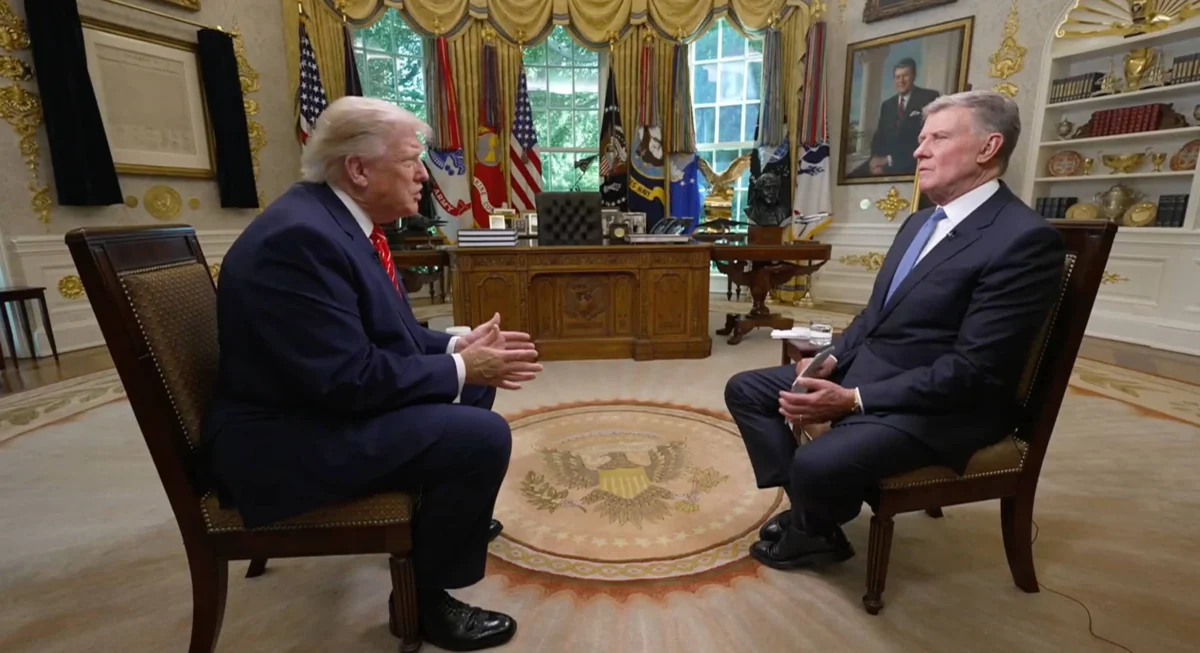
In a wide-ranging interview from the Oval Office, President Donald Trump delved into a series of contentious issues, from the ethical complexities surrounding his children’s business dealings to his ongoing efforts to remove a Federal Reserve governor, and the legislative gridlock impacting a bipartisan housing bill. The discussions, which took place on July 2, 2026, also touched upon his recent financial disclosures and his perceptions of the Supreme Court’s internal dynamics, collectively painting a picture of an administration grappling with numerous challenges at the intersection of power, finance, and governance.
The Presidency’s Shadow: Business Scrutiny and Family Finances
A significant portion of the President’s remarks focused on the intense scrutiny faced by his children’s business ventures, a recurring theme throughout his tenure. President Trump expressed a sense of empathy for his offspring, particularly given the unprecedented level of examination their investments attract. "Anything they do, because the presidency is so powerful… if they buy a cupcake company, well, the energy to make the cupcakes, is you know, sort of like, how’s my energy policy?" Trump remarked, illustrating his view that even seemingly innocuous business activities can be perceived through a lens of potential conflict of interest when connected to the nation’s highest office. He further elaborated, "Almost anything they do, if they want to buy a truck… if they buy an energy efficient truck, they have insider information."
This sentiment underscores a long-standing debate over presidential family business ethics. Historically, presidents have sought to create clear firewalls between their official duties and family financial interests to avoid even the appearance of impropriety. The Trump administration, however, has been unique in the extent to which the President’s adult children have maintained active roles in global business while their father occupies the White House. This arrangement has consistently drawn criticism from ethics watchdogs and congressional Democrats, who argue that it creates fertile ground for conflicts of interest, potential insider trading, and foreign influence.
Indeed, the investments of the younger Trumps have been heavily scrutinized, particularly as their portfolio has shown a discernible alignment with the strategic objectives of the administration. Reports indicate that the Trump administration has greenlighted deals or awarded contracts to various companies in which the President’s children hold investments. These include, but are not limited to, drone manufacturers and mining ventures, raising specific concerns about how government actions might directly or indirectly benefit the President’s family. Congressional Democrats have repeatedly vowed to investigate these transactions, citing potential violations of federal ethics laws and the Emoluments Clause of the Constitution, which prohibits federal officials from receiving gifts or payments from foreign governments without congressional consent. While presidents are largely exempt from many federal conflict-of-interest statutes, the ethical standard and public perception remain crucial.
Further complicating the financial landscape, the President’s recent financial disclosure revealed earnings exceeding $2 billion in 2025. During the interview, Trump stated that his son, Eric Trump, manages his finances in conjunction with "big firms." He clarified, "It’s given to big firms… my son Eric handles it. I don’t talk to him about things such as this. I think I’d be allowed to, I’m not sure even what the status is, but I don’t." Trump indicated that Eric channels these funds into "semi-blind trusts or blind trusts where people invest."
The concept of a "blind trust" is intended to fully divest an officeholder from knowledge of their assets and their management, thereby eliminating conflicts of interest. However, "semi-blind trusts," as described by the President, often fall short of this standard, as beneficiaries may retain some knowledge or influence over their assets. Ethics experts have consistently highlighted that true blind trusts, managed by independent third parties with no communication with the beneficiary, are the only mechanism to fully mitigate conflicts. The White House’s previous statements that the President’s finances are managed by his children have long fueled concerns, and the specification of Eric Trump in this role does little to quell these anxieties, particularly given his public profile and involvement in the Trump Organization.
Among the significant figures disclosed, approximately $515 million originated from sales of Trump-aligned World Liberty Financial (WLF) token sales, with an additional $65 million from sales of equity in WLF’s holding company. This foray into cryptocurrency, a nascent and often volatile market, has intensified the scrutiny over the President’s personal enrichment during his term. Trump staunchly defended the crypto venture, asserting there was "nothing illegal" and "nothing wrong" with it. However, the involvement of a sitting or former president in a commercial cryptocurrency venture, particularly one bearing his name, has sparked debate among financial regulators and ethics watchdogs about the appropriate boundaries for public officials and the potential for leveraging public office for personal financial gain. Such ventures can raise questions about market manipulation, investor protection, and the integrity of financial systems when associated with powerful political figures.
The Federal Reserve’s Independence Under Siege
Another critical point of discussion was President Trump’s renewed determination to remove Federal Reserve Governor Lisa Cook from her post. This declaration came even after the Supreme Court issued a ruling earlier in the week that temporarily blocked his ability to do so, sending her legal challenge back to a lower court. The Supreme Court’s 5-4 decision, while not definitively preventing a future firing, indicated that the current process was flawed, leaving the door open for Cook’s potential removal "on the merits."
Trump, undeterred by the judicial setback, explicitly stated his intent to oust Cook by "winning the case." He emphasized that the Supreme Court’s decision was based on "process and procedure" rather than the underlying allegations, suggesting his administration intends to pursue the case vigorously. This ongoing effort is a direct challenge to the cherished independence of the Federal Reserve, an institution deliberately designed to operate free from political interference to ensure stable monetary policy and protect the economy from short-term political whims.

The President’s justification for attempting to fire Governor Cook centers on allegations of "mortgage fraud," which he claims were uncovered by Bill Pulte. Pulte holds significant positions as both the head of the Federal Housing Finance Agency (FHFA) and the acting Director of National Intelligence. This dual role raises additional questions about the confluence of intelligence gathering, regulatory oversight, and political targeting. Economists and financial market analysts view any direct presidential intervention in the Fed’s personnel decisions with alarm, as it can destabilize markets and erode confidence in the central bank’s ability to make impartial, data-driven decisions. The removal of a Fed governor typically requires "for cause" justification, such as dereliction of duty, rather than policy disagreements or politically motivated accusations. Legal scholars are closely watching this case, as it could set a precedent for the limits of presidential power over independent agencies.
Legislative Gridlock: Housing, Voter ID, and the Filibuster
The interview also highlighted significant legislative bottlenecks, particularly concerning a bipartisan housing bill that had cleared Congress last month. President Trump offered a lukewarm reception to the bill, indicating his reluctance to sign it. This stance comes just a week after he abruptly torpedoed a planned triumphant signing ceremony on Capitol Hill for the housing legislation, effectively derailing what had been hailed as a rare moment of bipartisan cooperation. His primary condition for signing, he reiterated, is the passage of the SAVE America Act.
"There’s a lot of Democrat points in there that I don’t even think are good, but it’s fine," Trump said regarding the housing bill. "But I’ve made the case I’d rather not sign anything until we sign the SAVE America Act." This linkage has created a political impasse, stalling critical legislation aimed at addressing the nation’s severe housing affordability crisis, which has seen home prices and rental costs skyrocket across the country, exacerbating homelessness and economic inequality. The bipartisan housing bill was a collaborative effort, reflecting compromise from both sides to tackle a pressing national issue.
The SAVE America Act, which President Trump has championed for months, is a package of election reforms that includes requirements for voter identification at polls, proof of citizenship to register to vote, and a ban on mail-in voting. Proponents argue these measures are essential for ensuring election integrity and preventing fraud. However, critics, including numerous civil rights organizations and Democratic lawmakers, contend that such provisions, particularly strict voter ID requirements and bans on mail-in ballots, disproportionately disenfranchise low-income individuals, minority communities, the elderly, and students who may face greater challenges in obtaining required identification or casting in-person votes. The debate over voter ID and mail-in voting has been a flashpoint in American politics for years, with court challenges frequently arising over claims of voter suppression.
The President’s insistence on the SAVE Act has not only delayed the housing bill but has also caused significant disruption on Capitol Hill. Certain Republican members of Congress have threatened to continue voting down other pieces of legislation until the SAVE Act is passed, effectively shutting down the House floor for routine business. This tactic, while demonstrating a unified front for the President’s priorities, has contributed to an environment of legislative stagnation.
The path forward for the SAVE Act remains highly uncertain. The bill faces insurmountable obstacles in the Senate, where it lacks the necessary votes for passage. Senate Majority Leader John Thune, R-S.D., and his caucus have shown little appetite for eliminating the 60-vote filibuster, a procedural hurdle that requires a supermajority for most legislation to advance. President Trump, however, explicitly called for its abolition, stating, "What I’d really like is for them to kill the filibuster, terminate the filibuster." The filibuster’s elimination would fundamentally alter the legislative landscape, making it easier for a simple majority to pass legislation, but it remains a deeply divisive issue within both parties. Despite the legislative maneuvering, the bipartisan housing bill is expected to become law with or without Trump’s signature, unless he formally vetoes it, a step he has not yet indicated he will take.
The Judiciary and Perceptions of Partisanship
Finally, President Trump offered his observations on the dynamics within the Supreme Court, expressing frustration with what he perceives as a partisan divide. He complained that the three liberal justices on the bench consistently vote as a bloc, while the six conservative justices often splinter in their decisions. "Very, very seldom do they not vote as a bloc," Trump said of the liberals. "Whereas our people, and we have six, but they move around a little bit."
This commentary reflects a broader concern about the politicization of the judiciary, particularly the Supreme Court, whose members are technically nonpartisan and appointed for life to ensure their independence. While justices are often appointed based on their ideological leanings, the ideal of judicial independence posits that they should rule based on legal principles rather than political allegiances. Trump’s remark that "Republicans want to show everybody how they’re not controlled, how they’re so honorable" suggests a perceived weakness in conservative justices’ willingness to align strictly with a political agenda, contrasting with his view of their liberal counterparts.
The Supreme Court’s reputation relies heavily on public trust in its impartiality. Statements from political leaders that characterize justices as "our people" or imply partisan voting blocs can undermine this trust, fostering a perception that the court is merely another political arena rather than an impartial arbiter of the law. While ideological divisions on the court are well-documented, justices frequently cross ideological lines in their rulings, and many significant decisions are unanimous or near-unanimous. The President’s comments, however, contribute to a narrative that views the judiciary through a partisan lens, potentially eroding its legitimacy in the eyes of the public and setting a dangerous precedent for future interactions between the executive and judicial branches.
In summation, President Trump’s latest interview provided a candid glimpse into the myriad challenges and controversies defining his administration, from navigating the ethical minefield of family business to asserting executive authority over independent institutions and wrestling with legislative impasses. Each topic underscores the ongoing tension between established norms, political ambition, and the pursuit of policy objectives.
