

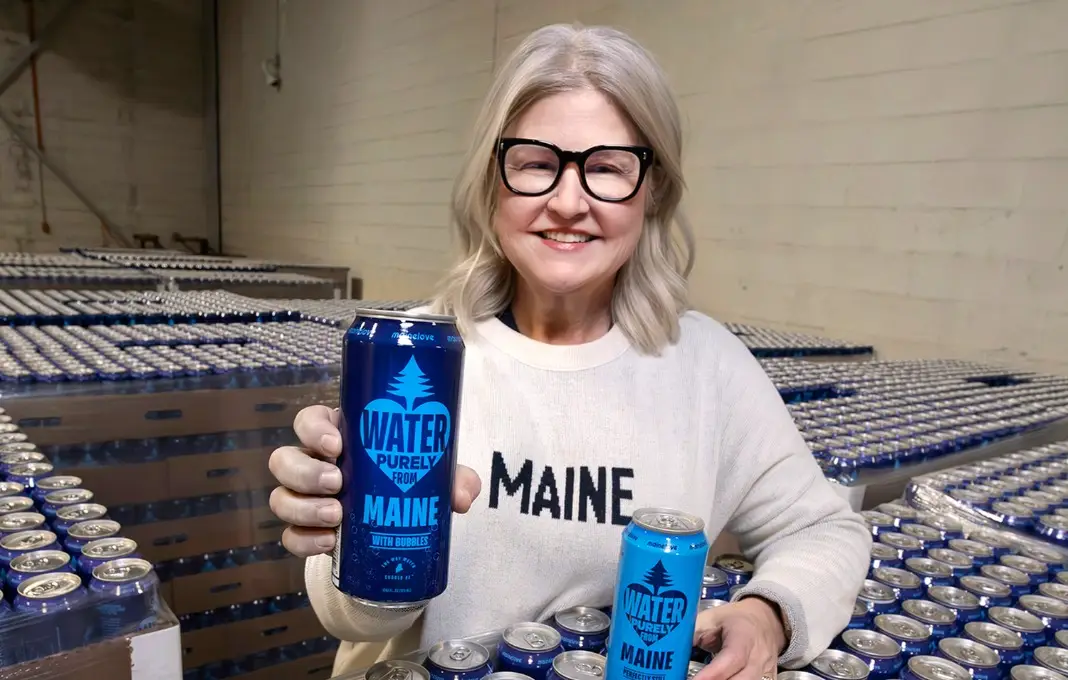
With alcohol consumption experiencing a nationwide decline, a significant portion of Maine’s vibrant craft brewing industry found itself facing periods of underutilization. Breweries, once humming with activity, were increasingly sitting idle for days at a time, a trend that spurred introspection and a search for alternative revenue streams. It was within this challenging landscape that Jen Millard, a 12th-generation Mainer, conceived of and meticulously built a new opportunity for the state’s beverage sector, transforming a potential crisis into a thriving enterprise.
Millard’s innovative solution centers on her canned water company, mainelove. Her stroke of genius lies in a business model that bypasses the substantial capital outlays typically required for beverage production. Instead, mainelove ingeniously leverages the existing infrastructure of local breweries during their off-peak hours, when they are not actively brewing beer. This symbiotic relationship has proven to be an unqualified success, benefiting not only the brewers and Millard’s burgeoning company, which now distributes its products across five states and in over 600 retail locations, but also the state of Maine itself. For generations, Maine has been a source of exported water, but mainelove is now generating significantly more local economic value, ensuring that a greater portion of this natural resource’s benefit remains within the state. In an exclusive interview, Millard detailed the genesis of mainelove, its rapid growth trajectory, and her ambitious plans for its future.
The Genesis of mainelove: A Brewer’s Insight Sparks an Opportunity
The decision to partner with local brewers was not a spontaneous one but rather the culmination of a deep-seated desire to contribute to her home state. "As a 12th-generation Mainer, I had always dreamed of starting a business in my home state, but never found the right opportunity," Millard explained. This long-held aspiration found its catalyst in early 2024 during a visit to her cousin, Frank Grondin, at his brewery, Brickyard Hollow.
During her visit, Millard observed a surprising amount of downtime within the brewery’s operations. Grondin confirmed that production for the week was already complete, a situation Millard later discovered was commonplace across many Maine breweries. "With alcohol consumption declining, a lot of brewing capacity was going unused for days at a time," she noted. Her subsequent research involved visiting over 40 breweries across Maine, where she consistently heard the same narrative of underutilized equipment and capacity.
Simultaneously, Millard recognized a critical asset that underpinned the quality of Maine’s celebrated beer: its pristine water. "I knew that one of the reasons Maine beer is so great is its access to Sebago Lake water," she stated. This realization sparked an "aha moment": could Maine’s exceptional water be bottled and canned, thereby offering breweries a vital avenue for revenue diversification?
Maine boasts a high concentration of brewers per capita who draw from the same exceptional water sources. This presented Millard with the foundational concept for an "asset-light" business model. "We partner with brewers to make water when they are not making beer," she articulated. Today, mainelove collaborates with three brewery partners to produce its product line, which includes still water, sparkling water, and three distinct flavored seltzers.
A Mutually Beneficial Partnership: Empowering Brewers and Local Economies
The advantages of this model extend directly to the brewery partners. By integrating them into the water economy, mainelove provides them with a crucial additional revenue stream. Perhaps more significantly, this initiative helps to retain a greater share of the economic value derived from Maine’s water within the state. Millard’s driving question throughout the business’s development was, "How do I build something meaningful in Maine?" This question guided her toward the innovative brewer partnership model. With approximately 65 brewers drawing from Sebago Lake, and an even larger number if considering the broader watershed, the potential for collaboration is substantial. The exceptional quality of this water is attributed to the natural filtration provided by the surrounding forests, a testament to Maine’s rich natural heritage.
Millard’s interactions with brewers revealed a shared set of challenges. "We are not pretending to save the beer industry, but we can create a new opportunity for them," she emphasized. A core principle in building mainelove was to maximize the retention of value within Maine. "Maine has been exporting water for generations, but the economic benefit has not always stayed in the state," Millard observed, underscoring the importance of her approach.
The Operational Framework: Efficiency, Quality, and Community
mainelove’s operational model is deliberately distinct. The company provides the proprietary drink formulas and procures the aluminum cans, which are then delivered to its three brewery partners. These breweries undertake the production and canning of the water, subsequently delivering the finished product to mainelove’s central warehouse. A critical aspect of this partnership is the adherence to Good Manufacturing Practices (GMP) standards, essential for food-grade manufacturing, as mandated by the FDA for water, which is classified as a food product.
In essence, mainelove is enabling these breweries to evolve into co-packers. They are compensated at a co-pack-style rate, a model that echoes Maine’s established cooperative structures seen in industries like lobster and oyster harvesting. Upon completion of production and testing, the product is marketed under the unified mainelove brand.
The economic rationale behind this model is compelling. "It takes less water to produce canned water than it does to produce beer, since we are not boiling off excess liquid," Millard explained. This inherent efficiency translates into a cost-effective operation that simultaneously supports Maine jobs. A primary objective for mainelove is to assist breweries in maintaining employment, honoring the source of their water, and contributing to the long-term preservation of the watershed.
Beyond its operational and economic contributions, mainelove is deeply committed to environmental stewardship. "We also strongly believe in giving back to land trusts because if we do not protect the forests, we will not protect the lake," Millard stated. This holistic approach fosters a "beautiful model: community-driven, job-creating, environmentally aware—and asset-light."
Investor Appeal: The Power of an Asset-Light Structure
From an investor’s perspective, the asset-light nature of mainelove’s business model is a significant draw. Millard’s personal investment in equipment is minimal, largely confined to a forklift, with warehouse space leased in Westbrook, Maine. This lean operational structure is highly attractive to investors, as it liberates capital that would typically be tied up in manufacturing facilities. Instead, these funds can be strategically deployed to fuel growth, particularly in areas critical to the beverage industry: promotions, sales, and marketing.
Scalability and Future Horizons: Expanding the Reach of Maine’s Water
The scalability of mainelove’s model is characterized by its rapid and dynamic nature. The inaugural year was dedicated to establishing distribution within Maine, a goal successfully achieved with presence in over 600 stores. Currently, mainelove’s distribution network spans five states: Maine, New Hampshire, Massachusetts, Vermont, and Connecticut. The next significant expansion is slated for Florida this fall.
Florida presents a particularly opportune market for mainelove. Maine’s brand recognition is already strong in the Sunshine State, especially among "snowbirds" who travel between the two regions seasonally. Furthermore, many areas in Florida grapple with considerable water quality challenges, making Maine-sourced water a compelling proposition. The licensing process in Florida was remarkably swift, completed in just one day, signaling immense potential for the brand’s growth within this market. Millard’s vision for mainelove extends beyond simply selling water; it’s about exporting Maine’s reputation for quality and natural purity, creating a sustainable economic engine that benefits the state and its people for generations to come. The company’s commitment to its operating model, environmental responsibility, and community engagement positions it for sustained success in the competitive beverage landscape.
