

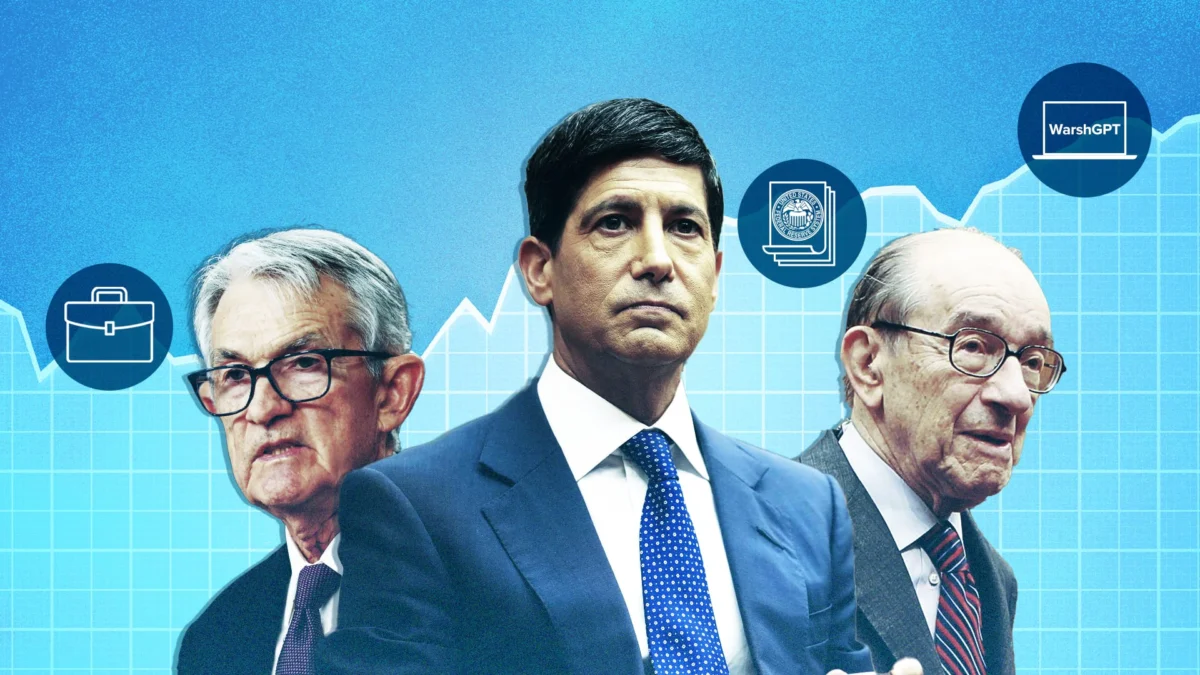
The bustling Washington, D.C., office of F/m Investments sits merely a short drive from the imposing headquarters of the Federal Reserve. Yet, in the wake of the central bank’s recent leadership transition, CEO Alexander Morris has observed that the intellectual distance between his firm and the Fed has grown immeasurably. Since assuming the chairmanship in May, Kevin Warsh has embarked on a significant overhaul of the central bank’s forward-looking communication strategy, a move that has resonated like an alarm through the financial markets. For participants like Morris, whose intricate investment theses are built upon discerning the Fed’s likely trajectory for interest rates, this shift demands a fundamental re-evaluation of established practices.
"We’ve made a pretty good business out of decoding Fedspeak," Morris remarked, referring to the notoriously nuanced and jargon-heavy pronouncements that have long characterized central bank communications. "And he just said he was going to go quiet on us." This sentiment encapsulates the challenge confronting Wall Street: adapting to a deliberate reduction in explicit guidance from the world’s most influential monetary authority. In response, F/m Investments, which manages exchange-traded funds linked to critical economic indicators like inflation and U.S. Treasurys, recently unveiled "WarshGPT." This artificial intelligence-powered tool represents a proactive measure, meticulously parsing nearly 1,800 documents and transcripts from Chairman Warsh’s public record to aid users in understanding his potential analytical framework for economic and monetary policy issues. F/m Investments is not alone; a growing number of financial institutions are now preparing for an era defined by less public forecasting from Warsh’s Federal Reserve, increasingly turning to advanced AI models to secure a crucial informational edge in their investment strategies.
A New Era of Deliberate Ambiguity at the Federal Reserve
Chairman Warsh’s appointment in May 2026 marked an immediate and discernible shift in the Federal Reserve’s communication posture. Historically, the central bank had moved towards greater transparency, a trend solidified under predecessors like Ben Bernanke and Jerome Powell. This trajectory saw the introduction of regular press conferences, the release of "dot plots" outlining policymakers’ interest rate projections, and increasingly detailed post-meeting statements. The rationale was clear: to reduce market uncertainty, anchor inflation expectations, and enhance the effectiveness of monetary policy by clearly signaling the Fed’s intentions.
However, Warsh’s initial actions suggest a departure from this established norm. The Federal Reserve meeting statement issued in June 2026 – the first under his chairmanship – was notably concise, clocking in at approximately 130 words. This represented a stark contrast to the average of over 300 words typically found in prior publications, as revealed by a CNBC analysis. Warsh himself acknowledged the statement’s "shorter" and "simpler" nature, explicitly stating that it purposefully excluded forward guidance. This omission alone signaled a significant pivot. Further data from UBS reinforced this observation, noting that in his inaugural post-decision press conference, Warsh dedicated only 5% of his sentences to policy-relevant topics. This figure stands in sharp relief against the 27% average recorded during Jerome Powell’s tenure, underscoring a deliberate intent to scale back direct policy signals.
This recalibration is not merely incidental; it is part of a broader strategic initiative. Warsh has established various task forces aimed at reshaping the Fed’s operations, with one specifically dedicated to rethinking how the central bank communicates. This institutional focus highlights a foundational shift in philosophy, moving away from a highly transparent, guidance-driven approach towards one that may prioritize flexibility and reduce market dependency on explicit Fed pronouncements.
Historical Context: From Greenspan’s Enigma to Powell’s Transparency
To fully appreciate the significance of Warsh’s communication shift, it is essential to contextualize it within the broader history of Federal Reserve "Fedspeak." The era of former Chairman Alan Greenspan, from 1987 to 2006, is often cited as the epitome of deliberate ambiguity. Greenspan was renowned for his convoluted, often impenetrable language, designed to provide maximum flexibility and minimize market overreactions. During his tenure, market participants resorted to interpreting the most subtle cues. Gary Richardson, a former historian at the central bank and now an economics professor at the University of California, Irvine, recalls a common joke from that era: Greenspan merely saying "good evening" could trigger a market decline.
One of the most colorful examples of this interpretive challenge was the so-called "briefcase indicator." This informal theory suggested that the size of the briefcase Greenspan carried to Capitol Hill meetings offered clues about upcoming policy decisions. A bulkier bag supposedly implied he had accumulated substantial evidence supporting a change in borrowing costs, while a lighter one suggested policy continuity. Such anecdotes underscore the lengths to which markets would go to glean insights from a Fed chairman who preferred to keep his cards close.
Following Greenspan, the Bernanke era ushered in a new chapter of increased transparency, particularly in the wake of the 2008 financial crisis. Bernanke, a scholar of the Great Depression, believed that clear communication was vital for managing expectations and effectively implementing unconventional monetary policies like quantitative easing. This trend continued and was refined under Chair Janet Yellen and her successor, Jerome Powell. Under Powell, the Fed embraced regular press conferences after every Federal Open Market Committee (FOMC) meeting, published the "dot plot" of individual policymakers’ rate projections, and issued detailed minutes, all aimed at providing the public and markets with a comprehensive understanding of the Fed’s thinking and future policy path.
Warsh’s current recalibration, therefore, represents a potential pendulum swing back towards a more guarded communication style. While unlikely to replicate Greenspan’s complete opaqueness, it signals a move away from the explicit forward guidance that became a hallmark of the post-crisis era.
The Market’s Technological Counter-Response: The Rise of WarshGPT
In this new landscape of reduced clarity, financial institutions are not merely lamenting the change; they are actively innovating. F/m Investments’ "WarshGPT" stands as a prime example of the market’s technological counter-response. Built for less than $1,000 using Anthropic’s Claude model – a direct competitor to OpenAI’s ChatGPT, despite the name’s playful nod – the tool was developed from inception to release in a remarkably swift two weeks. This rapid deployment included a critical pre-rollout testing phase involving a diverse group of experts, including former Fed alumni and seasoned newsletter writers, ensuring its accuracy and utility.
WarshGPT’s core functionality is to serve as an artificial intelligence-powered research assistant. It leverages a vast repository of nearly 1,800 documents and transcripts authored or delivered by Chairman Warsh, providing users with context-rich responses by also tapping into economic and political history. The goal is not to predict the future or generate new statements but to offer a deeper understanding of Warsh’s historical analytical framework and perspectives on economic and monetary policy issues. Crucially, F/m has set clear limits for WarshGPT: the bot will not impersonate Warsh, nor will it offer forward statements or forecasts, adhering strictly to a role of interpretive aid rather than speculative oracle.
The emergence of such bespoke AI tools underscores a broader trend. As Gary Richardson aptly notes, "Whether the Fed is providing a lot of information or a little information, investors have to understand what the Fed is likely to do in the future. With limited information, people are going to try to do anything they can to figure out what the Fed is thinking." This sentiment highlights the inherent drive of financial markets to reduce uncertainty, even when the primary source of information becomes more opaque.
Institutional Adaptation: New Strategies for Interpretation

Beyond bespoke AI solutions, established financial powerhouses are also recalibrating their analytical frameworks. UBS, for instance, has developed an interactive dashboard specifically for its clients to track the Fed’s policy tone. Elena Amoruso, a strategist at the Swiss bank, emphasizes that this tool provides an unbiased assessment of Warsh’s commentary during meetings, helping clients navigate the less explicit signals. Following Warsh’s debut policy meeting as chief last month, Amoruso communicated to clients that his policy-relevant comments were "overwhelmingly hawkish," a stance driven by his views on the labor market, economic growth, and the state of inflation. Her observation, "Arguably, this is the most high-value data set… in terms of how much one word can move dollars," succinctly captures the immense financial stakes involved in deciphering central bank communications.
At JPMorgan Asset Management, chief global strategist David Kelly is formulating contingency plans should the Fed further reduce its public releases. He specifically cites the "dot plot" – a graphical representation of individual FOMC members’ interest rate projections – as a critical piece of information. Should the central bank discontinue its publication, Kelly indicates that his team would intensify its scrutiny of individual speeches by members of the Federal Open Market Committee, the group responsible for setting interest rates. By meticulously analyzing their public remarks, Kelly’s team aims to infer their likely voting preferences in upcoming policy meetings. Despite the potential for significant changes, Kelly expresses a measured approach, suggesting that any major shifts in Fed communication would likely unfold over several months, and the final decisions might not be as drastic as some initially expect. "Just like the Federal Reserve says it can be patient in adjusting interest rates to the economy, we can be patient in adjusting our resources," Kelly affirmed, highlighting a strategic patience amidst the evolving landscape.
Steve Friedman, a senior macroeconomist at MacKay Shields and a New York Fed alumnus, offers another institutional perspective. He believes that while "less communication about the reaction function" is a negative for the broader economy, "less clarity about what the Fed may do can actually be a source of alpha for investors if you have a robust framework for thinking about the economy and monetary policy." In other words, for sophisticated investors with superior analytical capabilities, a less transparent Fed presents an opportunity to gain an informational advantage. Friedman specifically mentioned that if Warsh reduces his public speaking engagements, he would shift his focus to monitoring speeches from Fed Governor Christopher Waller, whom he describes as a "bellwether" for the broader committee. Waller recently underscored this point, stating that the Fed should not be focused on "fighting the last war" with inflation but cautioned that interest rate hikes could still be on the table, offering a nuanced glimpse into potential policy considerations.
Broader Implications and Market Dynamics: Volatility, Alpha, and Retail Challenges
The implications of a less transparent Federal Reserve extend across the entire spectrum of financial markets and investor types. One of the most immediate and widely anticipated consequences is an increase in market volatility. With less explicit forward guidance, policy decisions or public appearances by Fed officials could trigger more significant, unpredictable swings in asset prices. The absence of a clear roadmap forces markets to react more acutely to unexpected data points or subtle shifts in rhetoric, potentially amplifying price discovery mechanisms but also increasing short-term risks.
For institutional investors and hedge funds, this environment, while challenging, can also present opportunities for generating "alpha" – returns above what would be expected given the market risk. As Steve Friedman noted, those with superior analytical frameworks, sophisticated data models, and a deep understanding of economic fundamentals and monetary policy theory may be better positioned to anticipate the Fed’s actions, thereby profiting from market mispricings that arise from heightened uncertainty. This could lead to increased investment in proprietary research, advanced AI tools, and the recruitment of former central bank personnel who possess invaluable institutional knowledge.
However, for retail traders and ordinary investors, the landscape is likely to become considerably more challenging. Without clear guidance, interpreting the Fed’s intentions will demand a level of expertise and resource access that many individual investors lack. UC-Irvine’s Richardson cautions that retail traders may need to further diversify their portfolios to account for this added policy uncertainty. "For ordinary investors, it’s already really hard for them to figure out what’s going on," Richardson said. "It’s going to become much harder." This widening information asymmetry could exacerbate the divide between well-resourced institutional players and individual investors, making informed decision-making more arduous for the latter.
The heightened uncertainty is already reflected in divergent market expectations. According to CME’s FedWatch tool, fed funds futures traders are pricing in an almost 59% likelihood that the central bank will increase interest rates in September. Conversely, Kalshi traders, on an event prediction market platform, suggest it is most likely that the Fed will keep rates unchanged at that same meeting. This notable discrepancy underscores the current lack of a clear consensus on the Fed’s near-term policy path, a situation likely exacerbated by Warsh’s communication strategy.
The Rationale for a Less Transparent Fed: An Inferred Analysis
While Chairman Warsh has articulated his desire for "shorter" and "simpler" statements, the underlying motivations for this significant communication shift are subject to ongoing analysis. Several key rationales can be inferred:
Firstly, a less transparent approach could grant the Federal Reserve greater policy flexibility. Explicit forward guidance, while intended to anchor expectations, can sometimes box the central bank into a corner, making it difficult to deviate from previously signaled paths even if economic conditions change unexpectedly. By reducing explicit guidance, Warsh may seek to restore agility to monetary policy, allowing the FOMC to react more dynamically to evolving data without being constrained by past pronouncements.
Secondly, the move may aim to reduce market dependency on the Fed’s explicit signals. Over the years, markets have become increasingly reliant on central bank guidance, sometimes leading to an overemphasis on "Fedspeak" at the expense of fundamental economic analysis. A less communicative Fed might encourage market participants to focus more on underlying economic data, inflation trends, and labor market indicators, rather than parsing every syllable from official statements. This could foster more resilient and independently driven financial markets.
Thirdly, there might be an intent to combat moral hazard. In periods of extensive forward guidance, some market participants might perceive an implicit safety net, assuming the Fed will always step in to prevent significant market downturns. By fostering a degree of ambiguity, Warsh could be signaling a move towards a more hands-off approach, reminding markets that they bear responsibility for their own risk assessments.
Finally, Warsh’s strategy could be rooted in a belief that simplicity ultimately enhances effectiveness. In an information-saturated world, overly detailed communications can sometimes obscure the core message. By distilling the Fed’s stance to its essentials, Warsh might aim for clearer, more impactful communication that focuses on policy outcomes rather than intricate explanations of the path to achieve them. This draws a parallel with the Greenspan era, where a degree of ambiguity was seen as a powerful tool in itself, allowing the Fed to manage expectations without over-committing.
Navigating the New Monetary Landscape
The transition under Chairman Kevin Warsh marks a profound shift in the Federal Reserve’s approach to communication, moving away from an era of increasing transparency towards one characterized by deliberate brevity and less explicit forward guidance. This strategic recalibration poses significant challenges and opportunities for financial markets globally. Investment firms, from agile hedge funds to established asset managers, are rapidly adapting, developing sophisticated AI tools like WarshGPT and refining their analytical frameworks to decipher the nuanced signals emanating from the central bank.
While institutional players may find new avenues for generating "alpha" in this less transparent environment, the landscape for retail investors is set to become considerably more complex, demanding greater diversification and a more profound understanding of macroeconomic forces. The ultimate impact on market stability, price discovery, and the broader economy will unfold over time, but one thing is clear: the era of easy "Fedspeak" decoding may be drawing to a close, ushering in a new chapter where interpretive prowess, technological sophistication, and a keen eye for subtle cues will be paramount. As the world’s most powerful central bank intentionally speaks less, the market’s quest to understand its intentions will only intensify, forever altering the dynamics between monetary policy and financial markets.
