

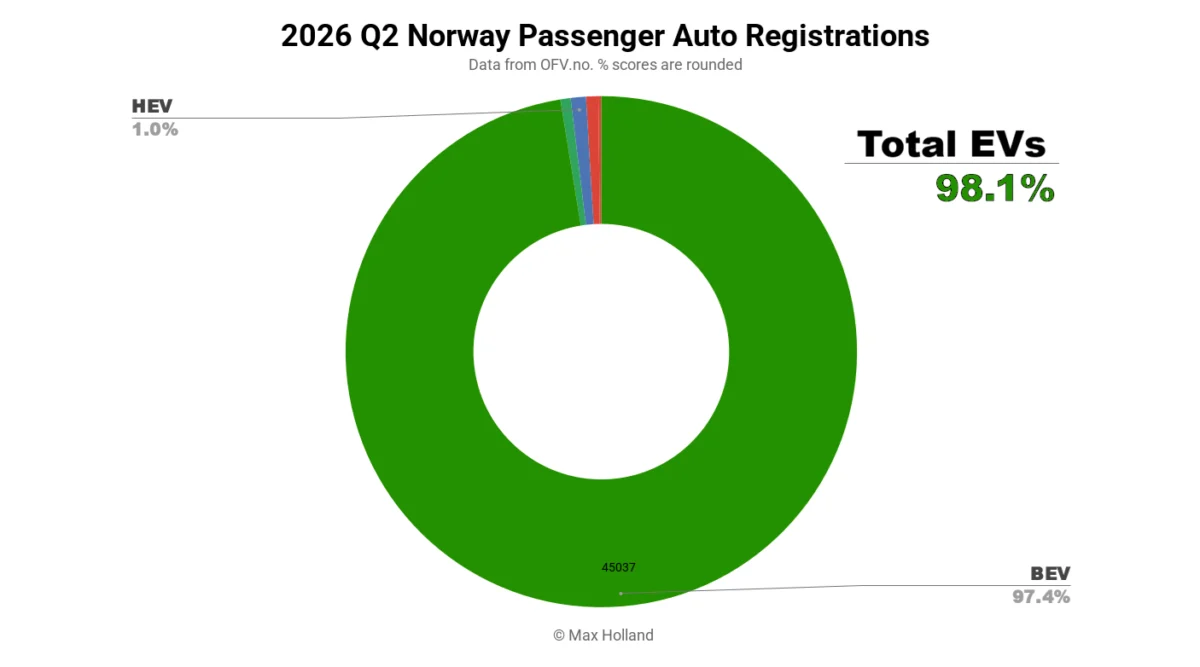
The second quarter of 2026 has marked a historic milestone for the Norwegian automotive industry, with plugin electric vehicles (EVs) capturing a staggering 98.1% of the new car market. This figure represents a significant increase from the 96.7% share recorded during the same period in 2025, signaling that the nation is within a fraction of a percentage point of achieving a fully electrified new passenger car fleet. According to the latest registration data, battery electric vehicles (BEVs) were the primary driver of this growth, while plugin hybrid electric vehicles (PHEVs) continued their steady decline in popularity.
Total automotive sales volume for the quarter reached 46,221 units, an increase of approximately 5% year-on-year. This growth occurred despite a complex macroeconomic environment characterized by fluctuating interest rates and shifting consumer confidence. The data confirms that Norway’s transition away from internal combustion engines (ICE) is nearly complete, with non-plugin vehicles now accounting for a mere 2% of new sales. Of that remaining 2%, half are traditional hybrids (HEVs), while pure petrol and diesel vehicles have been relegated to a marginal niche of the market. Industry analysts project that by the end of 2026, these residual categories will shrink further, likely representing only 1% of the total market share.
The State of the Norwegian Fleet: One Million BEVs
A critical highlight of the Q2 2026 report is the expansion of the existing passenger vehicle fleet. The total number of BEVs on Norwegian roads has officially surpassed the one-million-unit mark. This achievement means that pure electric vehicles now constitute more than one-third of the entire national passenger car fleet. For a country with a population of approximately 5.5 million, this represents one of the highest per-capita EV ownership rates in the world.

The rapid turnover of the fleet is a direct result of Norway’s long-standing "polluter pays" principle. For decades, the Norwegian government has utilized a combination of high taxes on fossil-fuel vehicles and significant exemptions for zero-emission vehicles to steer the market. While some of these incentives, such as the Value Added Tax (VAT) exemption, have been scaled back or tiered in recent years to manage the national budget, the momentum of the transition appears irreversible.
Market Leadership and the Rise of Toyota
The Tesla Model Y maintained its position as the undisputed leader of the Norwegian market in Q2 2026, moving 5,686 units. Despite increasing competition from both legacy manufacturers and new entrants, the Model Y continues to resonate with Norwegian consumers due to its charging infrastructure, efficiency, and brand recognition.
However, the most notable shift in the rankings involves Toyota. Long criticized by EV advocates for its perceived slow transition to full electrification, the Japanese automaker has made significant inroads in the Norwegian BEV market. The new Toyota Urban Cruiser secured the second-place spot for the quarter with 1,969 units sold, a remarkable feat considering the model only arrived in significant volume during the previous quarter. Its sibling, the Toyota C-HR, also saw a rapid ascent, finishing the quarter in fourth place with 1,553 units.
This surge suggests that Toyota is successfully leveraging its strong brand loyalty in Norway to transition its customer base toward fully electric options. The Volkswagen ID.4, a perennial favorite in the region, followed closely in third place with 1,820 units, maintaining a solid presence in the competitive crossover segment.

The Kia Niro Strategy: Navigating VAT Thresholds
One of the most intriguing developments in the Q2 data was the sudden resurgence of the Kia Niro. The model, which had largely disappeared from Norwegian sales charts in late 2024 and is slated for global discontinuation later this year, reappeared in 12th place with 990 units sold. This "last hurrah" for the Niro was the result of a calculated strategic move by Kia to address changes in Norwegian tax policy.
On January 1, 2026, the Norwegian government further tightened the VAT exemption ceiling for electric vehicles. Previously, the first 500,000 NOK (approximately $47,000 USD) of an EV’s price was exempt from VAT. That threshold was lowered to 300,000 NOK. Kia found itself in a difficult position as its primary new models, the EV3 and EV6, were priced above this new 300,000 NOK limit. To bridge the gap until the more affordable EV2 arrives in Q3, Kia re-released a limited "one-off" allocation of 1,350 Niro units priced specifically at 299,990 NOK to dodge the VAT burden. This move allowed the brand to remain competitive in the budget-conscious segment of the market during the transition period.
A Surge of New Entrants and the Affordability Frontier
The second quarter of 2026 saw an influx of new BEV models entering the Norwegian market, reflecting the country’s status as a primary "test bed" for global manufacturers. Notable debuts included the Subaru Unchartered and Subaru Outback BEVs, the Xpeng X9, the Zeekr 7GT, and the Kia EV5. Premium additions such as the Porsche Cayenne electric and the Volvo EX60 also made their first appearances in the registration data.
Perhaps the most significant trend among new entrants is the push toward affordability. As the early-adopter phase of the EV transition concludes, manufacturers are increasingly focusing on the sub-250,000 NOK segment. The Dongfeng Vigo made its debut with 102 units, priced aggressively from 244,900 NOK. Despite its low price, the Vigo offers a 52 kWh Lithium Iron Phosphate (LFP) battery and a 340 km WLTP range.

Industry analysts have noted that the Dongfeng Vigo’s specifications challenge established European players. For comparison, the Cupra Raval (the VW Group’s highly anticipated small electric hatchback) also debuted this quarter with a starting price of 248,900 NOK. However, the Raval features a smaller 37 kWh battery and a lower WLTP range of 300 km. The entry of competent, affordable Chinese models like the Vigo is placing immense pressure on European manufacturers to lower production costs and improve battery efficiency.
Economic Context and Market Headwinds
The robust sales figures for Q2 2026 come against a backdrop of a somewhat erratic Norwegian economy. The nation’s Gross Domestic Product (GDP) has seen multiple revisions, swinging from a contraction of 0.8% in mid-2025 to a growth rate of 1.7% in the first quarter of 2026. While the economy is showing signs of recovery, several indicators suggest a cautious consumer environment.
Headline inflation in Norway stood at 2.7% as of June, a decrease from the 3.6% recorded at the end of Q1. However, to combat persistent price pressures, the central bank (Norges Bank) has ticked interest rates upward from 4.0% to 4.25% since April. Higher borrowing costs typically dampen big-ticket purchases like automobiles, yet the EV market has remained resilient. This resilience is attributed to the fact that the operational savings of an EV (lower fuel and maintenance costs) often outweigh the increased financing costs in the eyes of Norwegian households.
Business confidence also remains a point of concern, sitting at 1.2 points at the end of the latest reporting period, down from 3.4 points a year prior. Despite this, the automotive sector remains a bright spot, largely because Norway sits outside the European Union’s protectionist tariff zone. This allows Norwegian consumers access to a wider variety of global BEVs, particularly from Chinese manufacturers, without the heavy duties recently imposed by the EU.

Broader Implications and the Path to 2027
Norway’s performance in Q2 2026 serves as a blueprint for other nations aiming for total electrification. The data suggests that once the market share for plugins passes the 90% threshold, the remaining transition happens rapidly as the infrastructure for internal combustion engines—such as specialized repair shops and petrol stations—begins to consolidate or disappear.
The transition is not without its challenges. As the fleet becomes dominated by BEVs, the Norwegian government is increasingly looking at ways to replace lost revenue from fuel taxes. Discussions regarding road pricing, weight-based taxes, and further adjustments to VAT are ongoing. However, the political consensus remains firmly in favor of maintaining Norway’s lead in the green transition.
Looking ahead to the remainder of 2026, the market is expected to see further diversification. The arrival of the Kia EV2 and the expansion of the Toyota BEV lineup will likely continue to shift the balance of power among manufacturers. Furthermore, as the "competent-and-affordable" segment grows with more entries from Dongfeng, BYD, and MG, the final 2% of the ICE market is expected to vanish almost entirely by early 2027.
Norway has effectively reached the "mature" stage of the EV transition, moving in tandem with advanced markets like China. For the rest of the world, the Norwegian experience in 2026 provides critical data on how a national power grid handles a million-unit EV fleet and how consumer behavior evolves when electric propulsion is no longer the alternative, but the absolute standard.
