


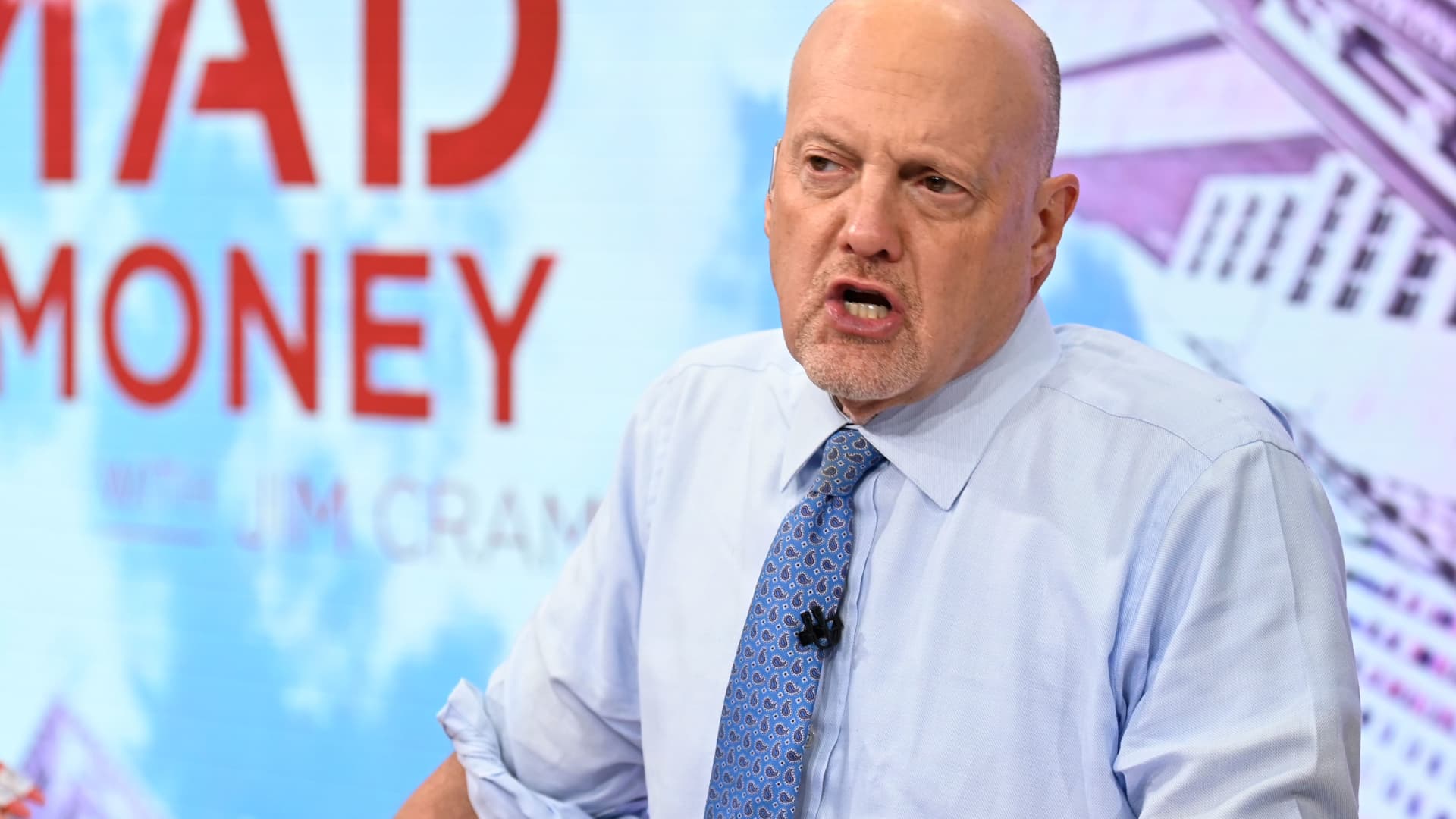
New York, NY – CNBC’s Jim Cramer declared Wednesday that a significant rotation is underway in the financial markets, with investors conspicuously abandoning higher-risk assets in favor of more traditionally defensive sectors. This pronounced shift, which Cramer characterized as a "market in flight," became acutely evident as all three major U.S. stock indexes registered notable declines, yet a deeper dive into sector-level performance revealed a calculated retreat from speculative investments.
A Day of Broad Market Declines
On Wednesday, June 9th, 2026, the equity markets experienced a widespread downturn, reflecting growing investor apprehension. The Dow Jones Industrial Average, a barometer of large-cap industrial stocks, saw a substantial drop of 953 points, or 1.87%. Similarly, the S&P 500, which encompasses a broader spectrum of U.S. equities, fell by 1.62%, while the technology-heavy Nasdaq Composite led the declines with a 1.98% loss. These declines, while significant on their own, masked a more fundamental recalibration of risk appetite among market participants, as highlighted by the "Mad Money" host.
Cramer’s analysis went beyond the headline numbers, pointing to a distinct undercurrent of investor behavior. "This is a market that’s lost its appetite for danger," he asserted, suggesting that the prevailing sentiment was one of caution and preservation rather than aggressive growth pursuit. This marked a stark contrast to the market dynamics that had largely dominated the preceding years, where high-growth technology companies and speculative ventures often commanded premium valuations and investor enthusiasm.
The Undercurrent: Sector Rotation and Defensive Gains
The most compelling evidence for this "flight to safety," according to Cramer, was found in the composition of stocks hitting 52-week highs on Wednesday. While the broader market was in retreat, a specific cohort of companies demonstrated remarkable resilience, even advancing to new annual peaks. This group, Cramer noted, was overwhelmingly populated by real estate investment trusts (REITs), insurance providers, consumer staples companies, and other businesses typically classified as lower-risk investments.
For instance, sectors like Utilities, Consumer Staples, and Healthcare, which are often considered defensive due to their stable demand regardless of economic cycles, showed relative strength or even positive performance on a day when broader indexes were struggling. While specific percentage gains varied, anecdotal evidence from market data indicated that these sectors experienced inflows, suggesting a deliberate reallocation of capital. Investors, it appeared, were actively seeking out companies with robust balance sheets, consistent earnings, and, crucially, stable dividend payouts, which become particularly attractive in periods of uncertainty.
Among the specific companies cited by Cramer that reached 52-week highs were Linde, a prominent industrial gas company, and TJX Companies, a multinational off-price department store corporation. Both stocks are held within Cramer’s Charitable Trust, underscoring their appeal as businesses with durable economic moats and reliable cash flows. Their inclusion on the list of top performers on a down day served as a tangible illustration of the market’s pivot. "You know what this says to me?" Cramer questioned rhetorically. "This market’s in flight. It doesn’t want a lot of risk."
Contrasting with Recent Market Trends
The scarcity of technology-related companies among the 52-week high achievers further underscored the shift. For years, the market narrative had been dominated by the spectacular growth of tech giants and innovative startups, fueled by low interest rates, ample liquidity, and a widespread belief in the transformative power of digital advancements. Companies in areas like cloud computing, artificial intelligence, and e-commerce frequently led market rallies, with investors often prioritizing future growth potential over immediate profitability or traditional valuation metrics.
While a few technology-adjacent companies, such as semiconductor equipment makers Applied Materials and KLA Corp, did make the list, their success was attributed to specific, strong demand for memory chips – a more fundamental, cyclical aspect of the tech industry rather than purely speculative growth. This exception only served to highlight the broader trend: the market was no longer indiscriminately rewarding all forms of technology and growth.
This compositional change represents a stark departure from the market leadership investors had grown accustomed to over the past several years. From the post-pandemic recovery highs of 2020 through much of 2021 and early 2022, technology and growth stocks frequently served as the primary drivers of market performance. The Federal Reserve’s accommodative monetary policy, characterized by near-zero interest rates and quantitative easing, created an environment where capital was cheap and readily available, making future earnings streams in high-growth companies appear more valuable. This era saw unprecedented valuations for companies with disruptive technologies but often limited profitability.
However, as economic conditions began to evolve, so too did investor preferences. Instead of chasing high-growth technology names, investors increasingly appear to be prioritizing stable cash flows, reliable dividend income, and businesses that can hold up in a more uncertain economic environment. This re-evaluation marks a move towards fundamental strength and defensive positioning, away from the more speculative corners of the market.
Broader Economic Backdrop Fueling Caution
The impetus for this dramatic shift can be traced to a confluence of macroeconomic factors that have gained prominence in recent months. Foremost among these are persistent inflationary pressures, which have proven more stubborn and widespread than initially anticipated. Rising consumer prices, exacerbated by supply chain disruptions, geopolitical tensions (such as ongoing conflicts impacting commodity prices), and robust labor markets, have prompted central banks worldwide, including the U.S. Federal Reserve, to adopt a more hawkish stance.
Expectations of aggressive interest rate hikes by the Federal Reserve have significantly altered the investment landscape. Higher interest rates increase the cost of capital for businesses, dampening growth prospects, and reduce the present value of future earnings, which disproportionately impacts growth stocks. Furthermore, rising rates make fixed-income investments, such as government bonds, more attractive, drawing capital away from equities, especially riskier ones. The yield on the 10-year U.S. Treasury note, for instance, had been steadily climbing in the weeks leading up to Cramer’s comments, signaling a broader repricing of risk and return across asset classes.
Beyond inflation and interest rates, concerns about a potential economic slowdown or even a recession have also begun to weigh heavily on investor sentiment. Geopolitical instability, ongoing energy crises, and the lingering effects of the pandemic on global supply chains have created a climate of heightened uncertainty. In such an environment, businesses with predictable demand, strong pricing power, and essential services or products become highly desirable, as they are perceived to be more resilient to economic downturns.
Analyst Perspectives on the Defensive Pivot
Cramer’s observations resonate with sentiments expressed by a growing number of market strategists and economists. Many analysts from major investment banks have been advising clients to consider a more balanced, defensive portfolio strategy. "The easy money in growth stocks has been made for now," commented one prominent market strategist, who preferred to remain unnamed, "Investors are now facing a reality where capital isn’t free, and fundamentals truly matter. Companies that can demonstrate consistent profitability and shareholder returns through dividends will likely outperform."

Another report from a leading financial institution highlighted the historical tendency for defensive sectors to outperform during periods of economic deceleration or rising inflation. "Utilities, consumer staples, and healthcare stocks tend to exhibit lower volatility and offer stable dividends, making them attractive havens when the broader market is under pressure," the report noted. This historical context provides a strong foundation for the current rotation, suggesting that it is not merely a transient phenomenon but a response to fundamental shifts in the economic paradigm.
The consensus among many financial commentators is that the market is undergoing a necessary re-evaluation of risk. The exuberance of the past few years, fueled by unprecedented liquidity and low rates, may have led to an overvaluation of certain assets. The current environment, therefore, represents a return to more traditional valuation principles, where profitability, balance sheet strength, and dividend yield are given renewed importance.
Implications for Investors and Corporate Strategy
For individual investors, this market rotation carries significant implications. Those heavily invested in high-growth technology stocks may need to re-evaluate their portfolios for excessive risk exposure. The new environment suggests a greater emphasis on diversification, asset allocation, and potentially a higher weighting towards value-oriented and defensive stocks. Seeking companies with strong free cash flow generation, consistent dividend growth, and manageable debt levels could become a cornerstone of successful investment strategies.
"The people have spoken," Cramer concluded. "They want safety, they want yield, and maybe they’re just sick and tired of the data center and the fast growers that now grow more slowly and represent too much risk." This statement encapsulates the prevailing sentiment: a desire for tangible returns and reduced volatility in a world that feels increasingly unpredictable.
For corporations, the shift implies a renewed focus on profitability, operational efficiency, and shareholder returns through dividends and share buybacks, rather than purely on revenue growth at any cost. Companies that can demonstrate resilience in challenging economic conditions, manage their supply chains effectively, and maintain strong pricing power are likely to be favored by investors. This could also influence mergers and acquisitions, with a greater emphasis on acquiring stable, cash-generating businesses.
The Road Ahead: Navigating a Risk-Averse Market
The current market environment suggests a period of heightened scrutiny and a potentially more challenging landscape for aggressive growth investors. While innovation and technology will undoubtedly continue to play a crucial role in economic progress, the market’s willingness to reward speculative ventures appears to be diminishing. Instead, prudence, stability, and a focus on fundamental value are regaining prominence.
As central banks continue their efforts to tame inflation, and as geopolitical uncertainties persist, the "flight to safety" observed by Jim Cramer is likely to remain a dominant theme. Investors will need to adapt their strategies to navigate a market that has indeed "lost its appetite for danger," prioritizing resilience and yield in an increasingly complex global economy. The era of "boring" stocks, characterized by their reliability and steady returns, appears to be making a strong comeback, signaling a mature and cautious phase in the market cycle.
