

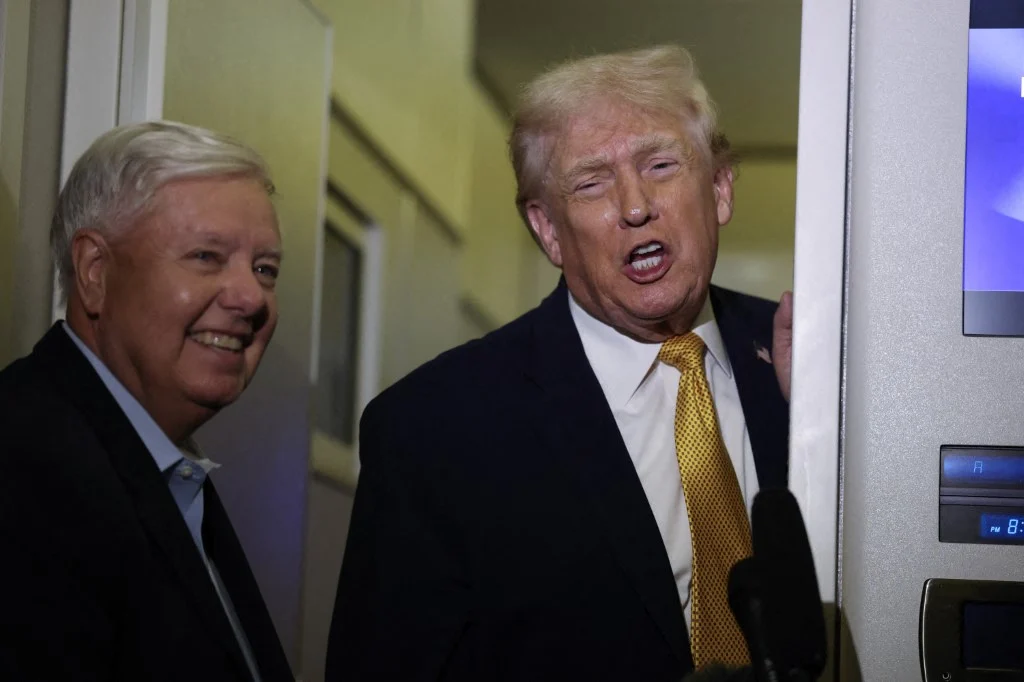
The United States political landscape was thrust into a state of profound uncertainty this weekend following the sudden passing of Senator Lindsey Graham, a towering and often controversial figure who served as a cornerstone of the Republican Party’s foreign policy and a pivotal ally to President Donald Trump. Graham, 71, died on Saturday evening at his residence, leaving a legislative vacuum in a narrowly divided Senate just months before the high-stakes 2026 midterm elections. His death comes at a moment of heightened international tension, particularly as the United States remains deeply involved in a military conflict involving Israel and Iran, a theater where Graham was one of the most vocal proponents of American intervention.
The loss of the South Carolina Republican not only deprives the Trump administration of its most effective legislative liaison but also complicates the Republican Party’s ability to maintain its slim majority in the upper chamber. With the absence of Senate Minority Leader Mitch McConnell, who remains hospitalized following a serious fall, the Republican caucus finds its voting power significantly diminished at a time when critical budget negotiations and judicial confirmations are reaching a boiling point.
Chronology of the Final Days and Medical Findings
The timeline leading to Senator Graham’s death highlights a characteristically frenetic period of diplomatic activity. On Friday, Graham was in Kyiv, marking his tenth visit to the Ukrainian capital since the escalation of the conflict with Russia. During this visit, he met with President Volodymyr Zelenskyy to reaffirm American commitment to military aid, a stance that often put him at odds with the more isolationist wings of his own party but cemented his status as a traditional hawk.
Upon his return to Washington on Saturday evening, Graham reportedly spoke with President Trump via telephone to debrief him on the Ukrainian mission and to coordinate strategy for the upcoming week. According to White House sources, the conversation was focused on legislative tactics to secure additional funding for the US-Israel-Iran theater. Shortly after the call, emergency services were dispatched to Graham’s residence.
Initial reports from the Senator’s office cited a "sudden and brief illness." however, a preliminary report from the medical examiner later clarified the cause of death as a dissection of the aorta. An aortic dissection is a catastrophic medical event involving a tear in the inner layer of the body’s main artery. The condition is frequently fatal if not treated with immediate surgical intervention, as it prevents the heart from pumping blood effectively to the rest of the body. The medical examiner noted that the tear was likely spontaneous, though the stresses of high-altitude international travel and the Senator’s age may have been contributing factors.
The Legislative Crisis: A Narrowing Senate Majority
The immediate impact of Graham’s death is most visible in the Senate’s arithmetic. Prior to this weekend, the Republican Party held a functional majority in the 100-member chamber. However, the combination of Graham’s passing and the ongoing recovery of Senator Mitch McConnell has temporarily reduced the active Republican voting bloc to 51. When weighed against a unified Democratic caucus of 47, plus various independents who often caucus with the left, the margin for error for the GOP has effectively evaporated.
This shift comes at a perilous time for the Trump administration’s domestic and foreign agenda. The Senate is currently tasked with several high-priority items:
- Military Appropriations: Increased funding for the ongoing strikes against Iranian infrastructure.
- Judicial Confirmations: A slate of conservative judges intended to fill vacancies before the midterms.
- The Debt Ceiling: Looming negotiations that require a disciplined majority to navigate.
Without Graham’s ability to whip votes and find "common ground" with moderate Democrats, the Republican leadership faces a steep climb. Graham was famously described by Trump as a "natural-born, hard-working politician skilled at dealing with people." His ability to translate Trump’s often populist rhetoric into legislative language that could pass through committee was considered unparalleled within the caucus.
Reaction from the White House and Capitol Hill
President Donald Trump, who was scheduled to appear on NBC’s Sunday morning talk show alongside Graham, instead used the platform to deliver a lengthy eulogy for his late ally. Trump’s tone was uncharacteristically somber, reflecting the personal and professional closeness the two had developed over the last decade.
"He’s a tough one to lose," Trump told the NBC anchor via telephone. "He was unique in every way. He was like a member of the family to me." Trump emphasized Graham’s utility in the Senate, noting that "if I had a problem with a Democrat, he could work it out."
Across the aisle, the sentiment was one of professional respect despite deep ideological fractures. Democratic Senator Richard Blumenthal of Connecticut took to social media to acknowledge Graham’s willingness to engage in dialogue. "He listened to me and others who might have opposing views and sought to bridge our differences," Blumenthal stated. This "bridge-building" was a hallmark of Graham’s later career, where he balanced a staunchly conservative voting record with a personal affability that allowed for bipartisan cooperation on issues like immigration reform and judicial standards—though he frequently drew fire from his own base for these very compromises.
International Implications: From Kyiv to Tehran
Senator Graham’s death has reverberated far beyond the Potomac. In Ukraine, President Zelenskyy expressed deep gratitude for Graham’s consistent advocacy, noting that his tenth visit was a testament to his "unwavering support" for Ukrainian sovereignty. Analysts suggest that Graham’s absence may embolden the "America First" wing of the GOP, which has been increasingly skeptical of continued high-level funding for the war in Eastern Europe.
Ian Lesser, a distinguished fellow at the German Marshall Fund, noted that Graham was a "transatlanticist" who served as a vital link between the MAGA movement and traditional NATO allies. "His loss could weaken the more cautious, security-driven voices in the Senate as the US reviews its force posture in Europe," Lesser explained.
Conversely, the reaction from Tehran was one of overt hostility. Iranian state television announced Graham’s death with celebratory rhetoric, calling him a "warmongering and anti-Iranian" figure. Graham had been a primary architect of the "maximum pressure" campaign and was a vocal supporter of the current US military strikes against Iranian targets. His death leaves a void in the Senate Foreign Relations Committee, where he often led the charge for aggressive containment of Iranian influence in the Middle East.
The Succession Process in South Carolina
The focus now shifts to South Carolina, where Governor Henry McMaster is tasked with filling the vacancy. Under South Carolina law, the governor has the authority to appoint a temporary replacement who will serve until a special election can be held.
The timeline for succession is already taking shape:
- Appointment: Governor McMaster is expected to name a temporary senator within the coming days. This individual will serve through the remainder of the current session.
- Special Primary: A primary election is scheduled for August 11, 2026, to determine the Republican and Democratic nominees.
- Run-off: If no candidate achieves a majority in the primary, a run-off will occur on August 25.
- General Election: The final vote will coincide with the November midterm elections, where the winner will serve out the remainder of Graham’s term.
Speculation is rampant regarding McMaster’s choice. While the governor could appoint a "placeholder"—a retired statesman who would not seek a full term—there is significant pressure from the White House to appoint a candidate who can immediately hit the ground running. President Trump hinted on Sunday that he already has a preferred candidate in mind, though he declined to name them out of respect for the mourning period. "I have somebody that I think would be great," Trump said, "but I don’t want to say it now."
Analysis: The Future of the Republican Senate Strategy
The passing of Lindsey Graham marks the end of an era for the Republican Party. Graham was one of the few remaining "old-guard" senators who had successfully transitioned into the era of Trumpian politics without losing his seat or his influence. He managed the difficult feat of being both a confidant to the President and a respected member of the Senate "club."
His death creates three distinct challenges for the GOP:
- Leadership Vacuum: Without Graham and with McConnell sidelined, the Senate Republicans lack a senior strategist capable of outmaneuvering a disciplined Democratic minority.
- Electoral Risk: South Carolina is a reliably red state, but a divisive primary to replace Graham could drain resources and energy away from more competitive races in battleground states like Pennsylvania and Arizona.
- Foreign Policy Drift: Graham was the glue holding together a coalition of interventionists and nationalists. Without his voice, the GOP’s stance on Ukraine and Iran may become more fragmented, leading to legislative gridlock.
As Washington prepares for a state funeral and the subsequent political maneuvering, the legacy of Lindsey Graham remains a subject of intense debate. To his supporters, he was a tireless defender of American interests and a master of the legislative craft. To his detractors, he was a political chameleon whose shifts in loyalty mirrored the changing winds of his party. Regardless of the viewpoint, his absence leaves a chasm in the US government that will be felt through the 2026 midterms and beyond. The coming weeks will reveal whether the Republican Party can maintain its cohesion without its most seasoned negotiator, or if Graham’s death will be the catalyst for a broader realignment of power in the United States Senate.
