

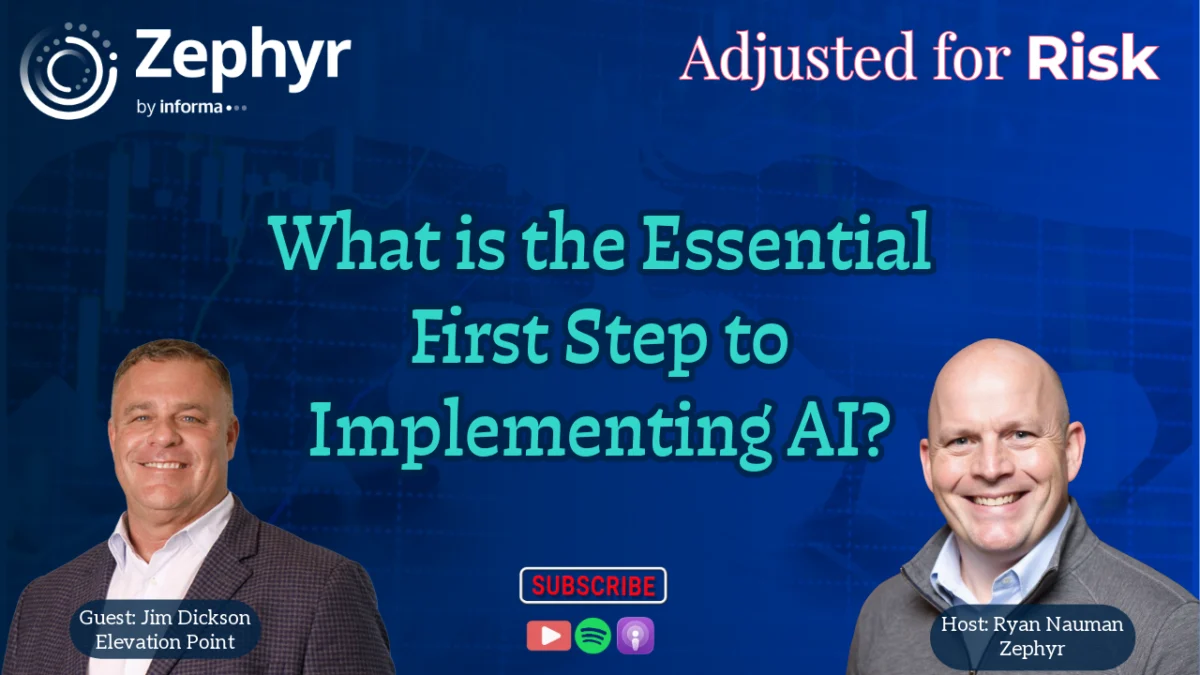
Recorded live at the recent Wealth Management Edge conference, a prominent gathering for industry leaders, the latest episode of Zephyr’s "Adjusted for Risk" podcast featured Jim Dickson, CEO and founder of Elevation Point, offering a pragmatic perspective on how financial advisory firms can effectively integrate Artificial Intelligence (AI). Dickson’s core argument centered on a critical, often overlooked, prerequisite for AI success: the meticulous organization, codification, and centralization of data into a robust warehouse or data lake. He emphasized that without this foundational work, firms are setting unrealistic expectations for meaningful AI-driven outcomes.
The podcast, hosted by Ryan Nauman and recorded on location at the conference, delved into Dickson’s vision of a future where financial advisory workflows are not merely enhanced by AI, but fundamentally transformed. He posited that these workflows will increasingly reside within the data layer itself, becoming "agentic" – capable of operating autonomously to achieve specific goals. This evolution, Dickson believes, will be instrumental in significantly improving client experience and boosting firm profitability. A key enabler for this future, according to Dickson, will be flexible integration capabilities, particularly through what he described as "plugin" layers built upon a Meta-Cognitive Platform (MCP).
Dickson outlined several high-impact AI use cases for financial advisors, including the automation of client review preparation, the personalization of client communications, and the streamlining of follow-up processes. However, he was quick to underscore that the human element remains indispensable, particularly for the "last mile" of client interaction and for providing crucial empathy during significant life events, such as marriage, divorce, or the loss of a loved one.
The Unseen Foundation: Data as the Bedrock of AI
Dickson’s central thesis resonated throughout the discussion: many firms are eager to deploy sophisticated AI tools without first addressing the fundamental challenge of data management. He described this as the "unglamorous" yet absolutely essential work of bringing disparate data sources – client profiles, investment holdings, communication logs, financial plans, and more – into a unified, structured repository. Without this organized data, AI algorithms lack the clean, comprehensive input they need to generate accurate insights and reliable actions.
"The allure of AI is undeniable, with its promise of automation and enhanced efficiency," Dickson stated during the podcast. "However, the reality is that without a solid data foundation, AI tools can become expensive experiments. Firms often jump to the AI layer, expecting magic, but the real magic begins with the data."
He elaborated on the concept of a data warehouse or data lake as the central nervous system for an AI-powered advisory firm. A data warehouse typically stores structured data for reporting and analysis, while a data lake can store vast amounts of raw, unstructured data, making it ideal for AI and machine learning applications. By consolidating data from various client management systems (CRM), portfolio accounting platforms, financial planning software, and even communication tools, firms can create a single source of truth. This eliminates data silos, reduces inconsistencies, and ensures that AI models are trained on the most complete and accurate information available.
The Dawn of Agentic Workflows and MCP Integration
Dickson’s vision extends beyond simple AI augmentation to a more profound shift towards agentic workflows. He explained that instead of advisors manually initiating every task or analysis, AI agents, powered by the centralized data, will proactively manage many aspects of client service.
"Imagine an AI agent that constantly monitors client portfolios and market conditions," Dickson illustrated. "When a specific threshold is breached, or a relevant life event is anticipated based on data patterns, the agent can automatically prepare a summary, draft personalized recommendations, or even schedule a follow-up with the advisor. This frees up the advisor to focus on higher-value strategic thinking and relationship building."
The critical enabler for this future, according to Dickson, is the development of flexible integration layers. He specifically mentioned Meta-Cognitive Platform (MCP) "plugin" layers as a key technology. MCPs are designed to understand and interact with various systems and data sources, acting as an intelligent intermediary. This allows AI models and agentic workflows to seamlessly connect with existing technology stacks without requiring extensive custom coding or disruptive system overhauls.
"The MCP layer acts like an intelligent translator and orchestrator," Dickson explained. "It allows us to build AI capabilities and agentic workflows that can plug into the existing ecosystem of a wealth management firm, providing the flexibility needed to adapt as technology evolves. This is crucial for avoiding vendor lock-in and ensuring long-term scalability."
Key AI Use Cases: From Preparation to Personalization
Dickson highlighted several practical AI applications that can deliver immediate value to financial advisors:
- Client Review Preparation: AI can automatically compile all relevant client data, performance reports, and market commentary, presenting it in a digestible format for the advisor ahead of client meetings. This can significantly reduce preparation time and ensure advisors are fully informed.
- Personalization and Customization: AI can analyze client preferences, communication styles, and financial goals to tailor messages, recommendations, and even investment proposals. This moves beyond generic advice to truly individualized client engagement.
- Follow-Up Automation: Post-meeting, AI can generate meeting summaries, action item lists, and follow-up reminders, ensuring that client needs are addressed promptly and efficiently. This can improve client satisfaction and retention.
Despite the advancements AI offers, Dickson reiterated that the human touch remains paramount. "AI can automate many tasks, but it cannot replicate genuine empathy or the nuanced understanding required during moments of significant personal change," he stated. "The advisor’s role in providing emotional support and guiding clients through complex life decisions is irreplaceable."
Navigating Implementation Challenges: Costs and Guardrails
The path to AI adoption is not without its obstacles, and Dickson candidly addressed two major concerns: token/compute costs and the establishment of robust guardrails.
"The cost of training and running sophisticated AI models can be substantial," Dickson acknowledged. "Firms need to carefully consider their budget and prioritize use cases that offer the highest return on investment. This is where a phased approach and a focus on efficiency are crucial."
The concept of "tokens" refers to the units of text that AI models process, and the cost associated with these can accumulate rapidly. Similarly, the computational power required for training and inference (running the AI) can be a significant expense. Dickson advocated for a measured approach, starting with less computationally intensive tasks and gradually scaling up as the firm gains experience and optimizes its AI infrastructure.
Equally important are the "guardrails" – the ethical and regulatory boundaries that must be put in place to ensure AI is used responsibly. This includes preventing bias in algorithms, ensuring data privacy and security, and maintaining compliance with industry regulations. Dickson emphasized the need for clear policies and ongoing oversight to mitigate risks.
"Guardrails are non-negotiable," Dickson asserted. "We need to ensure that AI is used to augment human judgment, not replace it entirely, and that client interests are always protected. This requires careful design, rigorous testing, and continuous monitoring."
Attracting the Next Generation of Talent
Dickson also touched upon the broader impact of AI on the workforce and how the wealth management industry can leverage this shift to attract top young talent. He noted that AI is displacing talent in various sectors, creating an opportunity for wealth management to become an attractive career path.
"As AI automates routine tasks in other industries, many bright young minds are looking for new avenues where their analytical and problem-solving skills can be applied," Dickson observed. "Wealth management, with its increasing reliance on technology and data, offers a compelling environment for these individuals."
He proposed mentorship and apprenticeship models as effective strategies for onboarding and developing this new generation of talent. By pairing experienced advisors with aspiring professionals, and providing structured learning opportunities that incorporate AI tools and data analytics, firms can cultivate a skilled and future-ready workforce.
"We need to showcase wealth management as a dynamic, intellectually stimulating field," Dickson urged. "By offering opportunities for hands-on experience with cutting-edge technology and by fostering a culture of continuous learning, we can attract the best and brightest who are eager to shape the future of financial advice."
A Gradual Approach to AI Training
Dickson’s advice on AI training goes beyond simple chatbot interactions. He advocated for a more comprehensive and gradual approach, moving from basic AI tools to more sophisticated applications.
"It’s not just about training advisors to use a specific chatbot," Dickson explained. "It’s about building a deep understanding of how AI can enhance their daily work. This involves training them on data literacy, how to interpret AI-generated insights, and how to effectively integrate these tools into their client interactions."
He suggested starting with pilot programs, focusing on specific AI use cases, and gradually expanding the scope as advisors become more comfortable and proficient. This iterative process allows firms to identify and address challenges early on, ensuring a smoother transition to an AI-enhanced operational model.
The Future of Financial Advisory: A Hybrid Model
In conclusion, Jim Dickson’s insights from the Wealth Management Edge conference paint a clear picture of the future of financial advisory: a sophisticated, data-driven ecosystem where AI and human expertise work in tandem. The emphasis on a robust data foundation, the embrace of agentic workflows, and the strategic use of flexible integration technologies like MCPs are presented not as optional upgrades, but as essential components for firms looking to thrive in the evolving landscape. While the allure of AI is undeniable, Dickson’s pragmatic approach serves as a vital reminder that true innovation lies in building upon solid groundwork, ensuring that technology serves to empower, not overwhelm, the human element at the heart of client relationships. The opportunity to attract new talent and redefine the advisory profession, he suggests, is intrinsically linked to this forward-thinking adoption of AI.
Zephyr provides financial data and analytics solutions for wealth management firms. Learn more about Zephyr here: https://informaconnect.com/zephyr/?utm_medium=Content&utm_source=Content_Podcast&utm_campaign=WM_Adjusted_forRisk&utm_content=WM_Adjusted_for_Risk%20
Elevation Point is a technology consulting firm specializing in wealth management. Learn more about Elevation Point here: https://elevationpoint.com/
Connect with Ryan Nauman: LinkedIn https://www.linkedin.com/in/ryannauman1/%20 | X https://twitter.com/LkTahoeBadger
