


The Canadian economic landscape in 2026 stands at a critical crossroads, characterized by a complex interplay of geopolitical friction, sluggish domestic growth, and a fundamental reordering of industrial priorities. For the first time in over a century, the foundational trade relationship between Canada and its largest partner has been systematically disrupted, sending shockwaves through traditional manufacturing and export sectors. This instability, compounded by the volatility of global energy markets stemming from the protracted conflict in Iran and a persistent cost-of-living crisis, has seen Canada’s real gross domestic product (GDP) struggle at a growth rate of just 1.7%—the lowest performance metric recorded since the global pandemic era. Amidst these headwinds, the annual release of the Corporate Knights Best 50 Corporate Citizens list serves as a barometer for a significant shift in corporate strategy: the decoupling of economic success from carbon intensity.

While economic downturns historically trigger a retreat from environmental, social, and governance (ESG) commitments, the 2026 rankings reveal a contrary trend. Leading Canadian firms are no longer viewing sustainability as a discretionary expense but as a core defensive strategy against energy price volatility and a primary driver of long-term revenue. This year’s list highlights 50 organizations that have successfully reoriented their business models toward energy resilience and green market opportunities, demonstrating that sustainable investment is becoming the primary mechanism for boosting bottom-line performance in a low-growth environment.
A Changing Guard: Methodology and Sectoral Shifts
The 2026 Best 50 ranking arrived with a refined methodology that places greater emphasis on "sustainable revenue momentum" and "sustainable investment ratios." This shift has resulted in a significant turnover within the list, welcoming 10 newcomers from sectors previously underrepresented in sustainability leadership, including real estate, municipal transit, and waste management. Perhaps most notable is the resurgence of the extractive industries. The mining sector secured six spots on this year’s list, nearly rivaling the pure-play power generation companies that have traditionally dominated these rankings. This evolution reflects the growing importance of "green mining"—the extraction of critical minerals essential for the global energy transition—and the adoption of more rigorous environmental standards within the Canadian resource sector.
Innergex Renewable Energy claimed the premier position for 2026, ascending from third place in the previous year. This rise underscores the stability and growth potential of the renewable power sector. Conversely, the 2025 leader, Boralex, slipped to seventh place, highlighting the intense competition among Quebec-based energy providers. Other dramatic movements include the telecommunications giant Telus, which climbed from 15th to 3rd, and the packaging firm Cascades Inc., which surged from 20th to 8th. The highest-ranked newcomer, Canadian Apartment Properties REIT, debuted at 16th, signaling that the real estate sector is finally integrating carbon-reduction strategies into its operational core.
The Pure-Play Pacesetters: Polaris and Innergex
The top of the 2026 list is dominated by companies whose entire revenue stream is derived from sustainable activities. Polaris Renewable Energy, based in Toronto, exemplifies this "pure-play" success, moving from 12th to 2nd place. The company’s trajectory is defined by a 21% revenue surge between 2022 and 2024, driven by an aggressive expansion strategy across Latin America and the Caribbean. By diversifying its portfolio to include geothermal plants in Nicaragua, hydroelectric projects in Peru and Ecuador, and solar and wind farms in Panama, the Dominican Republic, and Puerto Rico, Polaris has insulated itself from the domestic Canadian slowdown. In 2025, the company’s projects were estimated to have mitigated over 346,000 tons of carbon dioxide equivalent, proving that emerging markets offer a fertile ground for Canadian green expertise.
Innergex, the top-ranked firm, continues to set the benchmark for the power generation peer group. With a sustainable revenue ratio of 100% and a sustainable investment ratio also at 100%, the company’s A+ grade reflects its unwavering commitment to the transition. Its 9.68% compound annual growth rate (CAGR) in sustainable revenue demonstrates that even established renewable leaders can find paths to consistent growth.
Industrial Evolution: From Paper to Biomaterials
The 2026 rankings also highlight traditional industries that are reinventing themselves to survive the "fossil-fuel displacement" era. Kruger Products rose from 34th to 5th place, the second-largest year-over-year jump in the list’s history. As a fourth-generation family-run pulp and paper entity, Kruger has transitioned from a traditional manufacturer into a leader in circular economy practices. By bringing innovative biomaterials and recycled paper products to market, the company has successfully displaced high-volume, fossil-fuel-based plastics in the food packaging and labeling sectors.

Kruger’s commitment is verified by its adherence to the Forest Stewardship Council (FSC) standards, a crucial distinction in an era where many larger certifying bodies have faced scrutiny over clear-cutting practices. The company now operates facilities dedicated exclusively to FSC-certified products, ensuring that its business model preserves millions of trees annually while meeting the rising consumer demand for plastic alternatives.
Setting New Standards in Mining and Finance
The inclusion of Eldorado Gold at 20th place serves as a case study for the "standard-setter" model in the mining industry. With operations spanning Canada, Turkey, and Greece, Eldorado has integrated community-centric environmental projects into its operational overhead. Its Kışladağ gold mine in Turkey recently garnered international attention for a solar-powered water infrastructure project designed in collaboration with six local villages. This initiative eliminated energy costs for pumping clean water to over 350 households, illustrating how industrial projects can provide direct social utility. Domestically, the Lamaque Complex in Quebec achieved a rare AAA rating from the Mining Association of Canada, reflecting excellence in biodiversity conservation and Indigenous community relations.

In the financial sector, Vancouver City Savings Credit Union (Vancity) registered the most significant increase in sustainable revenue momentum, with a staggering 266% growth between 2022 and 2024. While part of this jump is attributed to more transparent disclosure of existing sustainable investments, it also reflects a deeper systemic shift. Vancity, which pioneered Canada’s first socially responsible mutual fund, now offers specialized mortgages for affordable housing and environmental financial products where profits are directly reinvested into sustainability causes. This "green grower" approach has placed Vancity at 9th overall, the highest-ranked bank on the list.
Waste Management and the Circular Economy
The 2026 list also acknowledges the critical role of waste management in the national climate strategy. Waste Connections, ranked 43rd, has transformed its operations to focus on landfill diversion and methane capture. In several markets, the company now diverts up to 70% of collected waste from landfills. More importantly, it has operationalized 23 landfill-gas generating facilities, capturing methane—a potent greenhouse gas—and converting it into enough electricity to power 312,000 homes. With a $500 million commitment to sustainability targets and a fleet of 1,000 electric or compressed natural gas vehicles, Waste Connections represents the "circular-economy champion" necessary for urban sustainability.

The Energy Transition Torchbearers
The ranking of Énergir at 24th place highlights the complexities of the energy transition for traditional natural gas utilities. Despite being a gas company, Énergir maintained a strong position due to its pivot toward renewable natural gas (RNG) and wind projects. The company’s ownership stake in the Seigneurie de Beaupré wind development and its investments in biomethane infrastructure in Saint-Sophie and Saint-Flavien illustrate a "transition torchbearer" model. While its overall score saw a slight decline from the previous year, its perfect sustainable revenue score—derived from its rapid scaling of green hydrogen and wind assets—points toward a future where traditional utilities function as diversified energy managers.
Broader Impact and Economic Implications
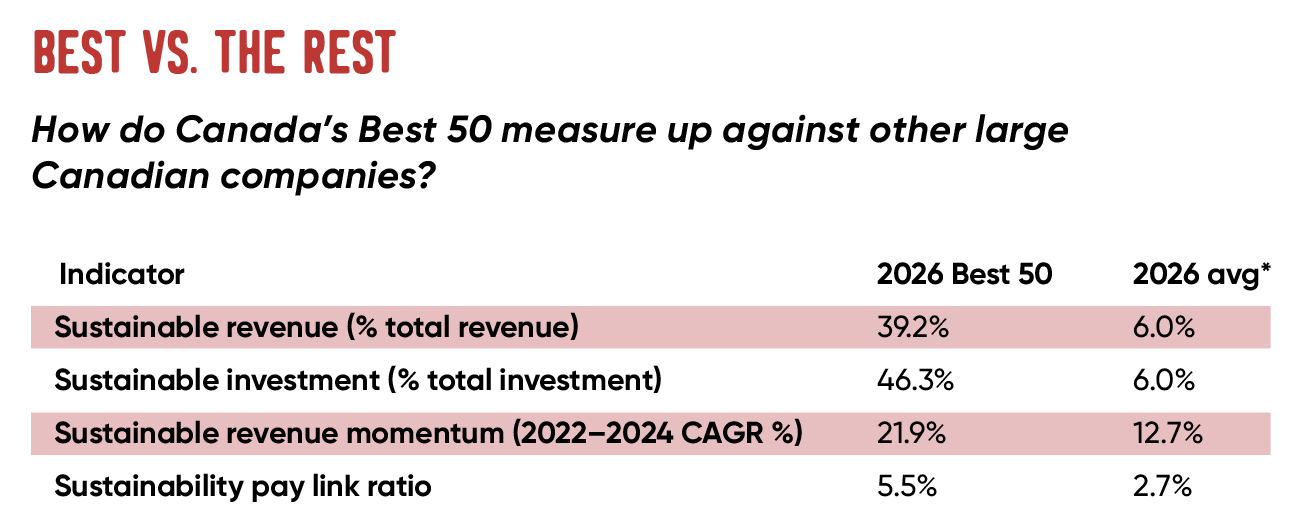
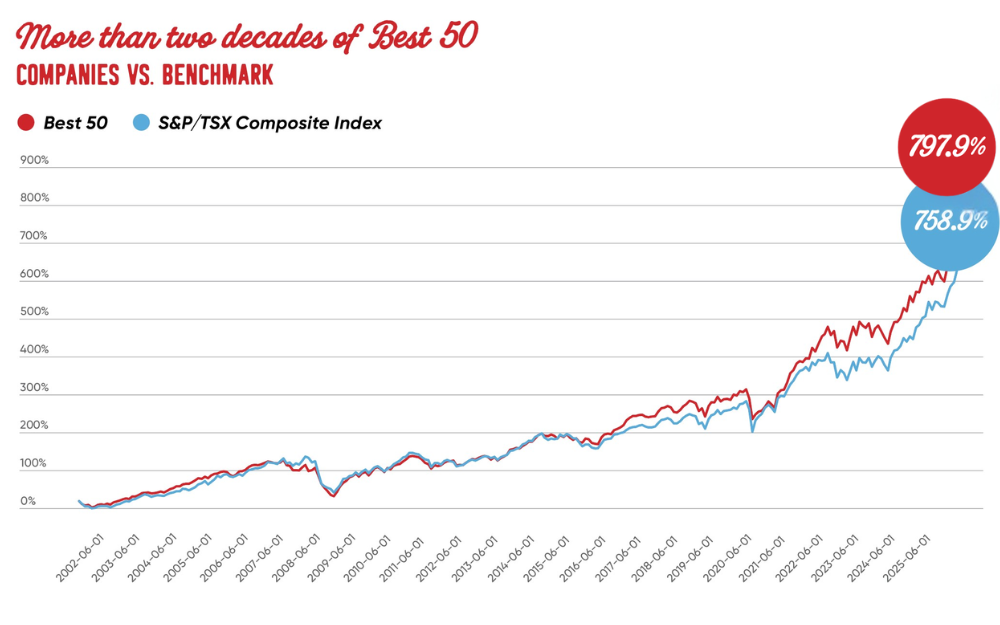
The 2026 Best 50 Corporate Citizens list suggests that the Canadian economy is undergoing a "quiet revolution." While headline GDP figures remain somber, the underlying data from these 50 companies indicates a robust and growing green economy. The average sustainable revenue ratio among the top 10 companies is significantly higher than the industry average, suggesting a correlation between sustainability and market resilience.

As Canada navigates a period of strained international relations and internal cost pressures, these corporate citizens are providing a blueprint for a new national identity. The shift is no longer just about meeting international climate accords; it is about economic survival. Companies like Stantec (17th) and WSP Global (10th) are exporting Canadian engineering expertise in sustainability to a world hungry for transition solutions. Meanwhile, transit authorities like the Société de transport de Montréal (4th) and the Toronto Transit Commission (21st) are demonstrating how public-sector entities can match private-sector efficiency in carbon management.
The 2026 rankings confirm that for Canada’s most successful firms, the "back burner" is no longer an option for sustainability. In an era of chaotic energy prices and shifting trade alliances, the green transition has become the most reliable path to financial stability and long-term growth. As the country moves toward the end of the decade, the performance of these 50 companies will likely dictate the broader trajectory of the Canadian economy in a post-fossil-fuel world.
