

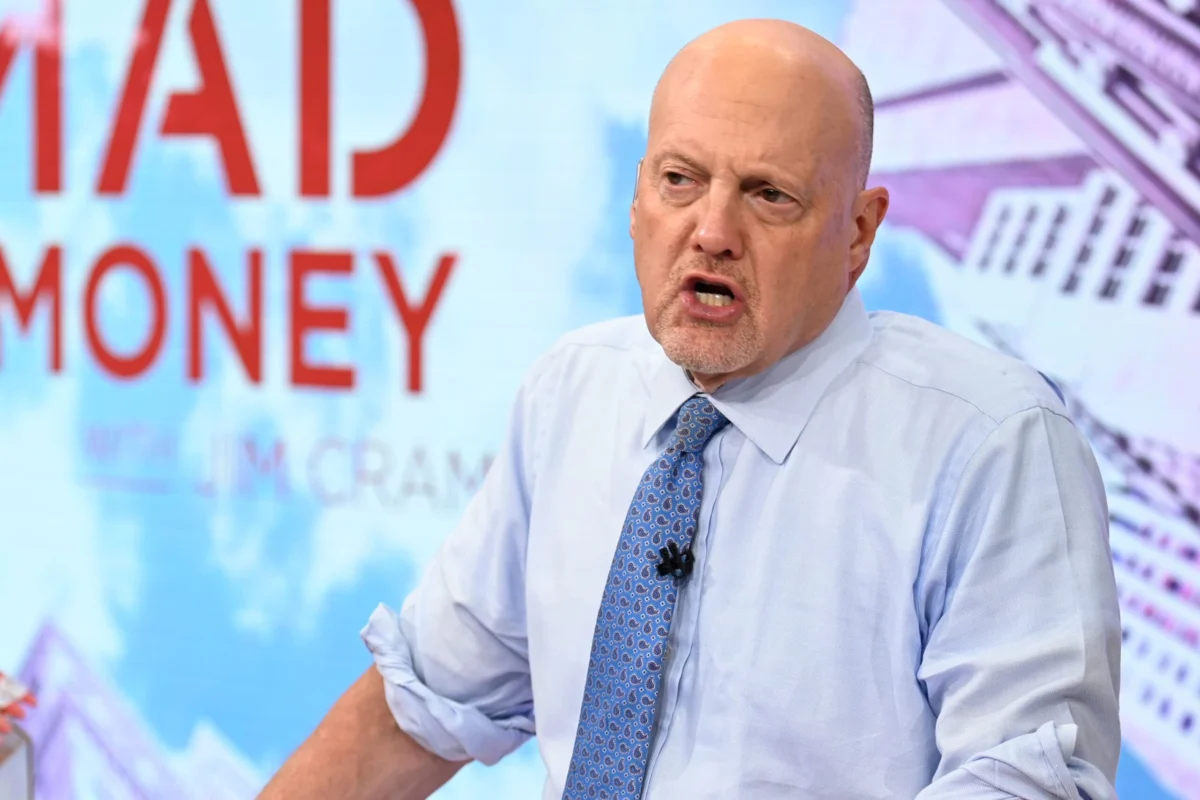
Investors are demonstrably retreating from the speculative fringes of the market, reallocating capital towards more stable, defensive assets, according to CNBC’s Jim Cramer. This significant shift, observed this past Wednesday as major indexes concluded trading lower, signals a profound change in investor sentiment, moving away from high-growth, risk-on strategies that have characterized much of the last decade. The Dow Jones Industrial Average registered a notable decline of 953 points, or 1.87%, while the S&P 500 and Nasdaq Composite followed suit, falling 1.62% and 1.98% respectively. However, Cramer highlighted that the true story lay beneath these headline figures, revealing a deeper rotation into traditionally defensive sectors.
"This is a market that’s lost its appetite for danger," the "Mad Money" host articulated, underscoring a palpable investor desire for security over aggressive growth. His analysis pointed to a clear pattern emerging from the S&P 500’s list of stocks that achieved 52-week highs on Wednesday. This list, often a bellwether for prevailing market enthusiasm, was conspicuously dominated by real estate investment trusts (REITs), insurance companies, and consumer staples – sectors renowned for their resilience and consistent performance, particularly during periods of economic uncertainty. Among these standout performers were Linde, a prominent industrial gas company, and TJX Companies, the parent company of T.J. Maxx and Marshalls, both holdings in Cramer’s Charitable Trust, further exemplifying the pivot towards established, robust businesses.
The Evident Shift: A Deeper Dive into Sector Rotation
The composition of stocks hitting new highs provides compelling evidence of this strategic pivot. Historically, periods of market exuberance often see technology and high-growth companies frequently topping such lists. However, Wednesday’s data presented a stark contrast. The overwhelming presence of REITs, which offer consistent dividend income and often act as an inflation hedge, alongside insurers, known for their stable cash flows and relatively inelastic demand, and consumer staples, which benefit from non-discretionary spending, paints a clear picture of investors prioritizing capital preservation and predictable returns. This flight to quality suggests a collective acknowledgment of heightened risks within the broader economic landscape.
Conversely, the representation of technology-related companies on this coveted list was conspicuously sparse. While exceptions like Applied Materials and KLA Corp, both semiconductor equipment manufacturers benefiting from robust demand for memory chips, managed to achieve new highs, their presence did not reflect the widespread tech dominance of previous years. This selective strength within the tech sector, limited to specific niches with strong underlying demand, further emphasizes the broader market’s cautious stance. "You know what this says to me?" Cramer questioned rhetorically. "This market’s in flight. It doesn’t want a lot of risk." This sentiment encapsulates a fundamental re-evaluation of risk-reward dynamics by a significant portion of the investing public.
Macroeconomic Headwinds Fueling the Exodus
The observed market shift is not an isolated event but rather a symptom of several powerful macroeconomic forces converging to reshape investor behavior. A primary driver has been the persistent and elevated levels of inflation, which have eroded purchasing power and squeezed corporate profit margins across various sectors. With inflation running significantly above central bank targets for an extended period, the allure of future growth, particularly for companies that are not yet profitable, diminishes as the real value of those future earnings is discounted more heavily. Defensive sectors, with their established cash flows and ability to pass on some cost increases, become more attractive in such an environment.
Compounding the inflation challenge are the aggressive monetary policy tightening measures undertaken by central banks globally, most notably the U.S. Federal Reserve. A series of substantial interest rate hikes, aimed at curbing inflation, has dramatically altered the cost of capital. Higher interest rates make borrowing more expensive for companies, impacting their expansion plans and profitability. Crucially, they also increase the discount rate used to value future earnings, disproportionately affecting growth stocks whose valuations are heavily reliant on long-term projections. Furthermore, rising rates make traditionally safer assets like bonds more competitive, offering a viable alternative to equities for investors seeking yield without the inherent volatility of the stock market. This shift in the risk-free rate creates a powerful incentive for investors to re-evaluate their equity holdings, especially those deemed speculative.
Adding to the complexity are escalating fears of an impending economic slowdown or outright recession. Indicators such as inverted yield curves, slowing manufacturing data, and declining consumer confidence have fueled concerns among economists and market participants. In anticipation of a potential downturn, investors typically rotate into defensive sectors that are less sensitive to economic cycles. Utilities, healthcare, and consumer staples, for instance, tend to maintain stable demand for their products and services even during recessions, making them relatively safe havens. Geopolitical instabilities, including ongoing conflicts and trade tensions, further amplify global economic uncertainty, prompting a broader "flight to quality" as investors seek to protect capital from unforeseen shocks.
A Historical Perspective on Defensive Rotations
The current market dynamic, characterized by a shift towards defensive assets, is not without historical precedent. Throughout economic history, periods of heightened uncertainty, elevated inflation, or impending recession have frequently triggered similar "risk-off" movements. During the dot-com bust of the early 2000s, for instance, investors rapidly abandoned overvalued technology and internet stocks in favor of more established, profitable companies. Similarly, leading up to and during the 2008 global financial crisis, there was a pronounced move into consumer staples, utilities, and high-quality bonds as investors sought refuge from the systemic risks gripping the financial system. These historical episodes underscore a consistent investor psychology: when the economic outlook darkens, the premium on safety, stability, and predictable income rises dramatically.
Market cycles inherently involve rotation. After prolonged periods of growth and expansion, often led by innovative, high-growth sectors, the market eventually recalibrates. This recalibration can be triggered by rising interest rates, inflationary pressures, or a deceleration in economic growth. Such shifts are a natural part of the investment landscape, reflecting an adaptive response to evolving economic realities. The current rotation suggests that investors are bracing for a more challenging economic environment than the one that prevailed during the era of ultra-low interest rates and abundant liquidity.
The Tech Reversal: From Dominance to Discretion
For much of the past decade, technology and high-growth stocks were the undisputed leaders of the market. Fueled by historically low interest rates, which made the present value of future earnings more attractive, and a wave of transformative innovation in areas like cloud computing, artificial intelligence, and e-commerce, these companies consistently outperformed. Investors were willing to pay premium valuations for companies demonstrating rapid revenue growth, often prioritizing market share expansion over immediate profitability. The narrative was one of disruption and exponential potential.
However, this period of unparalleled tech dominance is now facing significant headwinds. The dramatic increase in the cost of capital due to rising interest rates directly impacts the discounted value of future earnings, making highly valued growth stocks more vulnerable to corrections. Moreover, as many of these companies have matured, the expectation for continued hyper-growth has become more difficult to meet, leading to increased scrutiny on their paths to sustainable profitability. Supply chain disruptions, rising labor costs, and increasing regulatory oversight have also added pressure to the tech sector, impacting margins and operational efficiency. The market is increasingly differentiating between genuinely innovative and profitable tech companies and those whose valuations were primarily driven by speculative fervor.
Analyzing the New Market Leaders: Resilience and Dividends
The sectors currently attracting investor capital—REITs, insurance, and consumer staples—share common characteristics that make them appealing in the current environment.
Real Estate Investment Trusts (REITs): These entities own, operate, or finance income-producing real estate. They are legally required to distribute at least 90% of their taxable income to shareholders annually in the form of dividends, making them attractive for income-seeking investors. Furthermore, certain types of REITs, such as those owning essential infrastructure or data centers, can offer a degree of inflation protection as property values and rents often rise with inflation.
Insurance Companies: Insurers operate with relatively stable business models, collecting premiums and investing them until claims are paid. Their revenues are less susceptible to economic downturns, as insurance is often a necessity. Many insurers also boast strong balance sheets and a history of consistent dividend payments, making them a cornerstone of defensive portfolios.

Consumer Staples: Companies in this sector produce essential goods and services that people purchase regardless of economic conditions, such as food, beverages, household products, and personal care items. This inelastic demand provides a consistent revenue stream and earnings stability, making consumer staples a classic defensive play during periods of economic uncertainty.
Beyond Cramer’s specific mentions, sectors like Utilities and Healthcare also typically fall into the defensive category. Utilities provide essential services (electricity, water, gas) with regulated pricing and stable demand. Healthcare companies, offering products and services related to health and wellness, similarly experience relatively consistent demand, making them resilient during economic downturns. The resurgence of these "boring" stocks signals a fundamental shift in market preference, where predictability and resilience are valued over high-octane growth.
Expert Reactions and Broader Market Sentiment
Cramer’s observations are largely corroborated by a consensus among market strategists and economists who have been tracking the evolving macroeconomic landscape. Analysts from major investment banks have consistently highlighted the ongoing sector rotation, noting the outflow of capital from technology and discretionary sectors into more defensive areas. For instance, reports from institutions like Goldman Sachs and Morgan Stanley have frequently pointed to the increasing correlation between rising interest rates and the underperformance of growth stocks, while emphasizing the relative strength of value and defensive plays.
Investor sentiment surveys have also reflected this shift, indicating a growing pessimism regarding the near-term economic outlook and a corresponding increase in demand for protective assets. While some optimists still hope for a "soft landing" – a scenario where inflation is brought under control without triggering a severe recession – the market’s behavior suggests that a significant portion of investors are positioning their portfolios for a less benign outcome. The debate among experts often centers not on whether a rotation is occurring, but rather on its duration and magnitude. Is this a temporary tactical adjustment, or does it herald a more sustained, multi-year shift in market leadership? The prevailing view leans towards a prolonged period of elevated volatility and a more discerning approach to equity investing.
Implications for Investors and the Economy
The implications of this market shift are far-reaching for both individual and institutional investors. For those heavily invested in growth-oriented portfolios, the current environment necessitates a re-evaluation of risk exposure and potential rebalancing. Diversification across sectors, with an increased allocation to defensive plays, could provide a crucial buffer against further market volatility. Income-seeking investors, who may have struggled to find attractive yields in a low-interest-rate environment, might find renewed opportunities in dividend-paying defensive stocks and REITs.
For the broader economy, the market’s "flight to safety" can be interpreted as a forward-looking indicator of slowing economic activity. When investors favor stability over growth, it often signals an expectation of weaker corporate earnings and reduced consumer spending in the coming quarters. This could potentially translate into slower job growth, reduced capital expenditure by businesses, and a more challenging environment for startups and highly leveraged companies. The market’s behavior, therefore, provides valuable insight into the collective perception of future economic health, suggesting a period of caution and consolidation rather than aggressive expansion.
In conclusion, Jim Cramer’s assessment of a market "in flight," abandoning risk for safety and yield, accurately captures the prevailing sentiment driven by persistent inflation, aggressive interest rate hikes, and mounting recession fears. The observable shift into defensive sectors like REITs, insurers, and consumer staples, while technology stocks largely recede from their former dominance, marks a significant departure from recent trends. This strategic pivot by investors reflects a pragmatic adaptation to evolving macroeconomic realities, prioritizing stability and consistent returns in an increasingly uncertain global economic landscape. The market, it seems, has spoken, and its message is clear: safety first.
