

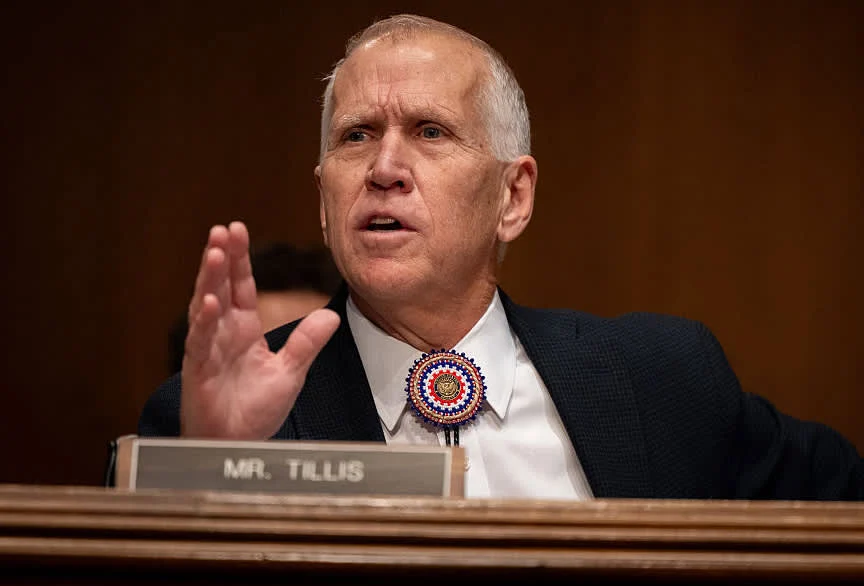
Washington, D.C. – In a sharp rebuke that has sent ripples through Capitol Hill, Senator Thom Tillis (R-NC) on Wednesday vehemently criticized President Donald Trump’s selection of Bill Pulte as acting Director of National Intelligence (DNI), labeling him an "incendiary attack dog" who possesses no viable path to Senate confirmation. The North Carolina senator, speaking on CNBC’s "Squawk Box," underscored the growing bipartisan consternation surrounding Pulte’s appointment, arguing that the head of the Federal Housing Finance Agency (FHFA) lacks the requisite experience, temperament, and political support for such a critical national security role. Tillis’s scathing assessment highlights a deepening rift between the White House and the legislative branch, threatening to derail crucial legislative efforts and raising profound questions about the integrity of the nation’s intelligence apparatus.
The Controversial Appointment and Immediate Fallout
President Trump’s decision to appoint Bill Pulte as acting DNI on Tuesday, February 4, 2026, while allowing him to concurrently retain his leadership positions at the FHFA and as chairman of mortgage giants Fannie Mae and Freddie Mac, immediately ignited a firestorm of criticism. Pulte is slated to succeed outgoing DNI Tulsi Gabbard, who announced her resignation last month, effective June 30. The dual-hatted appointment, unprecedented in recent memory for such a sensitive national security post, has been widely interpreted as a direct challenge to the Senate’s oversight authority and a potential circumvention of the confirmation process.
Senator Tillis minced no words in his condemnation, asserting, "I don’t think he has a prayer" of navigating the Senate confirmation process to become the permanent Director of National Intelligence. This sentiment resonates across the political spectrum, with numerous lawmakers, including key Republicans, expressing profound skepticism about Pulte’s suitability. The concerns extend beyond mere political disagreement, touching upon fundamental issues of qualifications, professional conduct, and the potential for politicization within the intelligence community.
Senator Tillis’s Scathing Critique and the "Amateur Hour" Allegation
Tillis, a prominent voice within the Republican caucus, offered a comprehensive indictment of Pulte’s capabilities and the White House’s decision-making process. He explicitly stated that Pulte possesses no known prior experience in intelligence, lacks geopolitical expertise, and has no established international connections – attributes Tillis described as fundamental for a DNI. "I don’t believe he’s ever had a security clearance. He clearly has no experience in intelligence, he has no geopolitical experience, no international connections – the sorts of things you would look for" in a DNI, Tillis articulated, painting a stark picture of a candidate utterly unprepared for the immense responsibilities of the role.
Beyond the lack of professional qualifications, Tillis strongly questioned Pulte’s temperament. He referenced reports of Pulte’s contentious history, including his removal from the family board of the homebuilding giant PulteGroup in 2020 following disagreements, and a subsequent public statement from the Pulte Family Charitable Foundation in June 2023 disavowing any association with Bill Pulte and clarifying that he does not speak for the family "in any capacity." Tillis argued, "Why do I bring that up? I bring it up because it suggests a temperament that’s probably not right for the DNI role." This public record, Tillis implied, points to a pattern of behavior ill-suited for the discreet, collaborative, and highly sensitive environment of national intelligence.
The North Carolina senator further excoriated the White House for what he perceived as a politically tone-deaf and strategically flawed appointment. "Whoever told the president to go ahead and commit to this publicly before vetting it should lose their jobs, because they should know that the math just works against Pulte being confirmed," Tillis declared. He concluded his remarks with a blunt assessment of the administration’s performance, stating, "They need to understand timing. Whoever these people are in the White House need to get the hell out of the White House. I am tired of amateur hour." This extraordinary public rebuke from a retiring Republican senator underscores the depth of frustration and alarm within the party regarding the administration’s personnel decisions.
Widespread Bipartisan Opposition Across Capitol Hill
The backlash against Pulte’s appointment is notably bipartisan, signaling a rare moment of consensus in an otherwise deeply divided Congress. Senator Tillis joins a growing chorus of prominent lawmakers from both sides of the aisle who have voiced profound concerns.
Senator Mark Warner (D-Va.), Vice Chairman of the Senate Intelligence Committee, emerged as a leading voice of Democratic opposition. Warner, whose committee plays a central role in DNI confirmation and intelligence oversight, reportedly urged Senate Majority Leader John Thune (R-S.D.) to help persuade President Trump to reverse Pulte’s appointment. A person familiar with the matter confirmed that Warner warned that if the reversal does not occur, "all options are on the table," including the potential torpedoing of a bipartisan deal to extend Section 702 of the Foreign Intelligence Surveillance Act (FISA) – a crucial national security tool. Warner publicly articulated his alarm on Tuesday, stating, "The idea that you put in somebody unqualified, who also has a record of weaponizing confidential information, and I’m supposed to ask, ‘just trust us?’"
Republicans have also been vocal in their disapproval. Senator Bill Cassidy (R-La.), who recently lost his primary election despite President Trump’s endorsement of a rival, stated during an interview at CNBC’s CEO Council Summit on Tuesday that Pulte does not appear "competent" to serve as acting DNI. Senate Majority Leader John Thune (R-S.D.), a key figure in navigating presidential nominations through the Senate, told reporters on Capitol Hill, "We don’t need a weaponized DNI, we need professionals there." These statements from influential Republicans underscore the serious challenges Pulte would face if his nomination were to proceed to a full confirmation vote.

Adding to the portrait of Pulte’s controversial past within the administration, an incident involving Treasury Secretary Scott Bessent came to light. During a Senate Finance Committee hearing on Wednesday, Tillis directly questioned Bessent about reports of a heated confrontation between the two officials last year. Bessent candidly confirmed the reports, stating, "I actually said I was going to kick his ass." He then downplayed the incident as "last summer" and likened it to "many teams have fights in the locker room, and then go out and win for the team on the field," suggesting it was an internal dispute now resolved. However, the revelation further highlights Pulte’s contentious relationships within the executive branch.
The Director of National Intelligence: A Critical Role in National Security
The position of Director of National Intelligence was established by the Intelligence Reform and Terrorism Prevention Act of 2004, following the recommendations of the 9/11 Commission. Its creation was a direct response to perceived failures in intelligence sharing and coordination among various U.S. agencies prior to the September 11, 2001, terrorist attacks. The DNI serves as the principal advisor to the President, the National Security Council, and the Homeland Security Council on intelligence matters related to national security.
The DNI is responsible for overseeing and directing the implementation of the National Intelligence Program, which encompasses the budgets, programs, and activities of 17 U.S. intelligence agencies. This includes the CIA, NSA, FBI, and intelligence elements of the military branches and other departments. Key responsibilities include integrating foreign, military, and domestic intelligence, ensuring intelligence analysis is objective and unpoliticized, and managing the vast resources of the intelligence community. The DNI also serves as the head of the Intelligence Community and is charged with enhancing collaboration, information sharing, and analytical rigor across these disparate agencies. Given the DNI’s critical role in national security and the protection of classified information, candidates are typically expected to possess extensive experience in intelligence, national security, foreign policy, or military leadership, often with a proven track record of managing complex organizations and navigating intricate geopolitical landscapes. The absence of such a background for Pulte is a central pillar of the current criticism.
Bill Pulte’s Controversial Record at the FHFA
A significant source of concern regarding Bill Pulte’s DNI appointment stems from his tenure as head of the Federal Housing Finance Agency. Pulte, widely seen as a staunch Trump loyalist, has faced accusations of leveraging his access to sensitive mortgage records to target perceived political adversaries of the president and refer them for prosecution. This alleged "weaponization" of a regulatory agency has deeply alarmed intelligence analysts and lawmakers, who fear that similar tactics could be employed with the nation’s most sensitive secrets if Pulte were to lead the intelligence community.
Among the high-profile targets of Pulte’s alleged actions were Federal Reserve Governor Lisa Cook and New York Attorney General Letitia James. Both faced allegations of mortgage-related wrongdoing initiated by Pulte during his time at the FHFA. Critics argue that these actions demonstrated a willingness to use a federal agency’s powers for political retribution rather than its intended regulatory purpose. Intelligence professionals typically operate under strict ethical guidelines, prioritizing objectivity and non-partisanship. The perception that Pulte has a history of politicizing official duties directly contradicts these foundational principles, raising serious questions about his ability to safeguard the impartiality and integrity of the intelligence community. His critics contend that such a track record is antithetical to the DNI’s mandate, which requires an unwavering commitment to objective intelligence analysis free from political influence.
Implications for Key Legislation: FISA Section 702 Reauthorization
The controversy surrounding Pulte’s appointment risks exacerbating existing deadlocks in Congress, particularly concerning the reauthorization of Section 702 of the Foreign Intelligence Surveillance Act (FISA). Section 702 is a critical surveillance authority that allows the U.S. government to collect the communications of non-U.S. persons located outside the United States for foreign intelligence purposes. While widely considered vital for national security by intelligence agencies, it has also been a contentious issue due to concerns about potential "incidental" collection of American citizens’ communications and privacy implications.
Congress has been grappling for weeks with efforts to reauthorize this crucial law, with a bipartisan deal still pending. Senator Mark Warner’s explicit warning that "all options are on the table," including tanking the FISA Section 702 extension, underscores the gravity of the situation. The DNI plays a direct role in overseeing FISA operations, and the appointment of a DNI perceived as unqualified or politically motivated could undermine trust in the program’s oversight and jeopardize its future. Lawmakers on both sides of the aisle are keen to ensure that the individual leading the intelligence community commands respect and confidence regarding their commitment to civil liberties and the rule of law. Pulte’s appointment, in this context, has injected a new layer of uncertainty and potential obstruction into an already delicate legislative process, risking a lapse in a critical intelligence capability.
The "Acting" Status Loophole and Broader Political Ramifications
A significant aspect of the current political maneuver is President Trump’s decision to appoint Pulte as "acting" DNI. This designation allows the administration to install Pulte in the position without immediate Senate confirmation, thereby circumventing the constitutional "advice and consent" role of the Senate. While acting appointments are common for short periods, maintaining an "acting" official indefinitely in such a sensitive role can undermine congressional oversight, create instability, and potentially bypass the vetting process designed to ensure competent leadership. Senator Tillis acknowledged this potential loophole, suggesting that the Trump administration could simply leave Pulte in place with the "acting" title, thus avoiding the uphill battle for full confirmation.
Such a move, however, would carry its own set of political and operational risks. It could further strain the already fraught relationship between the White House and the Senate, leading to increased legislative obstruction and a breakdown in trust. For the intelligence community itself, an acting DNI who lacks congressional backing could struggle to command the full authority and respect necessary to effectively lead and coordinate 17 diverse agencies. This situation could foster internal dissent, diminish morale, and potentially compromise the effectiveness of intelligence operations at a time of complex global threats.
The appointment also sets a concerning precedent regarding the qualifications expected for top national security positions. By prioritizing loyalty over demonstrated expertise and temperament, critics argue that the administration risks eroding the professionalism and non-partisanship that are cornerstones of effective intelligence work. The ongoing saga surrounding Bill Pulte’s DNI appointment is not merely a personnel dispute; it represents a significant challenge to the traditional checks and balances of American governance and raises fundamental questions about the future direction and integrity of the nation’s intelligence enterprise. As the debate continues, the implications for national security, legislative cooperation, and the very structure of the U.S. intelligence community remain profound and uncertain.
