

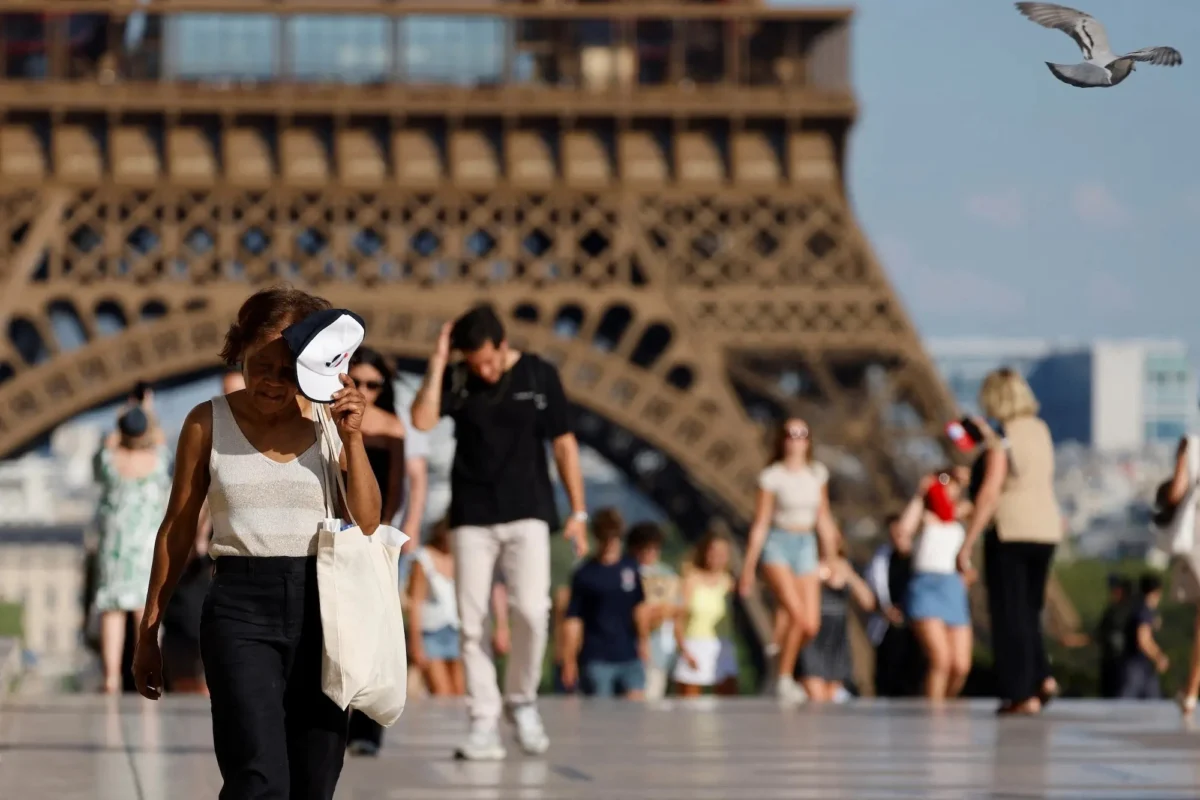
On a sunny Friday afternoon in October 2023, approximately 70 children filed into a cool, dark tunnel in the south of Paris. The setting was the Petite Ceinture, an abandoned railway line that encircles the city. Inside, the temperature remained a steady 64 degrees Fahrenheit (18 degrees Celsius), providing a stark contrast to the simulated catastrophe unfolding above. This was not a field trip, but a high-stakes rehearsal for a future that climate scientists warn is becoming inevitable.
The exercise, titled "Paris at 50 Degrees Celsius," was designed to simulate a reality where the French capital hits a staggering 122 degrees Fahrenheit. In this imagined disaster, the city’s infrastructure buckles under a heat wave of unprecedented duration and intensity. Children role-played victims of food poisoning from spoiled refrigerated goods following power outages, while others mimicked the symptoms of carbon monoxide poisoning from faulty emergency generators. Red Cross workers, firefighters, and city officials navigated the simulated chaos, making split-second decisions about which patients to prioritize as hospitals reached their breaking points.
This drill represents a burgeoning global trend. As the planet continues to warm, municipal governments are shifting their focus from theoretical planning to "stress testing" their emergency services, health systems, and essential infrastructure through live and tabletop simulations.
The Scientific Imperative for Heat Rehearsals
The impetus for the Paris simulation is rooted in increasingly dire climate modeling. While the city’s current record high is 108.7 degrees Fahrenheit (42.6 degrees Celsius), recorded in July 2019, experts at the Île-de-France Regional Climate Change Expertise Group suggest that the 122-degree mark could be reached by the turn of the century. This projection aligns with data from the Intergovernmental Panel on Climate Change (IPCC), which warns that European governments must prepare for a warming of 5 to 6 degrees Fahrenheit (2.8 to 3.3 degrees C) above pre-industrial levels.
The threat is not unique to Europe. Modeling indicates that by 2050, more than 1.6 billion people across nearly 1,000 cities will regularly face perilous heat conditions. Heat is often referred to as a "silent killer," contributing to an estimated 500,000 deaths annually worldwide. Unlike floods or hurricanes, the damage caused by heat is often invisible until it manifests as overwhelmed morgues or collapsed power grids.
In Paris, the preparation for the October drill took more than 18 months. Pénélope Komités, the city’s deputy mayor in charge of resilience, emphasized that the simulation was vital to move the conversation beyond abstract television reports. "It was very important for us to show people that heat waves are not just something we see on the TV, but something that can happen soon," Komités said. The city invested approximately €200,000 ($236,000) into the two-day event, hiring Crisotech, a consultancy specializing in crisis management, to develop a dozen complex scenarios.
Chronology of a Crisis: From Preparation to Implementation
The timeline for Paris’s heat adaptation strategy showcases a shift from reactive measures to proactive disaster management:
- July 2019: Paris records its highest temperature in history (42.6°C), serving as a wake-up call for city planners.
- Early 2022: The city commissions the Île-de-France Regional Climate Change Expertise Group to model "Paris at 50°C."
- Early 2023: Crisotech begins a nine-month collaboration with over 100 organizations, including utilities, nonprofits, and emergency services, to design the October simulation.
- October 2023: The live simulation takes place, involving citizens and school children in role-playing exercises followed by tabletop drills for officials.
- March 2024: Paris opens its first "Campus of Resilience" to provide ongoing training for residents and civil servants.
- 2024–2030: The city integrates 50 specific recommendations from the drill into its official Climate Action Plan.
This chronological progression demonstrates that effective heat management requires years of foundational work before a single drill can be executed.
Identifying the Breaking Points of Urban Systems
A primary goal of these simulations is to identify "cascading failures"—instances where one failure triggers a chain reaction across different urban systems. During extreme heat, the demand for air conditioning can lead to power grid failures. These outages, in turn, disable water pumps, transit systems, and refrigeration, leading to dehydration, transport paralysis, and foodborne illnesses.
Cassie Sunderland, managing director of climate solutions at C40—a global network of mayors—noted that success in these drills is measured by failure. "The most valuable ones are realistic enough to force decisions, yet unpredictable enough to expose coordination problems," Sunderland explained. For instance, simulations often force engineers to calculate the exact temperature at which steel train tracks begin to "kink" or expand, potentially derailing cars or forcing a total shutdown of the transit network.
In Phoenix, Arizona, a similar exercise revealed a critical lack of communication between different municipal departments. This discovery led to the creation of a dedicated "heat department," a move mirrored by cities like Athens, Greece, and Freetown, Sierra Leone, which have appointed Chief Heat Officers to centralize their response strategies.
The Medical and Social Challenges of Extreme Heat
Dr. Satchit Balsari, a professor of emergency medicine at Harvard Medical School, argues that many cities have "heat action plans" that exist only on paper. Simulations bridge the gap between theory and the messy reality of medical emergencies.
"How do you take a large human body and put it in ice? Is there a bucket that big?" Balsari asked, highlighting the logistical hurdles of treating heatstroke. "The answer is no, so is it a body bag? Where do you get all this ice?"
Beyond the immediate crisis, Balsari suggests that simulations must account for the "long tail" of heatwaves. High temperatures place immense strain on the kidneys and heart, leading to a surge in chronic health issues in the months following a heat event. A truly resilient city must plan for the healthcare capacity required to handle these delayed impacts.
The social dimension is equally critical. In the Paris drill, the inclusion of children was intentional. Not only will the younger generation bear the brunt of future climate extremes, but their participation helps socialize the concept of disaster preparedness within families. Pénélope Komités noted that the COVID-19 pandemic proved that well-informed communities respond more effectively to crises. If residents know how to recognize heatstroke symptoms and where to find "cooling islands," the burden on first responders is significantly reduced.
Global Expansion and Scalability
The "Paris model" is already being adapted by other major metropolitan areas. Barcelona, Spain, is currently developing its own simulation based on the Paris methodology. The Mediterranean basin is warming 20 percent faster than the global average, and Barcelona is projected to see some of the highest heat-related mortality rates in Europe.
Irma Ventayol, who leads Barcelona’s climate change department, is using simulations to ask granular questions about the city’s basic functions. "Can we cope with waste management at 40 degrees C or 50 degrees C? Are the trucks prepared?" she asked. Ventayol’s goal is to create a scalable protocol that can be used by other cities to address not just heat, but other climate impacts like flash flooding.
In Taiwan, the focus has shifted toward national-level coordination. Following a tabletop exercise in 2023, the country planned a live simulation for July 2024 to test how local and national agencies collaborate during a prolonged 104-degree Fahrenheit (40-degree Celsius) heat wave. Ken-Mu Chang, deputy director general of Taiwan’s Climate Change Administration, noted that early trials revealed a tendency for agencies to simply "explain existing plans" rather than actually demonstrating crisis response. The goal of newer drills is to make gaps in those plans "visible and concrete."
Analysis of Implications: From Simulation to Transformation
While simulations are a vital tool for emergency preparedness, experts warn they are not a panacea. True resilience requires a dual-track approach: preparing for the disaster while simultaneously working to lower urban temperatures.
The Paris simulation resulted in 50 concrete recommendations that are now being implemented. These include:
- Thermal Insulation: Retrofitting thousands of public housing units to improve heat resistance.
- Urban Greening: Replacing asphalt parking lots with trees to reduce the "urban heat island" effect. Paris planted 15,000 trees in the winter of 2023 alone.
- Public Cooling: Opening bathing spots along the Seine River and creating a network of "cool paths" throughout the city.
The economic argument for these exercises is also becoming clearer. While a drill may cost hundreds of thousands of dollars, the cost of inaction—measured in lost productivity, healthcare expenses, and infrastructure repair—runs into the billions. Smaller cities with fewer resources are being encouraged to conduct "micro-simulations" rather than large-scale live events. As Ziad Touat of Crisotech suggested, "It’s better to do five small ones than one big one."
The ultimate success of these rehearsals will not be known until the next record-breaking heat dome settles over a major city. However, the shift toward active rehearsal suggests that municipal leaders are finally treating extreme heat with the same gravity as a terrorist attack or a natural disaster. By imagining the unthinkable—a city at 50 degrees Celsius—planners are finding the flaws in their systems today so they can save lives tomorrow.
