


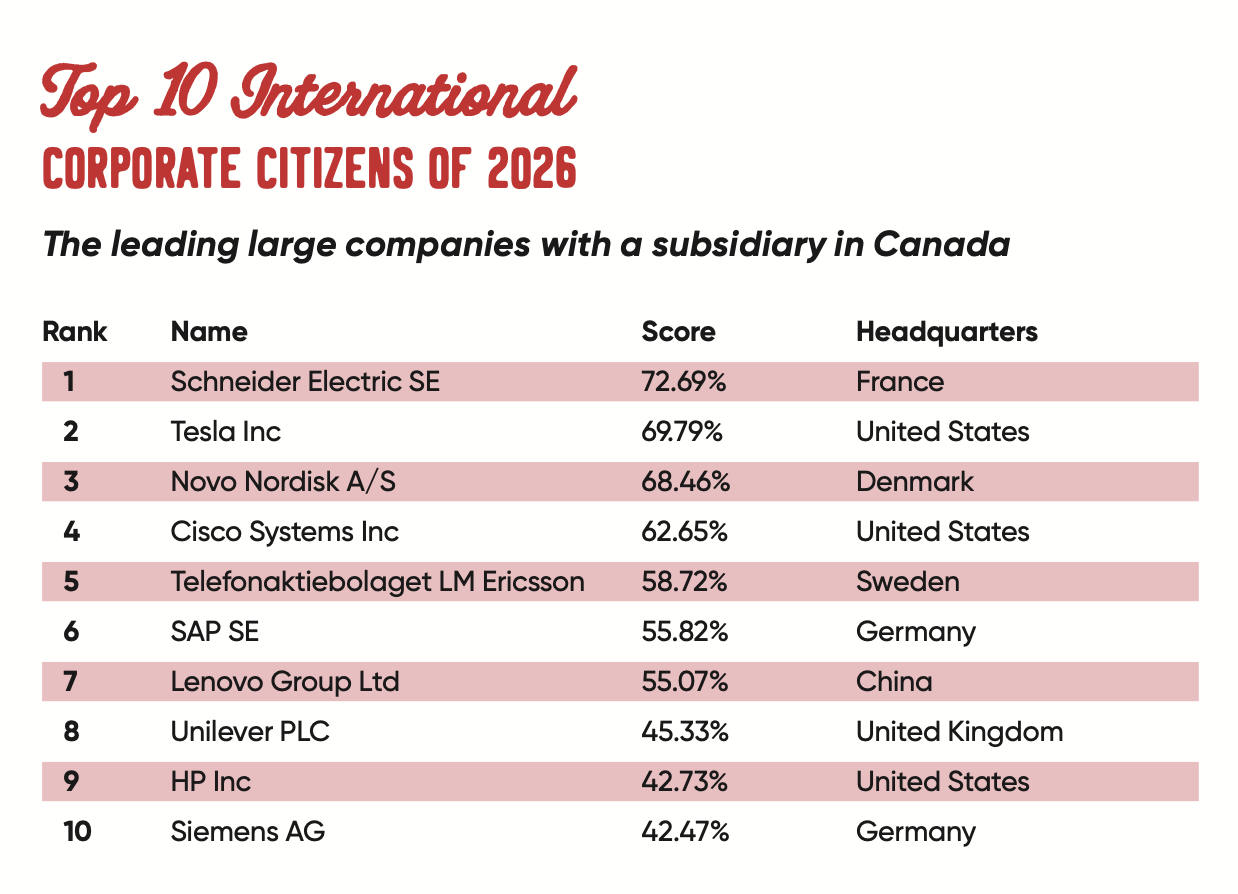
The 2026 ranking of the Top 10 International Corporate Citizens has been officially released by Corporate Knights, identifying the foreign-headquartered companies that have demonstrated the highest levels of environmental and social responsibility while maintaining a significant economic presence within Canada. This prestigious list is published in conjunction with the annual Best 50 ranking of Canada’s top sustainable companies, providing a comprehensive overview of the organizations driving the transition to a greener, more resilient economy. To qualify for the international ranking, companies must generate more than $1 billion in annual revenue from their Canadian operations, must not be listed or headquartered in Canada, and must achieve the highest scores based on the rigorous Corporate Knights sustainability rating methodology. This methodology is the same used for the 2026 Global 100, which evaluates the most sustainable corporations on a global scale.
The 2026 results highlight a significant trend in the corporate landscape: the dominance of technology and industrial firms that are intrinsically linked to electrification and digital infrastructure. Leading the pack this year is the French multinational Schneider Electric SE, which secured the top spot with an overall sustainability score of 72.69%. Schneider Electric is no stranger to the upper echelons of these rankings, having been named the most sustainable company in the world on the 2025 Global 100 list. Following closely in second place is the American electric vehicle and clean energy giant Tesla Inc., with a score of 69.79%. The third position is held by the Danish pharmaceutical leader Novo Nordisk A/S, which earned a score of 68.46%. Together, these three organizations represent the vanguard of international corporate citizenship, demonstrating that large-scale industrial and commercial success can coexist with aggressive decarbonization and social responsibility goals.
The 2026 Methodology: A Rigorous Framework for Accountability
The Corporate Knights sustainability rating methodology is widely regarded as one of the most stringent and transparent in the world. For the 2026 rankings, the assessment involved a detailed analysis of several hundred global companies with significant operations in Canada. The process begins with a screening of four key areas: sustainability disclosure, financial health, product categories (excluding companies involved in weapons, tobacco, and other harmful industries), and legal track records.
Once the initial screening is complete, companies are scored on up to 25 quantitative key performance indicators (KPIs). These KPIs cover a broad spectrum of corporate behavior, including resource management (such as energy, carbon, water, and waste productivity), employee management (including safety, turnover, and diversity in executive and board positions), and financial management (including clean revenue and clean investment).
A critical component of the 2026 methodology is the emphasis on "Clean Revenue" and "Clean Investment." These metrics track the percentage of a company’s total income and capital expenditures derived from products and services that have a clear environmental or social benefit, based on the Corporate Knights Clean Taxonomy. This focus ensures that companies are not merely "greenwashing" their internal operations but are actively pivoting their business models toward sustainable solutions. For the international firms operating in Canada, this means their multi-billion dollar footprints are being scrutinized for how much they contribute to Canada’s own climate and social targets.
Detailed Profile of the Top Three Performers
Schneider Electric’s first-place finish is a testament to its long-term commitment to being a "digital partner for sustainability and efficiency." The company specializes in energy management and automation, providing technologies that help buildings, data centers, and industries reduce their carbon footprints. Schneider Electric’s high score is driven by its massive investment in research and development for energy-efficient solutions and its internal goal to achieve carbon neutrality in its operations by 2025. In Canada, Schneider Electric has been a key player in the modernization of the electrical grid and the implementation of smart building technologies.

Tesla Inc.’s second-place ranking reflects its unparalleled impact on the transportation sector. As a pioneer in electric vehicles (EVs) and battery storage, Tesla has fundamentally shifted the global automotive industry toward electrification. In Canada, Tesla’s presence has grown through its extensive Supercharger network and its role in the battery supply chain, which is increasingly vital to the Canadian economy. Despite occasional controversies regarding its governance, Tesla’s core business model—which is almost entirely focused on clean energy and zero-emission transport—results in exceptionally high clean revenue scores.
Novo Nordisk, rounding out the top three, represents the healthcare sector. The Danish firm is a global leader in diabetes and obesity care. Its high sustainability score is attributed to its "Circular for Zero" environmental strategy, which aims to have zero environmental impact across its entire value chain. This includes shifting to 100% renewable electricity in production and designing eco-friendly packaging. Furthermore, Novo Nordisk has been recognized for its social initiatives, including programs to provide affordable insulin in low- and middle-income countries and its commitment to diverse representation in its workforce.
Industry Trends: The Rise of Digital and Electrical Infrastructure
Beyond the top three, the 2026 Top 10 list is characterized by a strong showing from United States-based technology firms. Cisco Systems, a multinational leader in networking hardware and telecommunications, and HP Inc., a primary manufacturer of personal computers and printers, both secured spots on the list. These inclusions highlight the critical role that digital infrastructure plays in the modern sustainability movement. Efficient networking and "green" computing are essential for reducing the energy consumption of the digital economy, which has become a major concern as data processing needs continue to surge.
The list also features a notable lack of diversity in terms of traditional consumer goods. Unilever PLC, the British multinational known for its vast portfolio of food, beauty, and home care products, sits in eighth place. Unilever is the only traditional fast-moving consumer goods (FMCG) company to make the cut this year. This highlights the difficulty that large-scale consumer goods companies face in decarbonizing complex, global supply chains that rely heavily on agriculture and plastic packaging. Unilever’s inclusion is largely due to its "Compass" strategy, which integrates sustainability into every brand and business unit, focusing on improving the health of the planet and social well-being.
Economic Context and the Quality of Investment
The release of these rankings comes at a time when the Canadian government and business leaders are intensely focused on attracting foreign direct investment (FDI). However, as Toby Heaps, CEO and co-founder of Corporate Knights, pointed out in a statement accompanying the release, the focus is shifting from the volume of investment to the character of that investment.
"Corporate investment is a major preoccupation in Canada today, but quality matters at least as much as quantity," Heaps stated. "Our Best 50 analysis shows that economy-wide, investment in sustainable activities is growing materially faster than its non-sustainable counterparts—and that’s one of the most important and encouraging economic signals we’ve seen."
This observation is backed by data showing that sustainable investments are increasingly seen as "future-proof." As global regulations tighten and carbon pricing becomes more prevalent, companies that have already integrated sustainability into their core operations are less exposed to transition risks. For Canada, attracting "high-quality" international corporate citizens like those on this list means securing investments that will support the country’s commitment to reaching net-zero emissions by 2050.
Chronology and the Evolution of Sustainability Standards
The 2026 rankings are part of a multi-decade evolution in how corporate performance is measured. Corporate Knights, founded in 2002, was an early advocate for the idea that social and environmental factors are material to financial performance. When the Global 100 was first launched in 2005 at the World Economic Forum in Davos, sustainability was often viewed as a niche concern or a matter of simple philanthropy.
Over the last twenty years, the landscape has changed dramatically:
- 2005–2012: The focus was primarily on environmental disclosure and "doing less harm."
- 2013–2019: The rise of ESG (Environmental, Social, and Governance) investing saw a massive influx of capital into sustainable funds, and Corporate Knights refined its KPIs to include social metrics like executive diversity and tax fairness.
- 2020–2025: The "Decade of Action" saw companies move toward science-based targets and net-zero pledges. The 2025 ranking, which saw Schneider Electric take the global top spot, emphasized the importance of "Clean Revenue" as the ultimate metric of a company’s impact.
- 2026: The current rankings reflect a "post-transition" mindset, where the leading companies are no longer just reducing their footprints but are actively building the infrastructure of the new economy—whether through EVs, smart grids, or sustainable healthcare.
Broader Implications for the Canadian Market
The presence of these international giants in Canada has profound implications for the domestic market. First, these companies often set the standard for their Canadian suppliers. When a company like HP or Cisco demands sustainable components or carbon-neutral shipping from its Canadian partners, it creates a ripple effect throughout the local supply chain, forcing smaller firms to upgrade their own sustainability practices.
Second, these rankings provide a roadmap for Canadian policymakers. The success of firms like Schneider Electric and Tesla in the Canadian market suggests that government incentives—such as green investment tax credits and EV subsidies—are working to attract the right kind of corporate partners. However, the dominance of foreign firms in sectors like electrification and high-tech infrastructure also serves as a challenge to Canadian-owned firms to accelerate their own innovation and sustainability efforts to remain competitive.
Finally, the 2026 Top 10 International Corporate Citizens list serves as a reminder that sustainability is no longer a peripheral corporate department; it is the core of modern business strategy. As the world moves closer to 2030—a key milestone for many international climate goals—the performance of these multi-billion dollar entities will be the primary factor in determining whether global and national environmental targets are met.
In conclusion, the 2026 rankings by Corporate Knights underscore a pivotal moment in the global economy. With Schneider Electric, Tesla, and Novo Nordisk leading the way, it is clear that the most successful international companies operating in Canada are those that have successfully aligned their profit motives with the urgent need for a sustainable future. As sustainable investment continues to outpace traditional investment, these "Corporate Citizens" are not just guests in the Canadian economy; they are the architects of its next chapter.
