

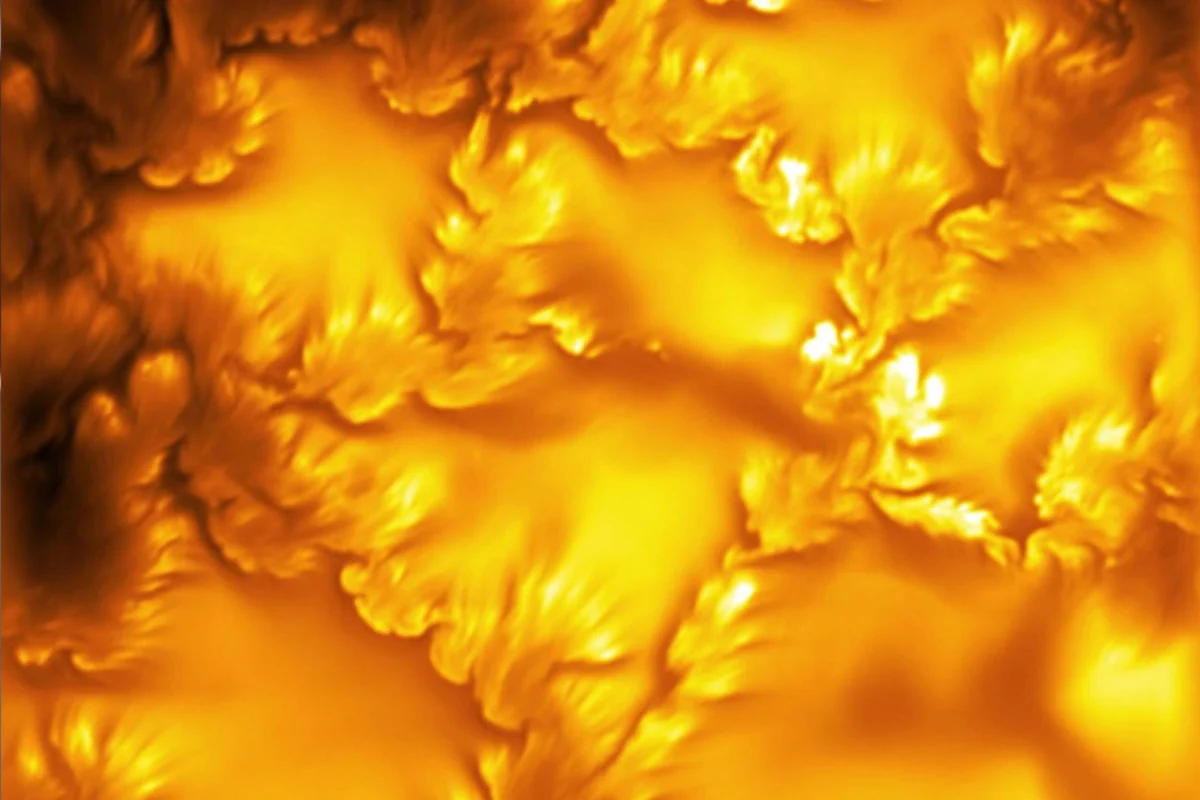
For decades, the international scientific community has operated under the theoretical assumption that the sun’s photosphere is a chaotic theater of microscopic plasma vortices. These structures, predicted to be born from the violent friction between intense magnetic fields and the relentless flow of superheated material, remained largely invisible to the human eye and traditional instrumentation. This week, however, the paradigm shifted. Using the Daniel K. Inouye Solar Telescope (DKIST), the world’s most sophisticated solar observatory, researchers have provided the first definitive visual evidence of these phenomena, confirming a physical prediction that has stood for more than a century.
The image, released via NASA’s Astronomy Picture of the Day and sourced from the National Solar Observatory (NSO), offers a glimpse into the sun’s atmosphere with a level of clarity never before achieved in visible light. Located at the summit of the Haleakalā volcano in Maui, Hawaii, the Inouye Solar Telescope has captured what scientists identify as the Kelvin-Helmholtz instability. This specific physical phenomenon, first theorized by Lord Kelvin and Hermann von Helmholtz in the late 19th century, manifests as a series of swirling, wave-like patterns that occur when two fluids—or in this case, plasma streams—interact at different velocities.
While the public is accustomed to the vibrant, false-color images of the sun provided by space-based observatories like the Solar Dynamics Observatory (SDO), which utilizes ultraviolet and X-ray wavelengths to highlight solar activity, the latest DKIST image is unique. It was captured in visible light, the portion of the electromagnetic spectrum detectable by the human eye. The resulting landscape is a complex tapestry of structures resembling organic petals, intricate folds, and delicate swirls. These are not merely aesthetic features; they are the fingerprints of fundamental fluid dynamics playing out on a stellar scale.
The Mechanics of the Kelvin-Helmholtz Instability
The Kelvin-Helmholtz (KH) instability is a universal principle of fluid dynamics. On Earth, it is most frequently observed in the atmosphere or the ocean. When wind blows over the surface of the water, the difference in speed between the air and the liquid creates ripples that can eventually "break" into curls. Similarly, in the sky, these instabilities create the famous "fluctus" cloud patterns—clouds that look like breaking ocean waves—often cited as a possible inspiration for the swirling skies in Vincent van Gogh’s The Starry Night.
On the sun, the medium is not air or water, but plasma—a state of matter consisting of a hot gas of ions and free electrons. Because plasma is electrically conductive, its movement is governed by both fluid dynamics and electromagnetism, a field known as magnetohydrodynamics (MHD). The "petals" observed in the DKIST image represent regions where plasma streams are sliding past one another at different speeds. The resulting friction causes the boundary layer to ripple, eventually curling into vortices that distribute energy across the solar surface.
Until this breakthrough, visible-light telescopes lacked the resolution to see these small-scale interactions. Previous observations often depicted the sun’s surface as a relatively smooth, granulated field. The Inouye telescope, however, possesses the resolution to see features as small as 20 kilometers in diameter—an extraordinary feat considering the sun is 150 million kilometers away from Earth. The vortices captured in this latest data set are estimated to be only a few dozen kilometers wide, appearing and vanishing in a matter of minutes.
A Century of Theoretical Development
The road to this discovery spans over 150 years of scientific inquiry. In the 1860s and 1870s, William Thomson (Lord Kelvin) and Hermann von Helmholtz began investigating the stability of fluid motion. Their work laid the foundation for understanding how turbulence forms in everything from pipes to planetary atmospheres.
By the mid-20th century, astrophysicists began to suspect that the KH instability must exist on the sun. Theoretical models suggested that the solar surface, or photosphere, was far more turbulent than early telescopes could reveal. However, the Earth’s atmosphere acts as a distorting lens, blurring the fine details of the sun’s surface for ground-based observers. Space-based telescopes, while avoiding atmospheric distortion, were often optimized for broader spectral ranges rather than the ultra-high resolution required to see KH vortices in visible light.
The construction of the Daniel K. Inouye Solar Telescope was specifically designed to bridge this gap. With a 4-meter aperture—the largest of any solar telescope in the world—and a sophisticated adaptive optics system that compensates for atmospheric turbulence in real-time, the facility was built to test these century-old theories. The confirmation of KH instability on the photosphere represents a "mission accomplished" moment for the National Science Foundation (NSF) and the NSO, which manage the facility.
Technical Specifications and the Role of DKIST
The image captured by DKIST spans an area roughly equivalent to the radius of the Earth. While this may sound vast, in solar terms, it is a microscopic "postage stamp" of the sun’s total surface area. The ability to zoom in with such precision is what allowed the Kelvin-Helmholtz waves to be identified.

The Daniel K. Inouye Solar Telescope employs several cutting-edge technologies to achieve this resolution:
- Specialized Cooling System: Because the telescope concentrates massive amounts of solar heat, it requires a cooling system involving over seven miles of piping and the production of several tons of ice daily to keep the mirrors and instruments from melting.
- Adaptive Optics: By using a deformable mirror that adjusts its shape 2,000 times per second, the telescope can cancel out the "twinkling" effect caused by the Earth’s atmosphere.
- Visible Light Spectrometers: These instruments allow scientists to measure the magnetic field strength and velocity of plasma with unprecedented precision, providing the data necessary to confirm that the observed swirls are indeed KH instabilities.
Implications for Solar Science and the Corona Mystery
The discovery of these plasma vortices is more than a historical curiosity; it is a critical piece of the puzzle in solving the "Coronal Heating Problem." For decades, scientists have struggled to explain why the sun’s outer atmosphere, the corona, is millions of degrees hotter than its surface. Under standard thermodynamic laws, temperature should decrease as one moves away from a heat source, yet the sun’s surface sits at roughly 6,000 degrees Celsius while the corona reaches millions of degrees.
The Kelvin-Helmholtz instability provides a mechanism for energy transfer. As these small vortices form and break, they convert the kinetic energy of the plasma streams into heat and magnetic energy. This process, known as turbulent dissipation, could be a significant contributor to the heating of the upper solar atmosphere. By studying how these vortices interact with the sun’s magnetic field lines, researchers can better understand how energy is pumped from the photosphere into the corona.
Furthermore, these instabilities play a role in the formation of solar flares and Coronal Mass Ejections (CMEs). CMEs are massive bursts of solar wind and magnetic fields that can travel through space and interact with Earth’s magnetosphere. When these solar storms hit Earth, they can cause geomagnetic storms capable of disrupting satellite communications, GPS signals, and even power grids on the ground.
Official Reactions and Future Outlook
While NASA and the NSO have expressed significant enthusiasm regarding the image, the scientific consensus is that this is only the beginning of a new era in solar meteorology. In official statements following the release, representatives from NASA’s Goddard Space Flight Center noted that the image represents the "sharpest view of the sun’s surface ever obtained," providing a baseline for future studies on solar turbulence.
Dr. Alexandra Tritschler, a senior scientist at the National Solar Observatory, has previously emphasized that the Inouye telescope would "open a new window into solar physics." The confirmation of the KH instability validates the telescope’s design and its potential to answer the most pressing questions about our star.
The next steps for the research team involve longitudinal studies. Now that they know where and how to look for these vortices, they can track their lifecycle—how they form, how long they last, and exactly how much energy they release. This data will be integrated into computer models of the sun, improving our ability to predict space weather.
Protecting Modern Infrastructure
The practical applications of this research cannot be overstated. In an increasingly digital world, our reliance on satellite technology and interconnected power grids makes us vulnerable to solar activity. The 1859 Carrington Event, the most intense geomagnetic storm on record, caused telegraph systems to fail and even catch fire. A similar event today could cause trillions of dollars in damage and years of infrastructure repair.
By understanding the microscopic instabilities like the Kelvin-Helmholtz phenomenon, scientists are essentially learning the "micro-physics" of the sun. Just as terrestrial meteorologists study small pressure changes to predict hurricanes, solar physicists are now using DKIST to study plasma vortices to predict solar storms. The ability to visualize the sun’s surface in visible light with such clarity allows for a more accurate assessment of the magnetic stresses that lead to solar eruptions.
As the Daniel K. Inouye Solar Telescope continues its mission at the peak of Haleakalā, it will continue to strip away the mysteries of the sun. The confirmation of the Kelvin-Helmholtz instability is a testament to the power of human curiosity and the endurance of scientific theory. A prediction made in the era of steam engines has finally been validated in the era of supercomputers and space exploration, proving once again that the laws of physics are as constant as the star that sustains life on our planet.
