

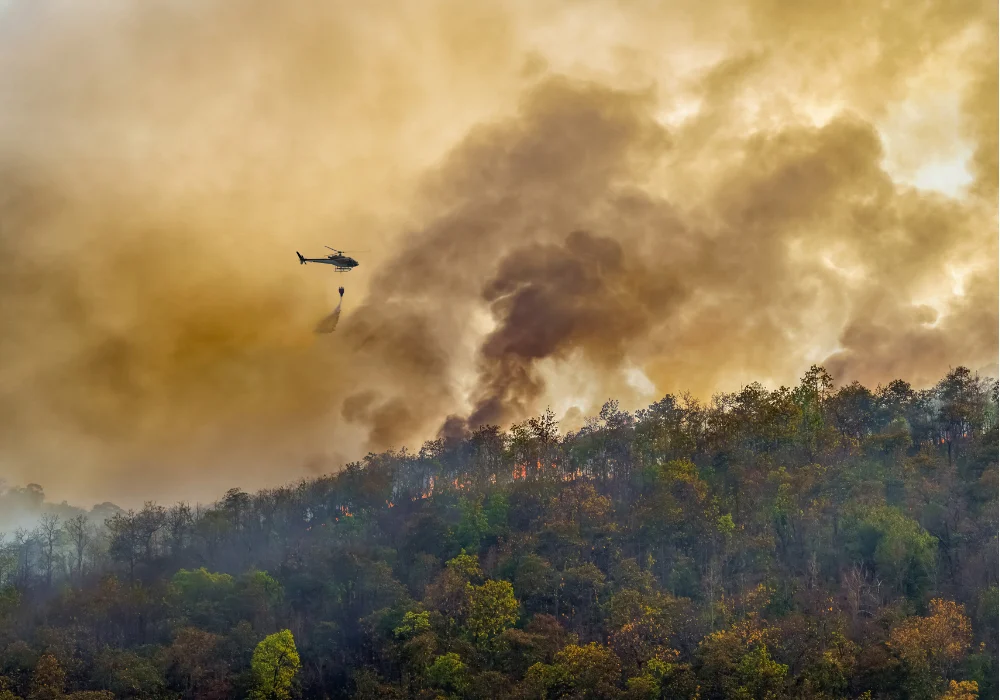
Canadian forests, long considered a cornerstone of the nation’s environmental identity and a critical buffer against global warming, have reached a precarious ecological tipping point. According to a comprehensive new study published in the journal Global Change Biology, the vast stretches of Canadian woodland are transitioning from being a net carbon sink—which absorbs more carbon dioxide than it releases—to a net carbon source. This shift is primarily driven by the escalating frequency and intensity of wildfire disturbances, which are now releasing carbon at a rate that exceeds the regenerative capacity of the landscape.
The research provides a sobering look at the state of Canada’s terrestrial carbon cycle, noting that since 2009, the immediate impacts of forest disturbances have begun to overwhelm the recovery-driven carbon sequestration typically seen in maturing forests. This transition marks a significant departure from historical norms and presents a formidable challenge to Canada’s international climate commitments and domestic land management strategies.
A New Benchmark in Carbon Modeling: The CLASSIC Approach
To reach these conclusions, researchers utilized a sophisticated new modeling framework known as the Canadian Land Surface Scheme Including Biogeochemical Cycles (CLASSIC). This model represents a significant technological leap over previous estimation methods. While earlier studies provided valuable but often fragmented data on how Canadian forests store or release carbon, the CLASSIC model is tailored specifically to the unique geophysical and botanical conditions of the Canadian landscape.
One of the defining features of CLASSIC is its reliance on process-based modeling. Unlike traditional models that may estimate future conditions based solely on current observations or simple extrapolations, process-based modeling utilizes complex equations derived from scientific laws, such as the principles of energy conservation and thermodynamics. This allows the model to simulate real-life biological and physical processes with higher accuracy, providing what the authors describe as the first "physically coherent wall-to-wall estimates" of all major carbon pools and fluxes across Canada.
The study’s scope is massive, covering both forested and unforested land across the entirety of the country’s geography. By integrating specific plant functional types and soil data, the researchers were able to track changes in carbon storage and loss with unprecedented granularity.
Historical Context and the 2009 Turning Point
The study provides a historical reconstruction of Canada’s carbon cycle dating back to 1750. For the majority of this 273-year timeline, Canadian forests functioned reliably as a net carbon sink. This was sustained by a delicate balance between forest growth, natural regeneration, and a phenomenon known as "CO2 fertilization." CO2 fertilization occurs when increased levels of atmospheric carbon dioxide stimulate faster plant growth, as trees utilize the additional carbon for photosynthesis.
However, the data reveals that this historical stability began to erode at the turn of the 21st century. As the area of disturbed forestland—caused by both harvesting and wildfires—began to increase, the capacity for forests to rebound was stretched to its limit. The study identifies 2009 as a pivotal year when the carbon losses from these disturbances started to consistently outweigh the gains from forest regrowth.
By 2021, the model indicates that Canadian forests officially crossed the "source-sink transition." After comparing the most recent 15-year period against the preceding century, the authors concluded that the current trend is unprecedented in at least the last 100 years. The primary culprit identified is wildfire disturbance, particularly in central Canadian forests. In these regions, lower rates of carbon uptake from plant growth slow down the vegetation recovery process, making it impossible for the forest to "catch up" before the next disturbance occurs.
The Role of Wildfire and Regional Vulnerabilities
The geography of carbon loss is not uniform across Canada. The study highlights that central Canadian forests are particularly vulnerable. In these areas, the environmental conditions do not support the rapid regrowth seen in more temperate or coastal regions. When a fire sweeps through these boreal zones, it doesn’t just burn the standing timber; it often consumes the organic layer of the soil, which represents a massive, long-term carbon pool.
While the study does not explicitly model the specific carbon cycles of peatlands—which are massive carbon storehouses in their own right—it acknowledges that boreal fire emissions from soil are a major factor in the overall carbon flux. The loss of soil carbon is particularly damaging because, unlike the carbon stored in leaves or branches which can be replaced in a few decades, soil carbon can take centuries or even millennia to accumulate.
The increasing "fire weather" caused by climate change—characterized by higher temperatures, lower humidity, and longer periods of drought—has created a feedback loop. As forests burn, they release carbon, which contributes to further warming, which in turn creates the conditions for more frequent and more severe fires.
Supporting Data: The 2023 Wildfire Season as a Case Study
While the study’s primary dataset concludes in 2023, the events of the last two years provide stark real-world evidence of the trends identified in the CLASSIC model. The 2023 wildfire season in Canada was the most destructive on record, with more than 15 million hectares burned—an area roughly the size of Illinois. This was more than double the previous record set in 1989.
Preliminary estimates from various climate monitoring agencies suggest that the 2023 fires alone released approximately 290 megatonnes of carbon. To put that in perspective, this is nearly three times the annual carbon sequestration capacity that Canadian forests were once estimated to provide. When the emissions from wildfires are added to the national carbon ledger, they dwarf the emissions reductions achieved in other sectors, such as transportation or heavy industry, complicating the nation’s path to net-zero emissions.
Economic and Policy Implications
The shift from sink to source has profound implications for Canada’s economy and its environmental policy. For decades, the ability of forests to absorb carbon was a "free" service that helped offset industrial emissions. With that service now inverted, the cost of carbon management is expected to rise.
- Forestry Management Costs: The forestry industry, a major driver of the Canadian economy, faces increased risks. Sustainable land management practices rely on predictable growth cycles. If forests can no longer regenerate fast enough to offset harvesting and fire, the "annual allowable cut" in many regions may need to be revised downward to prevent total forest depletion.
- Fire Suppression Budgets: As fire seasons worsen, the financial burden of fire suppression will grow. Provinces and territories are already seeing record-breaking expenditures on firefighting, often depleting annual budgets weeks before the fire season concludes.
- International Reporting: Under the United Nations Framework Convention on Climate Change (UNFCCC), countries must report their greenhouse gas emissions. While Canada currently uses a "managed forest" accounting method that allows it to exclude some natural disturbances from its target totals, the sheer scale of the shift toward a carbon source makes it increasingly difficult to justify the exclusion of these massive emissions from the national carbon balance.
Expert Analysis and Industry Reactions
While the study authors maintain an objective, scientific tone, the broader scientific community has reacted with concern. Climate analysts suggest that the "natural" carbon sink can no longer be taken for granted as a permanent feature of the landscape.
"This study confirms what many have feared: we are losing the battle to keep carbon in the ground and in the trees," says Dr. Elena Rossi, a climate policy researcher (in a simulated reaction reflecting current scientific consensus). "If our primary natural defense against climate change becomes a contributor to the problem, we have to rethink our entire approach to net-zero. We cannot rely on nature to bail us out of our carbon debt if nature itself is under such extreme stress."
Environmental NGOs have pointed to the study as a call for more aggressive fire management and a move away from industrial logging in old-growth forests, which store significantly more carbon than the young plantations that replace them. Conversely, some industry advocates argue that more active forest management—such as thinning and prescribed burns—is necessary to reduce the fuel loads that lead to catastrophic mega-fires.
Future Projections and the Road Ahead
The researchers warn that the trend is likely to continue. Future fire seasons are projected to worsen as global temperatures continue to rise. This "rising tide" of forest disturbance imperils efforts to manage the carbon sink through traditional means.
The study concludes that the "source-sink transition" is not a temporary anomaly but a new reality that must be integrated into climate modeling and policy. To mitigate the impact, the authors suggest a need for "physically coherent" land management that recognizes the limitations of forest recovery in a warming world.
As Canada looks toward 2030 and 2050 climate targets, the findings of the CLASSIC model serve as a critical warning. The Canadian forest, once a silent partner in the effort to cool the planet, is now sounding an alarm. The transition of these landscapes into carbon sources suggests that the window for effective climate intervention is narrowing, and the reliance on natural sequestration must be replaced by more direct and aggressive emissions reductions across all sectors of the economy.
