

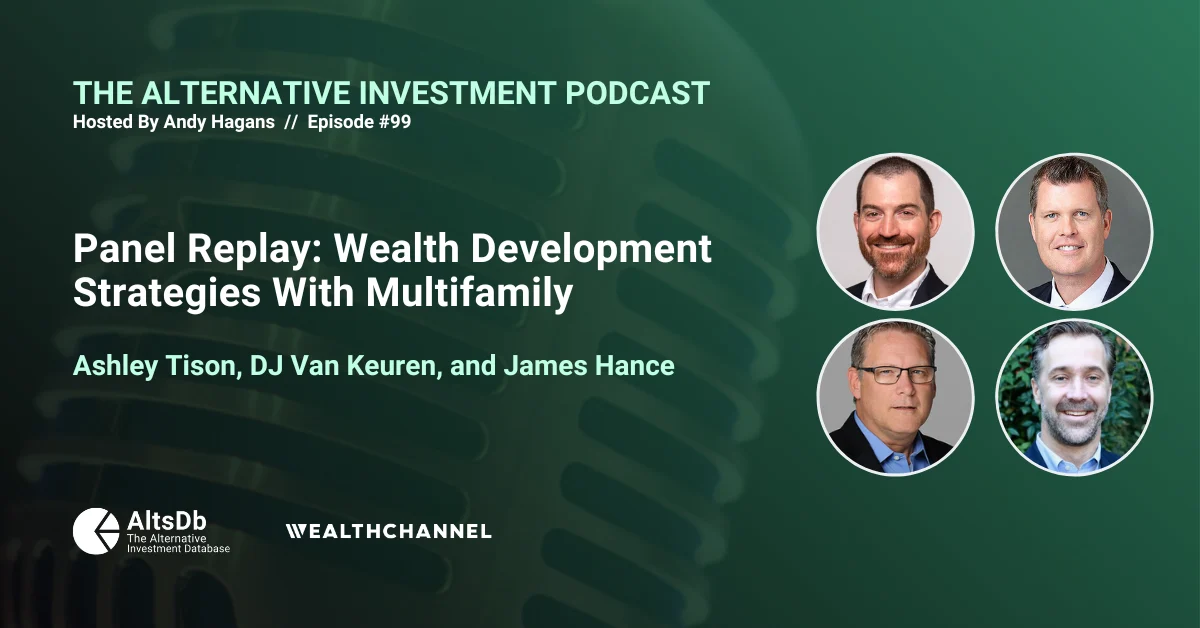
The dynamic landscape of wealth development through multifamily real estate was the central theme at the Multifamily Investor Expo 2023, where a distinguished panel of experts convened to dissect strategies for growing and preserving capital. Moderated by Andy Hagans of AltsDb and WealthChannel, the discussion featured insights from Ashley Tison, founder and CEO of OZPros; DJ Van Keuren, co-managing member at Evergreen Property Partners and founder of the Family Office Real Estate Institute; and James Hance, founder at Green Bison Capital. Their collective expertise offered a comprehensive look at why multifamily continues to be a cornerstone for sophisticated investors seeking long-term financial security.
The panel, held as part of the larger Multifamily Investor Expo, aimed to demystify the complexities of real estate investing for accredited and high-net-worth individuals, family offices, and registered investment advisors. The event itself serves as a crucial platform for networking and education within the alternative investment space, bringing together key players and thought leaders to address the evolving challenges and opportunities in sectors like private equity, venture capital, and real estate.
The Enduring Appeal of Multifamily Real Estate
The core of the discussion revolved around the fundamental question: why multifamily? James Hance of Green Bison Capital articulated a compelling case, highlighting the intrinsic value and essential nature of housing. "People always need a place to live," Hance stated, emphasizing the stability derived from multiple units. He contrasted this with the volatility of single-family rentals, underscoring multifamily’s consistent cash flow potential. Furthermore, Hance pointed to the ability of investors to actively drive value through operational improvements and the significant tax advantages, particularly depreciation, which can offset tax liabilities, framing it as a "deferred tax strategy."
DJ Van Keuren, drawing from extensive experience with family offices, echoed these sentiments. His firm’s annual study on family office real estate investing consistently identifies multifamily as a preferred asset class. Van Keuren elaborated on the risk mitigation inherent in large apartment complexes, where a single vacancy represents a much smaller percentage of overall occupancy compared to a single-family dwelling. He also cited macro economic factors, such as rising home prices and the burden of student loan debt, which are pushing more individuals towards rental housing, thereby fueling sustained demand for multifamily properties, especially in high-growth urban and suburban areas.
Ashley Tison of OZPros added another dimension, focusing on the scalability and efficiency of multifamily investments. He described how condensing residents into a smaller footprint leads to reduced infrastructure needs and more efficient property management compared to dispersed single-family rentals. Tison also highlighted the environmental benefits, positioning multifamily development as a more sustainable approach that combats urban sprawl and aligns with modern urban planning principles that favor density and reduced reliance on personal vehicles. This "green" aspect, he noted, can be a powerful tool in addressing community concerns and gaining approvals for new developments.
Navigating Tax Advantages in Real Estate Investing
A significant portion of the panel’s discourse was dedicated to the various tax-advantaged strategies available to investors in the multifamily sector. Ashley Tison provided an in-depth overview of Opportunity Zones, a program designed to incentivize investment in economically distressed communities. He explained how these zones offer deferral of capital gains taxes, the ability to reinvest gains into qualified opportunity funds, and the potential for eliminating capital gains taxes on appreciation of the new investment if held for a specified period. Tison illustrated the power of these benefits by suggesting they could enhance an Internal Revenue Rate (IRR) by approximately 3%, a substantial improvement in a market where cap rates have historically been low.
DJ Van Keuren identified the 1031 exchange as another critical tax strategy for high-net-worth investors. Despite its widespread availability, he noted that a significant percentage of eligible investors do not utilize this mechanism, often due to a lack of education. The 1031 exchange allows investors to defer capital gains taxes by reinvesting the proceeds from the sale of one investment property into a like-kind property. This mechanism is instrumental in compounding wealth over time, as gains are reinvested without immediate tax implications. Van Keuren also touched upon other less common but potentially valuable tax credits, such as low-income housing tax credits and new market tax credits, as well as emerging opportunities in carbon credits.
James Hance corroborated the significant utilization of 1031 exchanges within his client base, reporting that approximately 20% of capital raised over the past two years originated from such exchanges. He highlighted the unique ability to execute 1031 exchanges within syndication structures, particularly through tenancy-in-common (TIC) arrangements. This allows investors to transition from active property management to passive investment while deferring taxes and potentially achieving a step-up in basis. Hance also noted that some investors, finding returns squeezed in certain DST (Delaware Statutory Trust) offerings, have increasingly turned to syndications for their 1031 exchanges.

Market Dynamics in 2023: Navigating Higher Interest Rates
The conversation then shifted to the current market environment, specifically addressing the impact of higher interest rates. Andy Hagans posed the critical question of whether 2023 presents an opportune moment for investment or if a more cautious approach, involving holding cash for future opportunities, is advisable.
James Hance acknowledged that the era of cap rate compression has likely concluded. He emphasized the paramount importance of due diligence on the sponsor, advocating for vertically integrated operators with proven track records and strong capitalization. Hance suggested that the current environment, characterized by higher interest rates and potential property distress, is creating opportunities for well-capitalized investors to acquire assets at more favorable terms, particularly from distressed sellers or those unable to refinance maturing debt.
DJ Van Keuren observed that many family offices, having learned from past market cycles, are actively holding "dry powder" and are poised to capitalize on emerging opportunities. Unlike previous downturns where investors waited for the market to recover, this time, families are looking to enter the market during the nascent stages of a potential correction. He stressed the enduring importance of fundamental market analysis, including cost of living, quality of life, and underlying demand, as these factors can enable investors to succeed in any market condition. Van Keuren cautioned that the current debt landscape presents significant challenges, with potential for negative leverage and a less forgiving environment for operators who have historically relied on easy refinancing. He advocated for rigorous stress-testing of deals, examining scenarios with increased vacancy rates and higher interest expenses.
Ashley Tison added that while his exuberance for opportunities remains, it must be tempered with pragmatism. He echoed the need for robust stress-testing and acknowledged that projections, while essential, are inherently based on assumptions. For investors utilizing Opportunity Zones, the time-sensitive nature of the program can also act as a catalyst for action, encouraging them to deploy capital within specified timelines. Tison also pointed out that the value-add component, often present in Opportunity Zone projects, can provide a buffer against market volatility.
Lessons from Family Offices for Long-Term Wealth Management
A significant portion of the discussion focused on the principles and practices of family offices that manage generational wealth. DJ Van Keuren, while acknowledging the challenges of wealth preservation across generations, highlighted patience and sound decision-making as core tenets. He emphasized that the fundamental principles of real estate investing remain consistent regardless of the capital amount, stressing the importance of sponsor quality, market fundamentals, and long-term perspectives. The illiquid nature of real estate, he noted, actually fosters patience. Building trust and strong relationships with partners is key, as is the practice of thoroughly stress-testing investment scenarios.
Ashley Tison shared an anecdote about a client who, after a substantial capital gain, faced challenges in managing liquidity and tax implications. This experience underscored the critical need for professional guidance and careful planning to avoid missteps that could trigger significant tax liabilities. Tison advocated for surrounding oneself with experts and educating younger family members on wealth management principles to ensure long-term preservation. He also introduced the concept of establishing a family constitution, outlining core values and mission statements to guide future generations and trustees in managing inherited wealth.
Andy Hagans underscored the importance of humility for investors, regardless of their success in other ventures. He stressed that amassing wealth in one sector does not automatically confer expertise in another, such as real estate. The most successful individuals, he observed, are adept at identifying and partnering with talented professionals and operators who possess specialized knowledge and a proven track record, ideally spanning multiple market cycles.
The Future Outlook: Ground-Up vs. Value-Add Development
In a rapid-fire lightning round, the panelists addressed the current outlook for ground-up development versus value-add strategies. James Hance favored value-add, citing his personal preference for lower risk and a longer time horizon for ground-up projects, especially in the uncertain 2023 environment. Ashley Tison, however, leaned towards ground-up development, particularly within the Opportunity Zone framework, where the "substantial improvement" threshold often necessitates new construction rather than renovation. DJ Van Keuren offered a nuanced perspective, suggesting that the optimal strategy depends on the specific property type and market conditions. He noted that stalled or underperforming properties might present excellent value-add opportunities, while emerging sectors like cold storage may require ground-up development to meet demand.
The discussion concluded with a reiteration of the central theme: multifamily real estate, when approached with strategic planning, expert guidance, and a long-term perspective, remains a powerful engine for wealth development and preservation. The insights shared at the Multifamily Investor Expo 2023 provided attendees with a roadmap to navigate the complexities of the market and leverage its potential for sustained financial success.
