

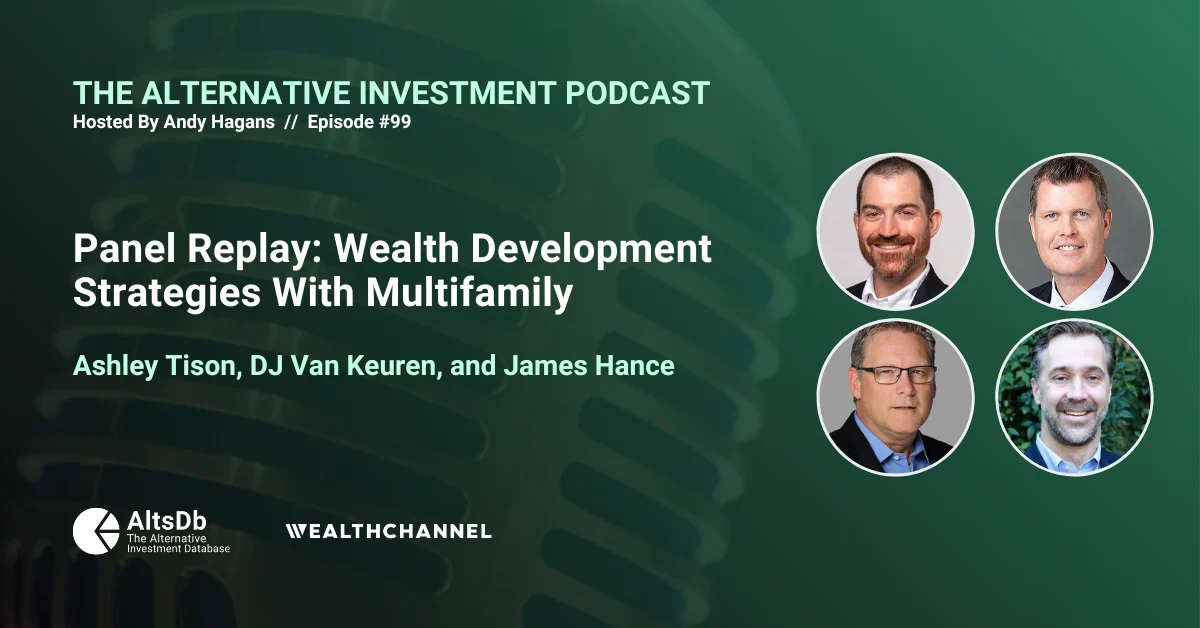
The Multifamily Investor Expo 2023, a premier event for real estate investment professionals, recently convened a distinguished panel of experts to delve into the intricate strategies for wealth development through multifamily real estate. Moderated by Andy Hagans of AltsDb and WealthChannel, the discussion featured insights from Ashley Tison, founder and CEO of OZPros; DJ Van Keuren, co-managing member at Evergreen Property Partners and founder of the Family Office Real Estate Institute; and James Hance, founder at Green Bison Capital. The session, streamed live and available on YouTube, explored the enduring appeal and robust potential of multifamily investments in building generational wealth.
The Multifamily Advantage: A Cornerstone of Wealth Creation
The core of the discussion revolved around the fundamental reasons why multifamily properties stand out as a superior asset class for wealth accumulation and preservation. James Hance articulated a foundational argument rooted in the intrinsic value and essential nature of housing. "People always need a place to live," Hance stated, emphasizing the inherent stability of this sector. He highlighted the advantage of scale within multifamily, where diversification across numerous units mitigates risk compared to single-family homes. The consistent cash flow generated by rental income, coupled with the ability to drive appreciation through operational efficiencies and value-add strategies, forms a compelling investment thesis. Hance also underscored the significant tax advantages available to direct real estate investors, particularly the utilization of depreciation to offset taxable income, framing it as a sophisticated deferred tax strategy.
DJ Van Keuren, drawing on extensive experience with family offices, confirmed the sector’s popularity among ultra-high net worth individuals. His firm’s annual study on family office real estate investment consistently identifies multifamily as a leading property type. Van Keuren elaborated on the risk mitigation benefits, noting that a single vacancy in a large apartment complex represents a far smaller percentage of overall occupancy compared to a standalone property. He also linked the rising demand for rental housing to broader economic trends, including increasing home prices and the burden of student loan debt, which collectively make renting a more accessible and often necessary housing solution for a significant portion of the population, especially in high-growth metropolitan areas.
Ashley Tison echoed these sentiments, emphasizing the scalability and efficiency of multifamily investments. He described how consolidating a large number of residents into a concentrated area leads to reduced infrastructure needs and more streamlined management. Tison further posited that multifamily development aligns with growing environmental consciousness, contributing to reduced urban sprawl and promoting more sustainable living patterns. This "green" aspect, he suggested, can be a valuable talking point in navigating community development and addressing potential NIMBYism.
Navigating Tax Advantages: Maximizing Net Returns
A significant portion of the panel’s dialogue focused on the sophisticated tax strategies available to multifamily investors, particularly for high net worth individuals and family offices aiming to maximize their after-tax returns. Andy Hagans highlighted the importance of "triple net" returns – what investors can ultimately keep and reinvest after all expenses, including taxes and inflation.
Opportunity Zones (OZs) emerged as a key discussion point. Ashley Tison, an expert in OZ structuring, explained how investors can defer capital gains taxes by reinvesting profits into qualified opportunity funds. He detailed the four primary benefits of the OZ program: deferral of capital gains, reduction of taxable gains by 10% after five years and 15% after seven years, elimination of depreciation recapture upon sale of the OZ investment, and the complete exclusion of capital gains on the appreciation of the OZ investment after a 10-year holding period. Tison noted that for investors facing substantial capital gains, particularly from the sale of businesses or significant asset disposals, the OZ program offers a powerful mechanism to preserve and grow wealth. He illustrated this with an example of how an OZ investment can effectively increase an Internal Rate of Return (IRR) by approximately 3% compared to a similar investment outside of an OZ.
The conversation then broadened to other critical tax-advantaged investment vehicles. DJ Van Keuren highlighted the 1031 exchange as another immensely popular and effective strategy. He expressed surprise that a significant percentage of families do not utilize 1031 exchanges, attributing this to a lack of education. The 1031 exchange allows investors to defer capital gains taxes by reinvesting the proceeds from the sale of one investment property into a "like-kind" property. This mechanism facilitates continuous wealth compounding without the immediate burden of taxation. Van Keuren also mentioned other tax credit programs like Low-Income Housing Tax Credits (LIHTCs) and New Market Tax Credits (NMTs) as potential avenues for investors seeking tax efficiency and social impact.
James Hance corroborated the significant use of 1031 exchanges within his client base, noting that approximately 20% of the capital his group raises comes from these exchanges. He detailed how 1031s can be structured within syndication deals, allowing investors to transition from active property management to passive investing while still deferring capital gains. This is particularly attractive for individuals who have managed their own portfolios and seek to simplify their investment approach. Hance also touched upon the concept of "step-up in basis" at death, a key estate planning consideration that can impact the long-term wealth transfer strategy associated with 1031 exchanges.
Ashley Tison added a nuanced perspective on estate tax implications and the lifetime exemption amounts, particularly post-2025. He cautioned that while 1031 exchanges offer a step-up in basis, assets exceeding the then-current lifetime exemption threshold could be subject to estate taxes. He contrasted this with Opportunity Zones, where the value contributed to the fund is frozen for estate tax purposes, offering a distinct advantage for those concerned about future estate tax liabilities.
Market Dynamics in 2023: Navigating Higher Interest Rates
As the panel progressed, the conversation shifted to the prevailing market conditions of 2023, characterized by higher interest rates. Andy Hagans posed a critical question: Is this an opportune time to invest, or should investors hold cash for potential future opportunities?

James Hance acknowledged that the era of cap rate compression is likely over. He emphasized the increased importance of thorough sponsor due diligence, advocating for vertically integrated operators with strong track records and robust capitalization. Hance indicated that the current environment presents opportunities, particularly for well-capitalized investors who can capitalize on distressed properties resulting from refinancing challenges and maturing debt. He noted that signs of such opportunities are already emerging, with some deals becoming available due to owners unable to secure favorable refinancing terms.
DJ Van Keuren observed that many family offices have been strategically holding "dry powder" and are now poised to take advantage of market shifts. He contrasted this with previous downturns, where families often entered the market later as recovery began. This time, he suggested, families are more proactive in seeking opportunities during the downturn. Van Keuren stressed the importance of fundamental market analysis, including cost of living, quality of life, and job growth, as key drivers of demand. He cautioned against a complete halt to investing, as opportunities can arise in any market, but also highlighted the impending "reckoning" for less resilient operators, especially those with floating-rate debt. He advised investors to stress-test deals rigorously, considering scenarios with higher vacancy rates and increased interest expenses, to ensure returns remain attractive even under adverse conditions.
Ashley Tison shared a perspective on investor sentiment, suggesting that while fear and uncertainty might deter some, it can also signal a bullish environment for disciplined investors. He emphasized the need for a balance between optimism and practical risk assessment, echoing DJ Van Keuren’s call for thorough stress testing of investment assumptions. Tison also noted that investors within Opportunity Zones, driven by the program’s time-sensitive nature, may exhibit a more bullish outlook, as they are compelled to deploy capital within specific timelines. He also pointed out that the inherent value-add potential in many OZ projects can provide a buffer against market volatility.
Lessons from Family Offices and Generational Wealth
A significant portion of the discussion centered on the principles and practices that individual high net worth investors can glean from successful family offices managing generational wealth. DJ Van Keuren, despite acknowledging that wealth preservation across generations is a persistent challenge, highlighted core tenets. He underscored the importance of patience and long-term perspective, noting that real estate’s illiquid nature necessitates a strategic, enduring approach. Van Keuren emphasized finding trustworthy partners, conducting thorough due diligence on sponsors, and consistently stress-testing investment assumptions. He also pointed to the power of referrals and networking within family office circles as a valuable lesson.
Ashley Tison expanded on this, advocating for a proactive approach to family governance and wealth transfer. He suggested that families establish core value statements and mission declarations, not just for business operations but also for their family’s long-term financial well-being. These principles, Tison explained, can guide family members and trustees in making informed decisions about wealth distribution and management, preventing common pitfalls associated with wealth dissipation across generations.
Andy Hagans synthesized these points, emphasizing the critical role of humility and surrounding oneself with expertise. He noted that success in one field does not automatically translate to mastery in another, such as real estate. The most effective high net worth individuals, he argued, recognize their limitations and strategically partner with trusted advisors and experienced operators who possess specialized knowledge and a proven track record through multiple market cycles.
Lightning Round: Ground-Up vs. Value-Add in the Current Climate
To conclude the session, a rapid-fire question was posed: In the current environment, does ground-up development or value-add strategies present a better outlook?
James Hance favored value-add, citing his personal preference for a lower risk-return profile and the long-term nature of ground-up development, which he finds more challenging to underwrite in the current uncertain climate.
Ashley Tison, however, leaned towards ground-up development, particularly within the Opportunity Zone framework. He explained that the substantial improvement threshold required for OZ benefits often necessitates new construction rather than renovation.
DJ Van Keuren offered a more nuanced response, stating that the optimal strategy depends on the specific property type and market conditions. He suggested that both approaches can yield opportunities, from stalled development projects ripe for completion to undervalued existing properties that can be significantly enhanced through strategic renovations. The key, he reiterated, is rigorous analysis to ensure the potential returns justify the associated risks.
The panel concluded with a strong emphasis on the enduring power of multifamily real estate as a wealth-building vehicle, the critical importance of strategic tax planning, and the necessity of informed, disciplined investment decisions in navigating evolving market dynamics. The insights shared by the expert panelists provided attendees with valuable frameworks for approaching multifamily investments with a focus on long-term wealth creation and preservation.
