

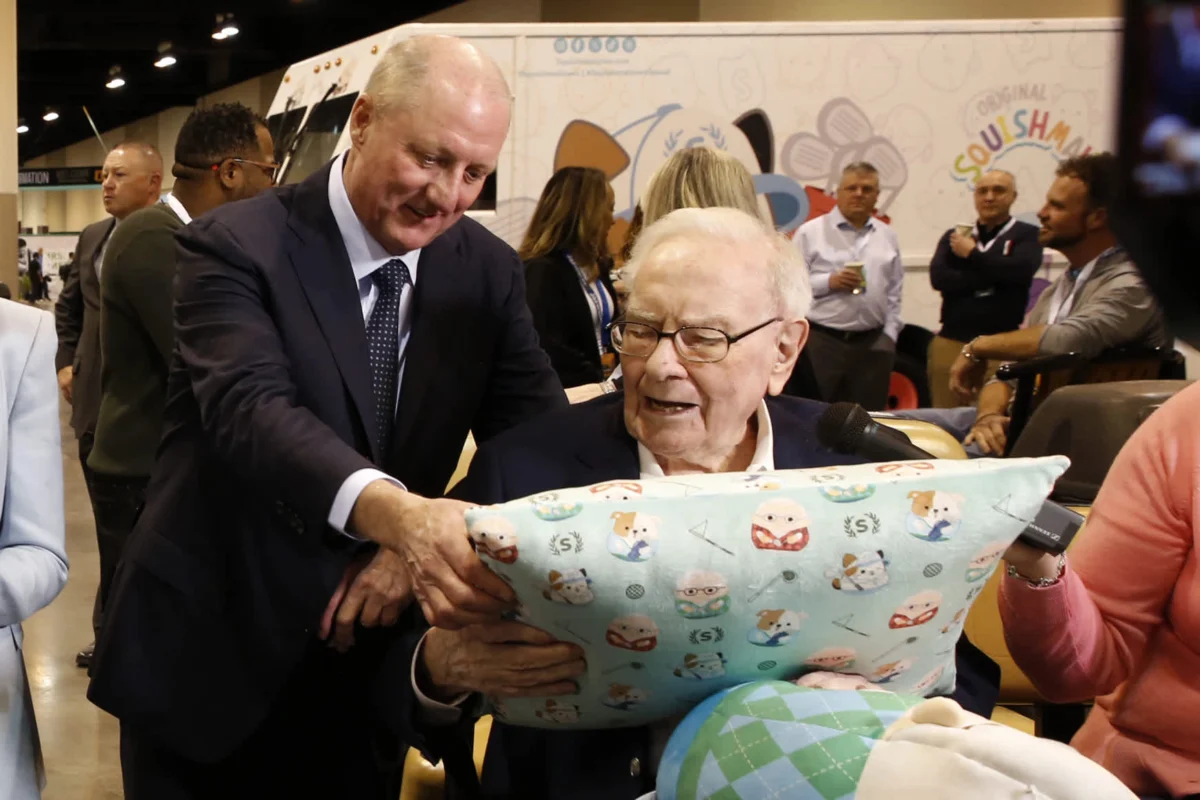
Despite approaching his 96th birthday and the established succession plan naming Greg Abel as his successor, Warren Buffett appears to remain the principal architect behind Berkshire Hathaway’s substantial equity investment decisions, overseeing its more than $350 billion portfolio. Recent disclosures and an interview confirm Buffett’s direct involvement in major stock picks, even as Berkshire’s diversified portfolio sees a dynamic shift with Alphabet challenging Coca-Cola for the third-largest holding spot and a significant real estate antitrust settlement facing further appeals.
Buffett’s Enduring Influence on Investment Strategy
For years, the question of who makes Berkshire Hathaway’s critical investment decisions has loomed, particularly concerning the massive public equity portfolio. While Greg Abel, Vice Chairman of non-insurance operations, is designated to eventually take the reins as CEO, recent events strongly suggest that the "Oracle of Omaha" himself, Warren Buffett, continues to be the primary decision-maker for significant stock allocations. This observation, highlighted by financial analysts, underscores Buffett’s enduring commitment to Berkshire’s investment philosophy and his hands-on approach even at an advanced age.
In a candid CNBC interview last month, Buffett explicitly stated that he "initiated" Berkshire’s substantial investment in Alphabet (Google’s parent company). This revelation is particularly noteworthy given that Alphabet first appeared in Berkshire’s portfolio during the third quarter of the previous year. The scale of this move became even clearer with the second-quarter acquisition of $10 billion in Alphabet shares directly from the company. Reports from Bloomberg News detailed a "stealthy weekend call" from Goldman Sachs to Berkshire, which led to Abel’s "rapid signoff" on the deal, part of Alphabet’s enormous $80 billion equity offering aimed at funding its ambitious artificial intelligence buildout. While Abel’s quick approval indicates a collaborative spirit and shared strategic alignment, Buffett’s explicit statement about initiating the investment firmly places the strategic impetus with him.
This continued direct involvement in stock selection contrasts with Abel’s primary responsibilities. Abel, who holds no formal portfolio management experience, is largely focused on overseeing Berkshire’s vast array of operating companies and identifying new acquisition targets for the conglomerate. His recent activities include the $6.8 billion acquisition of Taylor Morrison Home, a deal that closed after the second quarter, demonstrating his focus on expanding Berkshire’s operational footprint rather than day-to-day stock trading. The second-largest purchase in Q2, Delta Air Lines, is widely attributed to one of Berkshire’s portfolio managers, Ted Weschler, further delineating the roles within the investment team. This structure suggests a clear division of labor, with Buffett still steering the ship on monumental equity decisions, leaving the management of operating subsidiaries and other stock selections to Abel and the portfolio managers, respectively.
A Tight Race: Alphabet Edges Out Coca-Cola in Portfolio Rankings
The second quarter of the current year marked a significant reshuffling within Berkshire Hathaway’s top equity holdings. A substantial $17 billion increase in Berkshire Hathaway’s Alphabet stake propelled the tech giant into the third position of the company’s equity portfolio, momentarily displacing Coca-Cola, a long-standing and iconic holding for the conglomerate.
As of June 30, the close of the second quarter, Alphabet shares held a market value of $37.77 billion within Berkshire’s portfolio, commanding a lead of $5.26 billion over Coca-Cola, which stood at $32.51 billion. This shift reflected a broader market trend favoring growth-oriented technology stocks and highlighted Berkshire’s evolving investment landscape, albeit still anchored by its traditional value investing principles.
However, the dynamics of the market are ever-present. Following the close of the second quarter, Alphabet shares experienced a decline of 3.5%, while Coca-Cola, often seen as a defensive consumer staple, rallied significantly, appreciating by 12.1%. These divergent movements quickly eroded Alphabet’s comfortable lead. As of Friday’s close, the gap between the two behemoths had narrowed to a razor-thin $20 million. On two distinct occasions, July 30 and August 20, Coca-Cola briefly reclaimed its third-place spot by marginal differences at market close, illustrating the intense competition for portfolio dominance within Berkshire’s diverse holdings.
This close race for the third-largest holding spot underscores the strategic tension within Berkshire’s portfolio. While Apple remains the undisputed top holding, representing a significant portion of the portfolio’s value, the contest between Alphabet and Coca-Cola symbolizes the ongoing balance between embracing new-economy growth companies and maintaining positions in time-tested, stable businesses. For investors, this provides a fascinating insight into the ongoing adaptation of Berkshire’s strategy in a rapidly changing global economy, carefully balancing innovation with enduring value.
Appeals Court Upholds Landmark Real Estate Commissions Settlement
In a significant legal development impacting the real estate industry, a federal appeals court in St. Louis has upheld the 2024 settlement of a class-action antitrust suit. This suit targeted Berkshire Hathaway subsidiary HomeServices of America and the National Association of Realtors (NAR), accusing them of colluding to inflate real estate commissions through long-standing rules governing commission splitting.
The initial settlement, a substantial agreement exceeding $1 billion, saw HomeServices of America committing to pay $250 million. A core component of the settlement required the NAR to revise its controversial rules regarding broker compensation, a move anticipated to foster greater competition and potentially reduce costs for consumers. The lawsuit had alleged that these rules, which typically required sellers to pay the buyer’s agent commission, artificially kept commission rates high across the industry.
Despite the settlement, a faction of plaintiffs expressed dissatisfaction, arguing they were "short-changed" and that the deal did not adequately compensate them for the alleged damages. These objectors sought to block the settlement, initiating an appeal. However, the 8th U.S. Circuit Court of Appeals this week delivered a definitive ruling, backing a lower court’s approval of the settlement. This decision provides a measure of legal certainty for HomeServices of America and the NAR, effectively closing one chapter of a protracted legal battle.
The attorney representing some of the objectors has indicated that they are considering an appeal to the Supreme Court, stating, "Everyone got next to nothing for the sake of settling. There’s something just not right about that." This sentiment reflects the deep divisions among affected parties regarding the fairness and adequacy of the settlement terms. The gravity of the initial jury trial in 2023, which found the defendants liable for $1.78 billion in damages—an amount that could have been tripled under U.S. antitrust law, potentially reaching over $5 billion—underscores the immense financial risk that prompted the settlement.

Chris Kelly, CEO of HomeServices, welcomed the appeals court’s decision, stating that it provides "additional certainty" to the company, its agents, and its customers. This clarity is crucial for an industry grappling with fundamental changes to its operating model.
However, the legal challenges are not entirely over for Berkshire Hathaway. Its unit, Berkshire Hathaway Energy (BHE), still faces a separate proposed antitrust class action lawsuit over real estate commissions. A judge ruled last April that BHE is not covered by the HomeServices settlement, meaning it must contend with its own legal battle. When BHE was initially targeted two years ago, a plaintiff’s lawyer reportedly told The New York Times, "Berkshire Hathaway is the leader of the pack. It’s much bigger than N.A.R… If you want to bring about change in corporate America, hit them in the pocketbook. And that’s exactly where this is aimed." This ongoing litigation highlights the broad and systemic challenges facing the real estate brokerage industry and its major players. The outcome of these cases is expected to have far-reaching implications for how real estate transactions are conducted and how agents are compensated in the future.
Buffett’s Philosophy on Utility and Market Endorsement (1994 Archive)
A dive into the CNBC Buffett archive reveals a timeless insight from a 1994 appearance where Warren Buffett articulated his approach to evaluating a product’s usefulness when considering an acquisition. During a Q&A session, an audience member inquired about how he assesses a product’s utility.
Buffett’s response, "Well, obviously we look at what the market says is the utility," encapsulates his pragmatic, market-driven philosophy. He elaborated by referencing Dexter Shoe, an acquisition that, at the time, represented a product for which "year after year, people have essentially voted for the utility." This reflects his belief that sustained consumer demand is the ultimate arbiter of a product’s value.
He further illustrated his point with Coca-Cola, a cornerstone of Berkshire’s portfolio. "There are 750 million or so 8-ounce servings of one product or another from the Coca-Cola Company consumed every day around the world. And there are those of us who think the utility is very high. I can’t make it through the day without a few. But there are other people that might rate it differently." This playful admission underscored his personal affinity for the product, but more importantly, emphasized the undeniable global endorsement through massive consumption.
Buffett stressed that his assessment isn’t based on an independent, subjective judgment of utility, but rather on the collective "vote" of the market. He concluded, "I don’t think we would come to an independent decision that there was some great utility residing in some product that had been available to the public for a long time, but that the public had not endorsed in any way." This enduring principle highlights Buffett’s focus on businesses with proven, widespread appeal and sustained consumer demand, a hallmark of his successful value investing strategy that continues to guide Berkshire Hathaway’s acquisitions and investments.
Berkshire Stock Watch and Key Financials
As of the date of publication, Berkshire Hathaway’s Class A shares (BRK.A) were trading at $743,500.00, while Class B shares (BRK.B) stood at $495.82. The company’s trailing twelve-month (TTM) Price-to-Earnings (P/E) ratio for BRK.B was 12.47, reflecting a valuation that remains attractive to many long-term investors. Berkshire’s market capitalization reached an impressive $1,061,294,568,527, solidifying its position as one of the world’s most valuable companies.
The conglomerate’s cash reserves, a closely watched metric, totaled $365.5 billion as of June 30, a decrease of 8.0% from the March 31 figure. Excluding rail cash and subtracting T-Bills payable, the adjusted cash stood at $359.2 billion, down 3.8% from the prior quarter. This slight reduction in cash reflects Berkshire’s active capital allocation strategies, including significant share repurchases. In the second quarter of 2026, Berkshire repurchased $4.5 billion of its own shares, demonstrating management’s confidence in the intrinsic value of the company’s stock and its commitment to returning capital to shareholders. This strategy is a consistent feature of Buffett’s capital management, deploying excess cash when the stock trades below his estimate of its intrinsic value.
Berkshire’s Top Equity Holdings – August 21, 2026
Berkshire Hathaway’s equity portfolio remains a testament to its diversified investment approach, primarily focusing on established, high-quality businesses. The top holdings of publicly traded stocks in the U.S. and Japan, based on market value as of June 30, 2026 (as reported in Berkshire Hathaway’s 13F filing on August 14, 2026, and updated with current closing prices), continue to be dominated by a few key players. While specific figures can fluctuate daily, the core composition highlights Buffett’s long-term convictions.
Apple Inc. (AAPL) remains Berkshire’s largest holding by a significant margin, representing a substantial portion of the portfolio’s total value. Its continued prominence underscores Buffett’s appreciation for strong brands, consumer loyalty, and robust cash flows. Following Apple, Bank of America (BAC) typically holds the second position, reflecting Berkshire’s long-standing confidence in the financial sector and its stable, dividend-paying institutions.
The dynamic competition between Alphabet (GOOGL) and Coca-Cola (KO) for the third spot, as detailed earlier, showcases the blend of growth and value within the portfolio. Other significant holdings include American Express (AXP), Chevron (CVX), and Occidental Petroleum (OXY), among others, demonstrating a strategic allocation across financial services, energy, and consumer goods. The full, up-to-date list of holdings and their current market values is meticulously tracked and made available through CNBC.com’s Berkshire Hathaway Portfolio Tracker, offering continuous insight into the conglomerate’s vast investment landscape.
This detailed examination of Berkshire Hathaway’s recent activities underscores a pivotal moment for the conglomerate. Warren Buffett’s continued leadership in investment strategy, the evolving composition of its massive portfolio, and the resolution of significant legal challenges collectively paint a picture of a dynamic entity that, while rooted in time-tested principles, is continuously adapting to the complexities of the modern economic environment.
