

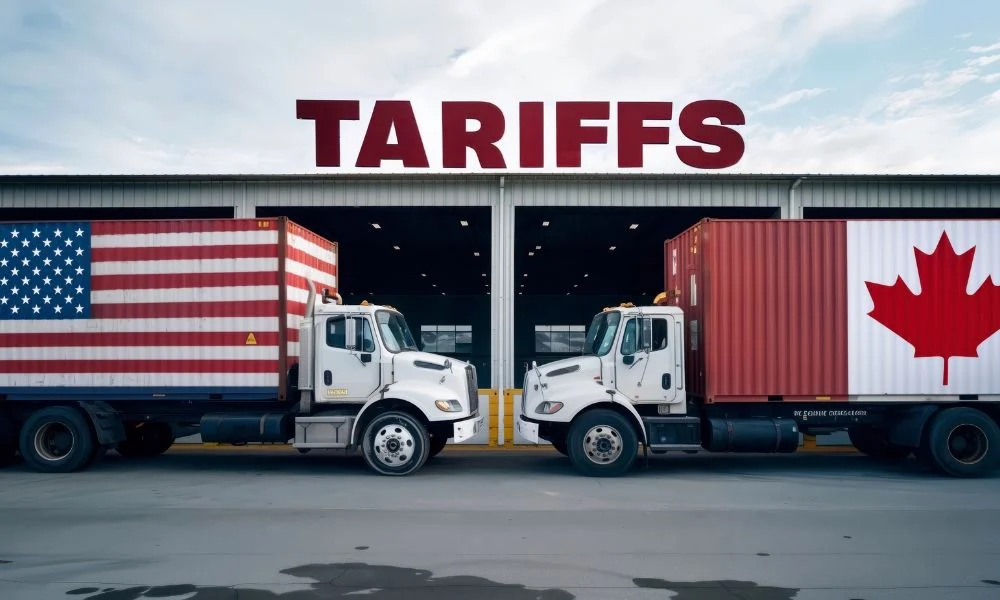
The recent breakdown in trade negotiations between the United States and Canada, which has seen the imposition of 50% tariffs on key Canadian exports such as dairy, alcohol, wood, and paper products, has introduced a significant layer of uncertainty into the North American economic landscape. Despite this substantial blow to Canada’s most critical trading relationship, and the potential for a notable drag on GDP – estimated by Josh Nye, Senior Economist at RBC Global Asset Management (GAM), to be between 0.2 and 0.3 percent – the Canadian equity market has demonstrated remarkable resilience. In the two trading days following the collapse of negotiations, the TSX 60 index gained approximately one percent, a performance that belies the immediate economic fallout for several industries and the pervasive sense of unease that now hangs over other Canadian businesses.
This apparent disconnect between economic headwinds and market performance underscores a crucial distinction that has been a recurring theme throughout the ongoing tariff disputes: the Canadian economy and the Canadian equity market are not monolithic entities, and the health of the former does not directly dictate the performance of the latter. Nye emphasizes this point, explaining the muted reaction observed in fixed-income markets and highlighting key considerations for financial advisors navigating this period of volatility for their clients.
Market Resilience Amidst Trade Tensions
"The TSX actually outperformed most markets [on Monday]," Nye observed, "and so it does, seem to be still fairly well insulated from this trade war." This resilience is attributed to a confluence of factors, including the recent upward movement in gold prices and the reversal of perceived improvements in the Middle East. "There are always a lot of factors at play here. Trade policy uncertainty is one, but there are some that perhaps show up more directly in the equity market here," Nye added.
The underlying strength of the Canadian equity market can be partly explained by its composition. Sectors of the Canadian economy most directly impacted by the US tariffs – primarily those involved in the export of goods like lumber, paper, and certain agricultural products – are relatively underrepresented on the Toronto Stock Exchange (TSX). Conversely, sectors that are traditionally considered defensive havens and are often overrepresented on the TSX, such as Canadian banks and gold miners, are showing robust performance. These sectors, in many instances, benefit from the broader global economic uncertainty, including the trade policies enacted by the Trump administration. Furthermore, shifts in US foreign policy in the Middle East have indirectly supported Canadian energy companies by contributing to an increase in global oil prices, providing another tailwind for certain segments of the TSX.
The Nuances of Economic Impact and Market Reaction
The imposition of these tariffs, particularly on goods previously protected under the Canada-United States-Mexico Agreement (CUSMA), has reintroduced a significant degree of uncertainty for Canadian business owners. While earlier in the year, survey data suggested that Canadian businesses were beginning to absorb and adapt to trade uncertainty, the latest round of tariffs could potentially reverse this trend. However, Nye’s core message remains consistent: the direct economic damage from these tariffs is likely to be narrowly concentrated, and the most heavily impacted sectors do not constitute a dominant portion of the TSX’s market capitalization.
For instance, the agricultural sector, a key target of the retaliatory tariffs, faces significant challenges. Canadian dairy farmers, for example, have expressed concerns about the long-term viability of their operations if export markets are severely curtailed. Similarly, the wood and paper industries, already subject to fluctuating global demand, now face an additional barrier to entry into their largest export market. The immediate financial impact for these businesses can be substantial, potentially leading to reduced investment, slower hiring, and in some cases, a need for government support.
Bond Markets and Monetary Policy in a Trade War Scenario
The introduction of tariffs, while posing a downside risk to Canadian GDP growth and potentially contributing to inflationary pressures through reciprocal tariffs, is unlikely to prompt an immediate interest rate cut from the Bank of Canada. Nye points out the temporal mismatch between monetary policy decisions and the unpredictable nature of trade policy. The resolution of the current trade dispute could occur at any moment, making a premature monetary policy adjustment potentially counterproductive. Furthermore, the dual impact of tariffs – dampening economic growth while simultaneously increasing the cost of imported goods, thereby posing an upside risk to inflation – could leave the Bank of Canada in a difficult position, with limited room to maneuver.
In response to the economic fallout, the Canadian federal government has announced a suite of fiscal support measures aimed at assisting affected industries and workers. These measures, while necessary to mitigate immediate economic pain, contribute to a broader global narrative surrounding developed nations and their increasing levels of debt relative to GDP. However, Nye suggests that global bond investors are more likely to anchor their assessment of Canadian bonds, particularly those at the longer end of the yield curve, to broader trends in developed bond markets. This means that rising bond yields in major economies like Japan or the United States could correlate with an increase in Canadian 10-year bond yields, irrespective of domestic fiscal policy.
Navigating Uncertainty: Advice for Advisors and Investors
The relative stability and demonstrated strength of Canadian assets, even amidst challenging economic news and a seemingly weakening outlook, should offer a degree of reassurance to financial advisors and their clients. Nye’s primary counsel to advisors is to caution against overreaction, which he identifies as the most significant pitfall for investors in the current environment. He reiterates the fundamental distinction between the Canadian economy and its equity market, emphasizing that even the economic impacts of the tariffs are expected to be localized.
Nye further posits that the current trade stance adopted by the United States is more a reflection of the Trump administration’s specific policies and the influence of a few key individuals, rather than a broad-based political consensus within the United States. He anticipates that any future administration, regardless of political affiliation, would likely adopt a more amenable approach to trade relations with Canada. Nevertheless, in the immediate term, Nye advises Canadians to prepare for continued economic volatility.
"I think this does argue for a somewhat conservative stance in in in your portfolios, and perhaps not making big bets just given you know the potential for policy volatility and volatility around other themes," Nye stated. This recommendation underscores the importance of maintaining diversified portfolios and avoiding speculative investments that could be disproportionately affected by unpredictable policy shifts. The ability of Canadian businesses to adapt to evolving trade dynamics, coupled with the inherent strengths of sectors that are less exposed to direct tariff impacts, will be critical in navigating the coming months. The global economic environment, with its own set of uncertainties, will continue to play a significant role in shaping market sentiment and investor behavior, making prudent financial planning and a long-term perspective more crucial than ever.
