

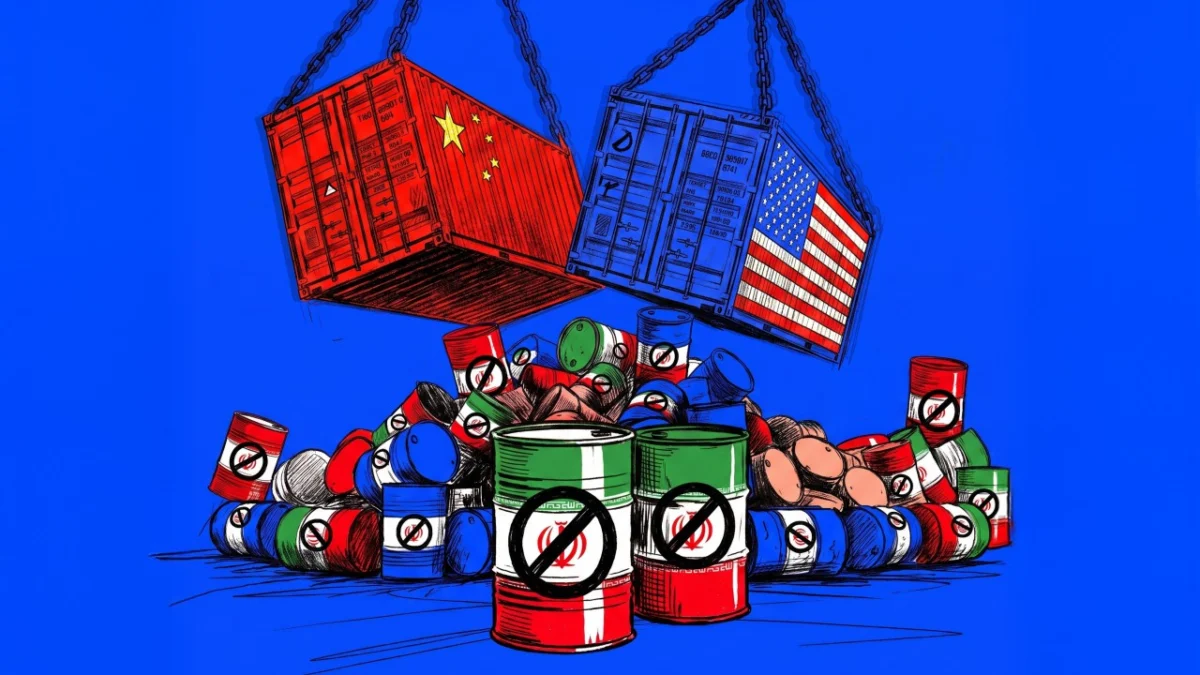
The geopolitical landscape between the world’s two largest economies has entered a period of renewed volatility following a series of aggressive economic measures initiated by the United States. Earlier this month, US Treasury Secretary Scott Bessent issued a stern warning regarding the enforcement of sanctions against any nation continuing to purchase Iranian crude oil. While the Secretary did not explicitly name the People’s Republic of China in his televised remarks, the implication was unmistakable. China remains the Islamic Republic’s most significant oil customer, serving as the primary destination for the vast majority of Iran’s exported crude. This development places Beijing squarely in Washington’s crosshairs, signaling a potential end to the brief period of relative stability that followed the high-level diplomatic engagements earlier this year.
The move against Iranian oil trade is not an isolated incident but rather the latest component of a broader strategy to exert pressure on Beijing’s economic and military infrastructure. The US Treasury Department has already unveiled a comprehensive package of new sanctions targeting 60 individuals, companies, and maritime vessels linked to Iranian trade. A significant portion of these entities is based in mainland China and Hong Kong, highlighting the interconnected nature of the global energy supply chain and the difficulty of decoupling these economic ties. This escalation comes just three months after the May summit between President Xi Jinping and President Donald Trump, an event that many analysts believed had stabilized bilateral trade relations. However, the fragile calm established during those talks is now being rigorously tested by a rapid succession of US policy shifts.
A Timeline of Tightening Restrictions
The current standoff is the result of a deliberate and fast-paced series of actions taken by Washington since the late spring of this year. To understand the depth of the current friction, one must examine the chronology of events that have unfolded over the last several months:
May 2024: President Xi Jinping and President Donald Trump held a summit aimed at cooling trade tensions. The meeting resulted in a temporary "standstill" agreement, with both sides pledging to work toward reducing trade deficits and addressing concerns over intellectual property.
June 2024: The Pentagon significantly expanded its list of “Chinese military companies.” Dozens of new entities were added to this registry, including global technology leaders such as Alibaba, Baidu, and BYD. This designation is particularly impactful as it restricts these companies’ access to US capital markets and limits the ability of American investors to hold stakes in these firms. The inclusion of BYD—a world leader in electric vehicles—and major internet platforms like Alibaba signaled a shift in US policy toward targeting China’s civilian-commercial champions.
July 2024: The US Trade Representative (USTR) announced a new wave of tariffs ranging from 10 to 12.5 percent on a wide array of goods from 60 different economies, with China being the primary focus. These measures followed a Section 301 investigation into alleged forced labor practices and broader human rights concerns. During the same month, the US Department of Commerce implemented a ban on the import of Chinese-made robots and power inverters, citing national security risks associated with the integration of Chinese software into American infrastructure.
August 2024: The focus shifted toward the renewable energy sector. Washington imposed a 15 percent tariff on polysilicon, a critical raw material for solar panel manufacturing. Given that China controls over 80 percent of the global polysilicon supply chain, this move was viewed as a direct attempt to challenge China’s dominance in the green energy market.
September 2024: Treasury Secretary Scott Bessent’s announcement regarding Iranian oil sanctions serves as the "Economic D-Day" warning. By targeting the energy lifeblood of the Iranian economy, the US is simultaneously attempting to disrupt Beijing’s energy security strategy, which relies heavily on discounted Iranian crude.
The Strategic Importance of Iranian Crude
For Beijing, the relationship with Tehran is not merely political but deeply structural. China’s demand for crude oil is the highest in the world, and Iranian oil provides a vital, albeit controversial, source of supply. According to industry data from energy analysts at Kpler and Vortexa, China’s imports of Iranian crude have frequently exceeded 1.2 to 1.5 million barrels per day over the past year.
Much of this trade is conducted through what is often referred to as the "shadow fleet"—a network of aging tankers that operate under flags of convenience and use ship-to-ship transfers to obscure the origin of the cargo. These transactions are typically settled in Chinese Yuan (RMB) rather than US Dollars, allowing both Tehran and Beijing to bypass the SWIFT banking system and avoid direct exposure to US financial sanctions. By targeting the vessels and the Hong Kong-based intermediaries involved in this trade, Washington is attempting to increase the "cost of doing business" for Beijing, making it riskier and more expensive to maintain this energy pipeline.
Expanding the Scope: Tech and Industrial Containment
The sanctions on oil are complemented by a robust effort to contain China’s technological ascent. The inclusion of Alibaba and Baidu on the Pentagon’s military list suggests that Washington no longer distinguishes between China’s private tech sector and its military-industrial complex. US officials argue that under China’s "Military-Civil Fusion" policy, any technological advancement in the private sector can be requisitioned for defense purposes.
The tariffs on polysilicon and the ban on power inverters represent a strategic strike against China’s "New Three" industries: electric vehicles, lithium-ion batteries, and solar products. These sectors have been the primary drivers of China’s recent export growth. By imposing price floors and tariffs, the US is attempting to create a protective barrier for its domestic renewable energy industry, which is currently struggling to compete with the scale and lower production costs of Chinese manufacturers.
Beijing’s Calibrated Response
In the face of this multifaceted onslaught, the Chinese government has adopted a strategy characterized by "strategic patience" and "precision retaliation." Gone are the days of the 2018-2019 trade war where Beijing responded to every US tariff with an equal and opposite blanket tariff on American agricultural or industrial goods.
Instead, Beijing’s current response is more deliberate. For instance, while the US has banned certain Chinese technologies, China has responded by launching anti-dumping investigations into European and American dairy and chemical products. Furthermore, China has utilized its control over critical minerals, such as gallium and germanium—essential for semiconductor manufacturing—by implementing export licensing requirements.
Official statements from the Chinese Ministry of Foreign Affairs have remained firm. Spokespersons have repeatedly stated that China will take "all necessary measures" to defend the legitimate rights and interests of its companies. However, behind the rhetoric, Beijing appears to be weighing the costs of escalation. Analysts suggest that China is wary of a total decoupling, which could further dampen its domestic economic recovery. Consequently, Beijing is striking back only when core strategic interests are at stake, such as its leadership in the EV market or its access to high-end computing resources.
Economic Data and Market Impact
The impact of these rising tensions is already being felt in global markets. The 15 percent tariff on polysilicon is expected to increase the cost of solar installations in the United States, potentially slowing the transition to renewable energy. Conversely, for Chinese producers, the loss of the US market is being offset by increased exports to the Global South and Southeast Asia, though at lower profit margins.
In the financial sector, the designation of Alibaba and Baidu as military-linked companies has led to a cooling of American institutional investment in Chinese tech stocks. Data from the second quarter of 2024 indicates a noticeable outflow of capital from US-based emerging market funds that heavily favor Chinese "Big Tech."
On the energy front, if the US successfully curtails Iranian oil exports to China, the global oil market could face significant tightening. A reduction of 1 million barrels per day of "discounted" oil for China would force Beijing to seek supplies from Russia or Saudi Arabia, potentially driving up Brent crude prices and fueling global inflationary pressures.
Broader Implications for Global Trade
The current trajectory of US-China relations suggests that the era of unfettered globalization is being replaced by a period of "geoeconomic fragmentation." The use of Section 301 investigations, military lists, and secondary sanctions on energy trade points toward a world where economic policy is increasingly dictated by national security imperatives.
For third-party economies, particularly those in the Middle East and Southeast Asia, this rivalry presents a difficult balancing act. Many nations are being forced to choose between US security guarantees and Chinese economic investment. The sanctions on 60 economies mentioned in the July tariff announcement indicate that Washington is willing to exert pressure on allies and neutral parties alike to ensure compliance with its strategic goals.
Conclusion: The Path Ahead
As the year progresses, the focus will likely remain on the enforcement of the Iranian oil sanctions and the potential for China to retaliate using its dominance in the global supply chain for critical minerals and green technology. The "fragile calm" of the May summit has evaporated, replaced by a sophisticated and high-stakes game of economic brinkmanship.
Washington’s tightening of the screws on multiple fronts—from energy to high-tech manufacturing—reflects a bipartisan consensus in the US that China represents a generational challenge. For Beijing, the goal remains the preservation of its economic growth and technological sovereignty without triggering a full-scale trade collapse. Whether these two competing visions can coexist without leading to a more severe rupture remains the defining question of the current geopolitical era. The coming months will determine if the "Economic D-Day" mentioned by Secretary Bessent leads to a total breakdown of trade or a new, albeit more restricted, equilibrium.
